| E - ISSN | : | 2953-8203 |
| P - ISSN | : | 2953-819X |
Vol. 1 No. 1 (2024)
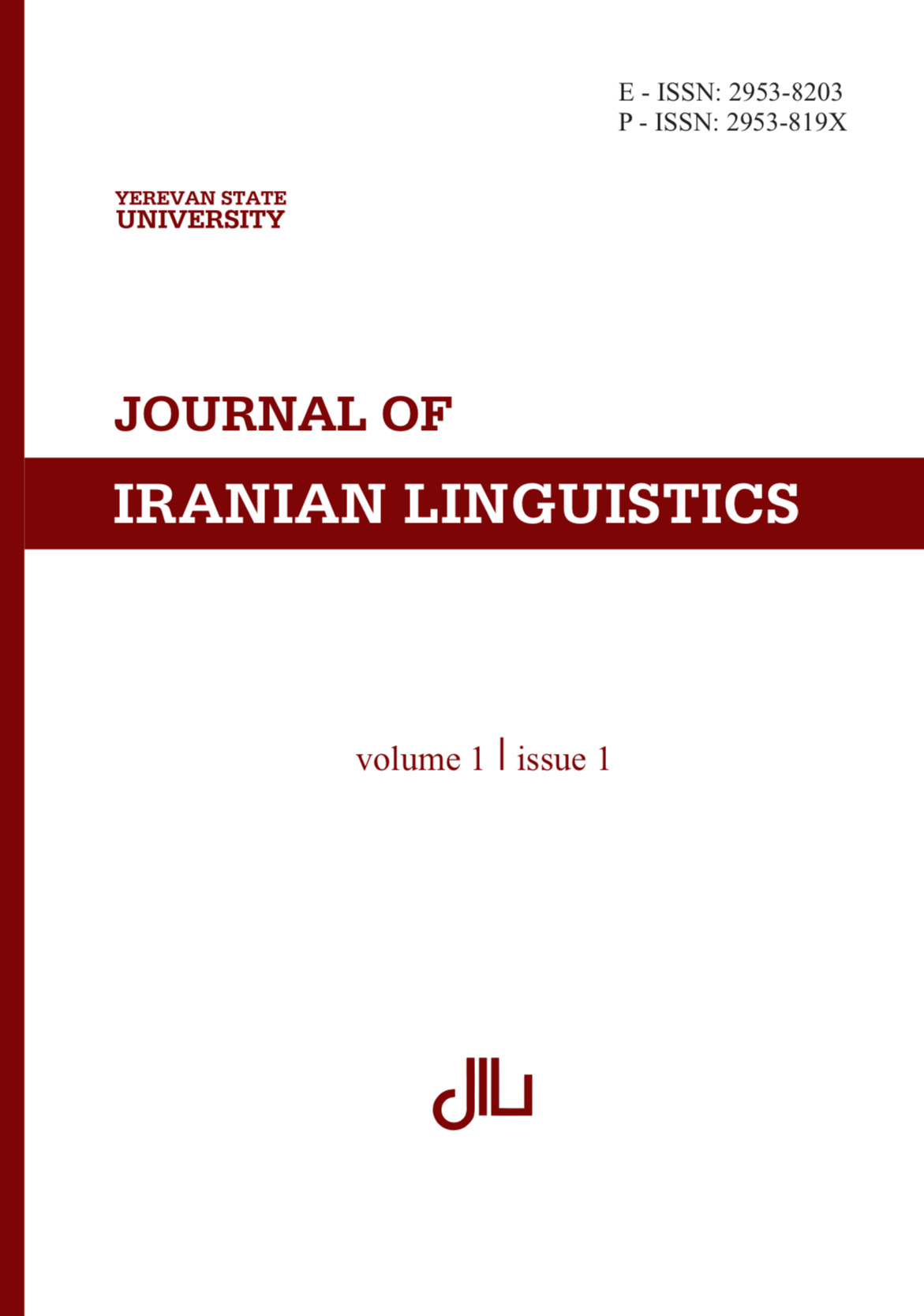
The inaugural issue of the Journal of Iranian Linguistics brings together groundbreaking research on Iranian languages, exploring diverse linguistic aspects such as phonology, syntax, historical linguistics, and dialectology. Each article offers new insights into the unique characteristics and development of Iranian languages, underscoring the journal’s mission to advance the understanding and appreciation of this linguistic family. This first edition sets the stage for further scholarly dialogue and discovery in Iranian linguistics.
Published:
2024-11-13
Full Issue
Articles
-
Articles
Where the Demons Fell. A Manichaean Sogdian Manuscript in Sogdian Script from Mani’s Book of the Giants
AbstractTwo unpublished Sogdian fragments in Sogdian Script of the Berlin Turfan collection, both from the same page and glassed together, contain a cosmogonic text on the falling of the demons/archons to the four directions of the earth and part of the myth of the creation of the protoplasts by the archdemons Šaqlūn and Pēsūs. This text will be proposed here as part of the Sogdian version of Mani’s Book of the Giants.
ReferencesDMTiii.22 = Sims-Williams, N. & Durkin-Meisterernst, D. (2022).
Gardner, I. (1995), The Kephalaia of the Teacher. The edited Coptic Manichaean Texts in Translation with Commentary. (Nag Hammadi and Manichaean Studies XXXVII), Leiden-New York-Köln: E. J. Brill.
GMS = Gershevitch (1954).
Gershevitch, I. (1954), A Grammar of Manichean Sogdian, Oxford: Basil Blackwell [repr. 1961].
Henning, W. B. (1940), Sogdica, (James G. Forlong Fund, 21), London: The Royal Asiatic Society [= Henning 1977, II, pp. 1-68].
Henning, W. B. (1943), “The Book of the Giants” Bulletin of the School of Oriental and African Studies, vol. 11/1, pp. 52-74 [= Henning 1977, II, 115-37].
Henning, W. B. (1977), (M. Boyce & I. Gershevitch eds.) Selected Papers, I-II, (Acta Iranica, 2ème série, 14-15. Hommages et Opera Minora, V-VI), Téhéran-Liège: Bibliothèque Pahlavi.
Morano, E. (2011), “New Research on Mani’s Book of Giants”, in: Der östliche Manichäismus Gattungs- und Werksgeschichte: Vorträge des Göttinger Symposiums vom 4.–5. März 2010. Edited by Zekine Özertural and Jens Wilkens. Abhandlungen der Akademie der Wissenschaften zu Göttingen NS 17, Berlin-Boston: De Gruyter, pp. 101-111.
Morano, E. (2016), “Some New Sogdian Fragments Related to Mani’s Book of Giants and the Problem of the Influence of Jewish Enochic Literature”, in: M. Goff, L. T. Stuckenbruck & E. Morano (eds.), Ancient Tales of Giants from Qumran and Turfan. Contexts, Traditions, and Influences (Wissenschaftliche Untersuchungen Zum Neuen Testament 360), Tübingen: Mohr Siebeck, pp. 187-198.
Pedersen, N. A. & J. M. Larsen (2013), Manichaean Texts in Syriac. First Editions, New Editions, and Studies, (Corpus Fontium Manichaeorum. Series Syriaca I), Turnhout: Brepols.
Reck, Ch. (2006), Mitteliranische Handschriften. Teil 1: Berliner Turfanfragmente manichäischen Inhalts in soghdischer Schrift (VOHD 18), Stuttgart: Steiner.
Reeves, J. C. (1992), Jewish Lore in Manichaean Cosmogony. Studies in the Book of Giants Traditions, Cincinnati: Hebrew Union College Press.
Sims-Williams, N. & Durkin-Meisterernst, D. (2022), Dictionary of Manichaean Sogdian and Bactrian. Second edition, revised and enlarged by Nicholas Sims-Williams, (Corpus Fontium Manichaeorum. Dictionary of Manichaean Texts. Vol. III. Texts from Central Asia and China, part 2), Turnhout: Brepols.
Stuckenbruck, L. (1997), The Book of Giants from Qumran.Texts, Translation, and Commentary. (Texte und Studien zum antiken Judentum 63), Tübingen: Mohr Siebeck.
Sundermann, W. (1994), “Mani’s ‘Book of the Giants’ and the Jewish books of Enoch: a case of terminological difference and what it implies”, Irano-Judaica III, Jerusalem: Ben Zvi, pp. 40-48.
Sundermann, W. (2001), Manichaica Iranica. Ausgewählte Schriften, herausgegeben von Chr. Reck, D. Weber, C. Leurini, A. Panaino, 2 vols, (Serie Orientale Roma LXXXIX, 1) Rome: IsIAO.
Yoshida, Y. (2008), Review of Reck, Christiane, Mitteliranische Handschriften Teil I:Berliner Turfanfragmente manichäischen Inhalts in soghdischer Schrift, in Indo Iranian Journal, vol. 51, pp. 51-61.
-
Articles
A New Possible Etymology for the Classical Persian Particle mar
AbstractThe etymology of the Classical Persian particle mar, which is traditionally believed to have an emphatic or restrictive sense, has long been an enigma to scholars of Iranian philology and Persian linguistics, esp. because there is no trace of it in the extant Middle Persian texts. Different etymologies have so far been proposed for mar, but it is often compared with the Early Judaeo-Persian preposition azmar (i) “for” and therefore believed to have originated from the word mar “number; account”. The present paper reviews all previous studies and attempts to provide a new possible etymology, according to which mar is a focus marker derived through a grammaticalization process from the Bactrian word μαρο [mar] “here”.
ReferencesAgostini, D. (2014), “Eschatological Seers and Otherworldly Travellers in Zoroastrianism”, Journal Asiatique, vol. 302, pp. 47-73.
Bahār, M.-T. (1355/1976), Sabkšenāsi, 4th ed., 3 vols., Tehrān: Ketābhā-ye Parastu.
Bailey, H. W. (1979), Dictionary of Khotan Saka, Cambridge: Cambridge University Press.
Beekes, R. (2010), Etymological Dictionary of Greek, 2 vols., Leiden: Brill.
Benveniste, É. (1938), “Sur un fragment d’un psautier syro-persan”, Journal asiatique, vol. 230, pp. 458-462
Benveniste, É. (1940), Textes sogdiens: édités, traduits et commentés, Paris: Librairie Orientaliste Paul Geuthner.
Bossong, G. (1985), Empirische Universalienforschung: Differentielle Objektmarkierung in den neuiranischen Sprachen, Tübingen: Gunter Narr Verlag.
Cheung, J. (2007), Etymological Dictionary of the Iranian Verb, Leiden: Brill.
Dāʿī al-ʾIslām, M.-ʿA., Farhang-e Neẓām, 5 vols., Hyderabad (Deccan): Aʿẓam Steam Press/Šams al-Maṭābiʿ Machine Press, 1929-1932-1934-1938-1939.
Darmesteter, J. (1883), Études iraniennes, 2 vols., Paris: F. Vieweg.
Diessel, H. (1999), Demonstratives: Form, Function, and Grammaticalization (= Typological Studies in Language 42), Amsterdam: John Benjamins Publishing Company.
Efimov, V. A. (1999a), “Ormuri jazyk”, in: Jazyki mira: Iranskie jazyki II: Severo-zapadnye iranskie jazyki, Moskva: Indrik, pp. 276-296.
Efimov, V. A. (1999b), “Parači jazyk”, in: Jazyki mira: Iranskie jazyki II: Severo-zapadnye iranskie jazyki, Moskva: Indrik, pp. 257-275.
Efimov, V. A. (2011), The Ormuri Language in Past and Present, ed. J. L. G. Baart, Islamabad: Forum for Language Initiatives.
Enju Širāzi, M. J. Ḥ., Farhang-e Jahāngiri, ed. R. ʿAfifi, 3 vols., Mašhad: Dānešgāh-e Mašhad, 1351/1972.
Eṣfahāni, Ḥ. (1289/1872), Dastur-e Soḵan, Istānbul: Author.
Eṣfahāni, Ḥ. (1308/1890), Dabestān-e Pārsi, Istānbul: Čāpḵāne-ye Maḥmudbek.
Faršidvard, Ḵ. (1382/2003), Dastur-e Mofaṣṣal-e Emruz bar Pāye-ye Zabān-Šenāsi-ye Jadid, Tehrān: Entešārāt-e Soḵan.
Garšāsb-Nāma, ed. Ḥ. Yaḡmāʾi, Tehrān: Ketābforuši-ye Boruḵim, 1317/1938.
Gershevitch, I. (1954), A Grammar of Manichean Sogdian, Oxford: Basil Blackwell.
Gharib, B. (1995), Sogdian Dictionary (Sogdian – Persian – English), Tehrān: Farhangān Publications.
Gholami, S. (2014), Selected Features of Bactrian Grammar, Wiesbaden: Harrassowitz Verlag.
Gignoux, Ph. (2010), “La collection de textes attribuables à Dādēn-vindād dans l’Archive pehlevie de Berkeley”, in: Sources for the History of Sasanian and Post-Sasanian Iran (= Res Orientales XIX), Bures-sur-Yvette: Groupe pour l’Étude de la Civilisation du Moyen-Orient, pp. 11-134.
Gindin, Th. E. (2007), The Early Judaeo-Persian Tafsīrs of Ezekiel: Text, Translation, Commentary, 3 vols., Wien: Österreichische Akademie der Wissenschaften.
Gray, L. H. (1937), “Notes on Modern Persian Morphology”, Journal of the Royal Asiatic Society, vol. 69, part II, pp. 305-309.
Heine, B., and Kuteva, T. (2002), World Lexicon of Grammaticalization, Cambridge: Cambridge University Press.
Henning, W. B. (1962), “Persian Poetical Manuscripts from the Time of Rūdakī”, A Locust’s Leg, Studies in Honour of S. H. Taqizadeh, London: Percy Lund, Humphries & Co. Ltd., 89-104.
Homāyunfarroḵ, ʿA. (1339/1960), Dastur-e Jāme-ʾe Zabān-e Fārsi, 2nd ed., Tehrān: Entešārāt-e ʿElmi.
Horn, P. (1893), Grundriss der neupersischen Etymologie, Strassburg: Karl J. Trübner.
Horn, P. (1898), “Neupersische Schriftsprache”, in: Grundriss der iranischen Philologie, Band I, 2. Abteilung, ed. W. Geiger and E. Kuhn, Strassburg: Karl J. Trübner, pp. 1-200.
Jackson, A. V. W. (1892), An Avesta Grammar in Comparison with Sanskrit (Part I: Phonology, Inflection, Word-Formation), Stuttgart: Kohlhammer.
Jāmiʿ al-Ḥikmatayn, ed. H. Corbin and M. Moʿin, Tehrān: Institut Français de Recherche en Iran, 1332/1953.
Jones, W. (1771), A Grammar of the Persian Language, London: W. and J. Richardson.
Ḵān al-ʾIḵwān, ed. ʿA. Qavim, Tehrān: Ketābḵāne-ye Bārāni, 1338/1959.
Kašf al-Maḥjūb, ed. V. A. Žukovskij, Leningrad: Gosudarstvennaja akademičeskaja tipografija, 1926.
Kent, R. G. (1953), Old Persian Grammar, Texts, Lexicon, 2nd ed., New Haven: American Oriental Society.
Ḵatib-e Rahbar, Ḵ. (1367/1988), Dastur-e Zabān-e Fārsi: Ketāb-e Ḥoruf-e Eżāfe va Rabṭ, Tehrān: Entešārāt-e Saʿdi.
Kieffer, Ch. M. (2009), “Parachi”, in: The Iranian Languages, ed. G. Windfuhr, London: Routledge, pp. 693-720.
Lagarde, P. de (1884), Persische Studien, Göttingen: Abhandlungen der historisch-philologischen Classe der königlichen Gesellschaft der Wissenschaften zu Göttingen XXXI.2.
Lazard, G. (1963), La langue des plus anciens monuments de la prose persane, Paris: Librairie C. Klincksieck.
Lazard, G. (1982), Les premiers poètes persans (IXe-Xe siècles), 2nd ed., 2 vols., Tehrān: Institut Français de Recherche en Iran.
Lazard, G. (2009), “Qu’est devenue la préposition ō?”, in: Zarathushtra entre l’Inde et l’Iran: Études indo-iraniennes et indo-européennes offertes à Jean Kellens à l’occasion de son 65e anniversaire, ed. É. Pirart and X. Tremblay, Wiesbaden: Dr. Ludwig Reichert Verlag, pp. 169-176.
Lenepveu-Hotz, A. (2018), “Specialization of an Ancient Object Marker in the New Persian of the Fifteenth Century”, in: Trends in Iranian and Persian Linguistics (= Trends in Linguistics: Studies and Monographs, vol. 313), ed. A. Korangy and C. Miller, Berlin: Walter de Gruyter, pp. 81-100.
MacKenzie, D. N. (1968), “An Early Jewish-Persian Argument”, Bulletin of the School of Oriental and African Studies, vol. 31, no. 2, pp. 249-269.
MacKenzie, D. N. (1986), A Concise Pahlavi Dictionary, 2nd ed., London: Oxford University Press.
Macuch, M. (2008), “Anhang VI: Zur juristischen Terminologie der Berliner Pahlavi-Dokumente”, in: Berliner Pahlavi-Dokumente: Zeugnisse spätsassanidischer Brief- und Rechtskultur aus frühislamischer Zeit (= Iranica 15), Wiesbaden: Harrassowitz Verlag, pp. 249-266.
Maggi, M., and Orsatti, P. (2018), “From Old to New Persian”, in: The Oxford Handbook of Persian Linguistics, ed. A. Sedighi and P. Shabani-Jadidi, Oxford: Oxford University Press, pp. 7-51.
Maškur, M.-J. (1340/1961), Dastur-Nāme dar Ṣarf va Naḥv-e Zabān-e Pārsi, 2nd ed., Tehrān: Moʾassese-ye Maṭbuʾāti-ye Šarq.
Mayrhofer, M. (1956-1976), Kurzgefaβtes etymologisches Wörterbuch des Altindischen, 3 vols., Heidelberg: Carl Winter.
Moʾayyedi, M., and Loṭfi, ʾA.-R. (1392/2013), “Barrasi-ye Sāḵt-e Do-Mafʿuli dar Motun-e Adab-e Fārsi”, Pažuhešhā-ye Zabān-Šenāsi, year 5, no. 1, pp. 101-119.
Moḥammad-Ḥosayn b. Ḵalaf Tabrizi, Borhān-e Qāteʿ, ed. M. Moʿin, 2nd ed., 4 vols., Tehrān: Ketābforuši-ye Ebn-e Sinā, 1342/1963.
Morgenstierne, G. (1929-1967), Indo-Iranian Frontier Languages, vol. I: Parachi and Ormuri (1929), vol. II: Iranian Pamir Languages (Yidgha-Munji, Sanglechi-Ishkashmi and Wakhi) (1938), vol. III: The Pashai Language, 2. Texts and Translations (1944), Oslo: H. Aschehoug & Co. (W. Nygaard); vol. III: The Pashai Language, 1. Grammar (1967), Oslo: Universitetsforlaget.
Morgenstierne, G. (1985), “Parāčī”, Encyclopaedia Iranica, ed. E. Yarshater, vol. I, London/New York: Routledge & Kegan Paul, pp. 522-525.
Nafisi, ʿA.-ʾA. (1355/1976), Farhang-e Nafisi, 5 vols., Tehrān: Ketābforuši-ye Ḵayyām.
Nātel-e Ḵānlari, P. (1365/1986), Tāriḵ-e Zabān-e Fārsi, revised ed., 3 vols., Tehrān: Našr-e Now.
Parizāde, M. (1399/2020), “Dasturi-Šodegi-ye mar va Pirā-Eżāfe-ye mar … rā dar Zabān-e Fārsi”, Pažuhešhā-ye Zabān-Šenāsi-ye Taṭbiqi, year 10, no. 20, pp. 221-242.
Paul, L. (2013), A Grammar of Early Judaeo-Persian, Wiesbaden: Reichert Verlag.
Phillott, D. C. (1919), Higher Persian Grammar, Calcutta: The University.
Platts, J. T. (1894), A Grammar of the Persian Language, London: Williams and Norgate.
Radetzky, P. K. (2002), The Functions and Evolution of Topic and Focus Markers, Unpublished PhD Dissertation in Linguistics, University of California, Berkeley.
Rückert, Fr. (1854), “Bemerkungen zu Mohl’s Ausgabe des Firdusi, Band I”, Zeitschrift der Deutschen Morgenländischen Gesellschaft, vol. 8, no. 2, pp. 239-329.
Ṣāḥebi, M. (1397/2018), “Vižegihā-ye Dasturi-ye Kamyāb va Barjaste dar Tarjome-ye Adʿiye-ye Ḏaḵīrat al-ʾĀḵirah”, Dastur, no. 14, pp. 17-49.
Salemann, C. (1895), “Mittelpersisch”, in: Grundriss der iranischen Philologie, Band I, 1. Abteilung, ed. W. Geiger and E. Kuhn, Strassburg: Karl J. Trübner, pp. 249-332.
Schmitt, R. (2014), Wörterbuch der altpersischen Königsinschriften, Wiesbaden: Reichert Verlag.
Shaked, Sh. (2003), “Early Judaeo-Persian Texts with Notes on a Commentary to Genesis”, in: Persian Origins: Early Judaeo-Persian and the Emergence of New Persian, ed. L. Paul, Wiesbaden: Harrassowitz Verlag, pp. 195-219.
Sims-Williams, N. (1986), “Sogdian kw and Slavonic kŭ”, Peredneaziatskij sbornik IV, pp. 116-121.
Sims-Williams, N. (1989), “Bactrian Language”, Encyclopaedia Iranica, ed. E. Yarshater, vol. III, London and New York: Routledge & Kegan Paul, pp. 344-349.
Sims-Williams, N. (2000), Bactrian Documents from Northern Afghanistan, I: Legal and Economic Documents (= Studies in the Khalili Collection, vol. III, Corpus Inscriptionum Iranicarum, part II, vol. VI), Oxford: Oxford University Press.
Sims-Williams, N. (2007), Bactrian Documents from Northern Afghanistan, II: Letters and Buddhist Texts (= Studies in the Khalili Collection, vol. III, Corpus Inscriptionum Iranicarum, part II, vol. III), London: The Nour Foundation.
Sims-Williams, N. (2011), “Early New Persian in Syriac Script: Two Texts from Turfan”, Bulletin of the School of Oriental and African Studies, vol. 74, no. 3, pp. 353-374.
Steingass, F. J. (1892), A Comprehensive Persian-English Dictionary, London: Routledge & Kegan Paul Limited.
Šafiʿi, M. (1343/1964), Šāhnāme va Dastur, Tehrān: Entešārāt-e Nil.
Ṭabiʿiyyāt-e Dānešnāme-ye ʿAlāʾi, ed. M. Meškāt, Tehrān: Anjoman-e Āṯār-e Melli, 1331/1952.
Tafsir-e Qorʾān-e Pāk, ed. M. Minovi, Tehrān: Bonyād-e Farhang-e Irān, 1348/1969.
Tāriḵ-e Balʿami, ed. M.-T. Bahār, 2nd ed., 2 vols., Tehrān: Ketābforuši-ye Zavvār, 1353/1974.
Tāriḵnāme-ye Ṭabari, ed. M. Rowšan, 3rd ed., 5 vols., Tehrān: Entešārāt-e Soruš, 1380/2001.
Tarjome-ye Qorʾān-e Muze-ye Pārs, ed. A. Ravāqi, Tehrān: Bonyād-e Farhang-e Irān, 1355/1976.
Tarjome-ye Tafsir-e Ṭabari, ed. H. Yaḡmāʾi, 2nd ed., 7 vols., Tehrān: Entešārāt-e Tus, 1356/1977.
Vahman, F. (1986), Ardā Wirāz Nāmag: The Iranian Divina Commedia, London: Curzon Press.
Vajh-e Din, ed. T. Erāni, Berlin: Kaviani GmbH, 1343/1924.
Weber, D. (2008), Berliner Pahlavi-Dokumente: Zeugnisse spätsassanidischer Brief- und Rechtskultur aus frühislamischer Zeit (= Iranica 15), Wiesbaden: Harrassowitz Verlag.
Whitney, W. D. (1879), A Sanskrit Grammar, Leipzig, Breitkopf and Härtel.
Yoshida, Y. (2009), “Sogdian”, in: The Iranian Languages, ed. G. Windfuhr, London: Routledge, pp. 279-335.
-
Articles
On the syntax of the Persian classical narrative poetry: constructions with a past participle in the Shāhnāme
AbstractThis paper aims to describe a particular syntactic construction: that of dependent constructions (clauses, phrases) with a verb in the form of a past participle. Examples of them are mainly taken from Ferdowsi’s Shāhnāme and texts of early poetry, where they represent a prominent and well-attested linguistic phenomenon, but examples from early prose texts have also been given. In the Shāhnāme and early poetry texts, constructions with a past participle are usually placed after a clause with a finite verb in the past tense. They are endowed with a series of syntactic and semantic functions which are not always distinguishable from each other, such as adnominal relativizing, or adverbial modification through phrases or clauses, or predicative complement to the verb. Of these, only participial constructions with an adverbial value, mainly expressing time, but also manner, cause, and other relations, continue up to the present, though in a more rigid form: they are placed before the main clause, and have the value of a subordinate adverbial clause indicating anteriority to the action of the main clause.
ReferencesPRIMARY SOURCES
Anvari, Ḥasan et alii. Farhang-e Sokhan. Tehrān, 1381/2002, 8 vols.
ʿAṭṭār, Farid al-Din. The Tadhkiratu ʾl-Awliyá. Part I. Ed. by Reynold A. Nicholson. London: Luzac & Leiden: Brill, 1905.
Balʿami, Abu ʿAli Moḥammad b. Moḥammad b. Balʿami. Tārikh-e Balʿami. Takmele va tarjome-ye Tārikh-e Ṭabari. Ed. by Moḥammad-Taqi Bahār “Malek al-Shoʿarā”. Revised edition by Moḥammad Parvin-Gonābādi. 2nd ed. 2 vols. Tehrān: Zavvār, 1353/1974.
Beyhaqi, Aboʾl- Fażl, Tārikh-e Beyhaqi. Ed. by [Qāsem] Ghani and [ʿAli-Akbar] Fayyāż. Tehrān: Chāpkhāne-ye Bānk-e melli-ye Irān, 1324/1945.
Beyhaqi, Aboʾl- Fażl: The History of Beyhaqi (the History of Sultan Masʿud of Ghazna, 1030-1040) by Abuʾl-Fażl Beyhaqi. Translated with a historical, geographical, linguistic and cultural commentary and notes by C.E. Bosworth. Fully revised and with further commentary by Mohsen Ashtiany. 3 vols. Boston & Washington: The Ilex Foundation & Center for Hellenic Studies Trustees for Harvard University, 2011.
Ferdowsi, Abuʾl-Qasem. The Shahnameh (The Book of Kings). Ed. by Dj. Khaleghi-Motlagh with M. Omidsālār and A. Khaṭibi. 8 vols. Albany: University of New York, 1987-2008.
Key Kāʾus b. Eskandar, Qābus-nāme. Ed. by Gholām-Ḥoseyn Yusofi. Tehrān: Bongāh-e tarjome va nashr-e ketāb, 1345/1966.
Key Kāʾus b. Eskandar, A mirror for princes. The Qābūs-nāma by Kai Kāʾūs ibn Iskandar Prince of Gurgan. Transl. by Reuben Levy. New York: E.P. Dutton & Co., 1951.
Neẓām al-Molk, Siyar al-moluk. Ed. by H. Darke, 2nd ed. Tehrān: Bongāh-e tarjome va nashr-e ketāb, 1347/1962.
Neẓām al-Molk, The Book of Government or Rules for Kings. The Siyar al-Muluk or Siyasat-Nama of Nizam al Mulk. Transl. from the Persian by Hubert Darke. New York: Rouledge, 2002 [1st ed. 1960].
Neẓām al-Molk, L’arte della politica (Lo specchio del principe nella Persia dell’XI secolo). … Traduzione dal persiano con introduzione e note a cura di Maurizio Pistoso. Milano & Trento: Luni Editrice, 1999.
Neẓāmi ʿArużi, Chahār maqāle. Ed. by Moḥammad Qazvini. Leiden: Brill, 1909.
Neẓāmi ʿArużi, Chahār maqāle. Revised translation of the Chahár Maqála (“Four Discourses”) […] by Edward G. Browne. Cambridge & London: Cambridge University Press & Luzac, 1921.
Neẓāmi Ganjayi. Xosrow va Širin. Ed. by Behruz Tharvatiyān. Tehrān: Ṭus, 1366/1987.
Saʿdi, Golestān. Ed. by Gholām Ḥoseyn Yusefi, 2nd ed. Tehrān: Khwārazmi, 1369/1990.
STUDIES
Aḥmadi Givi, Ḥ. (2001), Dastur-e tārikhi-ye feʿl. 2 vols. Tehrān: Nashr-e Qaṭre, 1380.
Asatrian, G. (1989), Otglagol′nye imena v srednepersidskom i parfyanskom (na materiale turfanskix tekstov). Jerevan: Izdatel′stvo AN armjanskoj CCR.
Bahār, M.-T. (1958), Sabk-shenāsi yā tārikh e taṭavvor e nathr e fārsi, 3 vols. Tehrān: Amir Kabir, 1337.
Bausani, A. (2023), Caratteristiche e sviluppi della sintassi persiana. Edizione e note a cura di Daniela Meneghini e Paola Orsatti. Pisa: Fabrizio Serra (= Rivista degli Studi Orientali, Nuova Serie 96/1. 43-102).
Beelaert, A.L.F.A. (2000), A Cure for the Grieving. Studies on the Poetry of the 12th-Century Persian Court Poet Khāqānī Širwānī. Leiden: Nederlands Instituut voor het Nabije Oosten.
Dahlén, A. P. (2011), He addressed the Kayānian king: “I am a prophet” ‒ The Image of Zoroaster in the Dāstān-e Goshtāsp (Tale of Goshtāsp). Orientalia Suecana 60. 117-39.
Farshidvard, Kh. (1999), Jomle va tahavvol-e ān dar zabān-e fārsi. 2nd edition. Tehrān: Amir Kabir, 1378 (1st ed. 1375/1996).
Haspelmath, M. (1995), The converb as a cross-linguistically valid category. In M. Haspelmath & E. König (eds.), Converbs in Cross-Linguistic Perspective. Structure and Meaning of Adverbial Verb Forms – Adverbial Participles, Gerunds –. Berlin & New York: Mouton de Gruyter. 1-55.
Holland, G. B. (1986), Nominal Sentences and the Origin of Absolute Constructions in Indo-European. Zeitschrift für vergleichende Sprachforschung 99/2. 163-93.
Jensen, H. (1931), Neupersische Grammatik. Heidelberg: Carl Winter’s Universitätsbuchhandlung.
Jespersen, O. (1933), Essentials of English Grammar. Boston & Sidney: Allen & Unwin.
Khaleghi Motlagh, Dj. (2001-2009), 4 vols. Notes on the Shahnameh (Persian Text Series). New York: Persian Heritage Foundation.
Khāleqi-Motlaq, J. (2002), Negāh-i be hezār beyt-e Daqiqi va sanjesh bā sokhan-e Ferdowsi. In ʿAli Dehbāshi (ed.), Sokhanhā-ye dirine. Majmuʿe-ye maqāle dar bāre-ye Ferdowsi va Shāhnāme. Tehrān: Afkār, 1381. 329-406.
Khānlari, P. N. (1986), Tārikh-e zabān-e fārsi, 1st revised edition, 3 vols. 1365. Reprint Tehrān: Ferdows, 13776/1998.
Lazard, G. (1963), La langue des plus anciens monuments de la prose persane. Paris: Klincksieck, 1963.
Lazard, G. (1964), Les premiers poètes persans (IXe–Xe siècles): Fragments rassemblés, édités et traduits. Tome 1: Introduction et traduction française. Tome 2: Textes persans. Téhéran: Département d’iranologie de l’Institut franco-iranien.
Lazard, G. (2006), Grammaire du persan contemporain. Nouvelle édition avec la collaboration de Y. Richard, R. Hechmati & P. Samvelian. Téhéran: Institut Français de Recherche en Iran [1st ed. 1957].
Lenepveu-Hotz, A. (2014), L’évolution du système verbal persan: Xe- XVIe siècles. Leuven: Peeters.
Orsatti, P. (2021), Bausani linguista. In Claudio Lo Jacono (ed.), Il retaggio culturale di Alessandro Bausani a un trentennio dalla sua morte. Roma: Bardi Edizioni. 179-192.
Orsatti, P. (2023), Alessandro Bausani e la storia della sintassi persiana, in Bausani 2023. 103-122.
Rubinčik, Ju. A. (2001), Grammatika sovremennogo persidskogo literaturnogo jazyka, Vostočnaja literatura RAN, Moskva.
Shafiʿi, M. (1964), Shāhnāme va dastur. Tehrān: Nil, 1343.
Shagal, Ksenia. 2019. Participles. A typological study. Berlin & Boston: de Gruyter.
Weisser, Ph. (2015), Derived Coordination. A Minimalist Perspective on Clause Chains, Converbs and Asymmetric Coordination. Berlin & Boston: de Gruyter.
Windfuhr, Gernot L. 1979. Persian Grammar. History and State of its Study. The Hague-Paris-New York: Mouton.
-
Articles
About šekam and šotor: The Development of the Initial Vs/šC- in Middle and New Persian
AbstractThe purpose of this paper is to survey the phonological evolution of the initial sequence Vs/šC- in Persian as reflected, for instance, in Middle Persian iškamb > New Persian šekam ‘belly’, and to explore philological issues associated with this evolution.
ReferencesAliyari Babolghani (ʿAlīyârī Bâbolqânī), S. (1396 Š/2017), Ganǰīne-ye gūyešhâ-ye Īrânī: Haft gūyeš az ḥâšīye-ye Zâgros. Tehran.
Aliyari Babolghani, S. (2024), “Old Persian <θ> /θ₁, θ₂/: Phonetic Value(s) and Phonological Development(s) into Middle Persian”. In: M. Afshin-Vafaei and P. Firoozbakhsh (eds.), Studia Persica 23. Tehran.
Aliyari Babolghani, S. (forthcoming) “The Imperfective Marker at-, da-, a-, ī-, etc. and its Significance in the West Iranian Historical Dialectology”.
Al-Muʿjam fī Maʿâyīr-i Ašʿâr al-ʿAjam by Šams-i Qays-i Rāzī. M. Qazvīnī (ed.), revised by M.T. Modarres Rażavī and S. Šamīsâ, 1388 Š/2009. Tehran.
Amouzgar, J. and A. Tafazzoli (2000), Le cinquième livre du Dēnkard [Studia Iranica, Cahier 23]. Paris.
Anonby, E.J. (2015), “The Keshmi (Qeshmi) Dialect of Hormozgan Province, Iran: A First Account”. Studia Iranica 44/2: 165-206.
Anonby, E.J. and P. Yousefian (2011), Adaptive Multilinguals: A Survey of Language on Larak Island [Acta Universitatis Upsaliensis, Studia Iranica Upsaliensia 16]. Uppsala.
Anvarī, Ḥ. ed. (1382 Š/2003), Farhang-e bozorg-e soxan, vol. 1, 5. Tehran.
Aṣγarī, S. A-M. (1401 Š/2022), Gūyeš-e Komzârī-e ǰazīre-ye Lârak: Vâǰšenâsī, dastūr, vâženâme, gozīde-ye motūn. MA thesis, University of Tehran [unpublished].
Authier, G. (2012), Grammaire juhuri, ou judéo-tat, langue iranienne des Juifs du Caucase de l’est [Beiträge zur Iranistik 36]. Wiesbaden.
Barbera, G. (2005), Lingua e cultura a Minâb (Iran sud-orientale): Profilo grammaticale, testi e vocabolario. PhD dissertation, University of Naples “L’Orientale” [unpublished].
Bartholomae, Ch. (1904), Altiranisches Wörterbuch. Straussburg.
Bailey, H.W. (1979), Dictionary of Khotan Saka. London-New York-Melbourne.
Borjian, H. (2016), “Kerman xvi. Languages”. Encyclopædia Iranica (online edition), available on (accessed on May 2022).
Bivar, A.D.H. and M. Boyce (1998), “Eṣṭaḵr”. Encyclopædia Iranica (online edition, 2012), available on (accessed on August 2024).
Cheung, J. (2007), Etymological Dictionary of the Iranian Verb [Leiden Indo-European Etymological Dictionary Series 2]. Leiden-Boston.
Cheung, J. (2016), “On the (Middle) Iranian borrowings in Qurʾānic (and pre-Islamic) Arabic”. halshs-01445860, available on .
Ciancaglini, C.A. (2008), Iranian Loanwords in Syriac [Beiträge zur Iranistik 28]. Wiesbaden.
de Blois, F. (2006), “Glossary to the New Persian Texts in Manichaean Script”. In: F. de Blois and N. Sims-Williams (eds.), Dictionary of Manichaean Texts, vol. II: Texts from Iraq and Iran (Texts in Syriac, Arabic, Persian and Zoroastrian Middle Persian), pp. 89-120. Turnhout.
Durkin-Meisterernst, D. (2004), Dictionary of Manichaean Middle Persian and Parthian [Dictionary of Manichaean Texts 3/1]. Turnhout.
Firoozbakhsh, P. (2019), The Former Dialect of Šīrāz in the Poetry of Šams Son of Nāṣir of Šīrāz (d. 763 AH/ 1362 CE). PhD dissertation, the University of Hamburg [unpublished].
Firoozbakhsh (Fīrūzbaxš), P. (2024), “Tarǰome-ye Fârsī-ye Fâteḥat-olketâb mansūb be Salmân-e Fârsī”. In: M. Afshin-Vafaei and P. Firoozbakhsh (eds.), Studia Persica 23. Tehran.
Gharib, B. (1995, repr. 2004), Sogdian Dictionary: Sogdian-Persian-English. Tehran.
Ghilain, A. (1939), Essai sur la langue parthe. Son système verbal d’après les textes manichéens du Turkestan oriental [Bibliothèque du Muséon 9]. Leuven.
Gignoux, Ph. (1972), Glossaire des inscriptions pehlevies et parthes [Corpus Inscriptionum Iranicarum, Supplementary Series 1]. London.
Gignoux, Ph. (1984), Le livre d’Ardā Vīrāz: Translittération, transcription et traduction du texte pehlevi. Paris.
Gignoux, Ph. and A. Tafazzoli (1993), Anthologie de Zādspram: Édition critique du texte pehlevi traduit et commenté [Studia Iranica, Cahier 13]. Paris.
Hallock, R. (1969), Persepolis Fortification Tablets [Oriental Institute Publications 92]. Chicago.
Henning, W.B. (1933), “Das Verbum des Mittelpersischen der Turfanfragmente”. Zeitschrift für Indologie und Iranistik 9: 158-253. Republished in 1977, W. B. Henning Selected Papers 1 [Acta Iranica 14: Hommages et Opera Minora 5], pp. 65-160. Leiden.
Henning, W.B. (1962), “Persian Poetical Manuscripts from the Time of Rūdakī”. In: W.B. Henning and E. Yarshater (eds.), A Locust’s Leg: Studies in Honour of S. H. Taqizadeh, pp. 89-104, pl. iv-v. London. Republished in 1977, W. B. Henning Selected Papers 2 [Acta Iranica 15: Hommages et Opera Minora 6], pp. 559-574. Leiden.
Henning, W.B. (1965), “A Sogdian God”. Bulletin of the School of Oriental and African Studies 28/2: 242-254. Republished in 1977, W. B. Henning Selected Papers 2 [Acta Iranica 15: Hommages et Opera Minora 6], pp. 617-629. Leiden.
Horn, P. (1898-1901, repr. 1974), “Neupersische Schriftsprache”. In: W. Geiger and E. Kuhn (eds.), Grundriss der iranischen Philologie 1/2: 1-200. Strasburg.
Ḥasandūst, M. (1393 Š/2014), Farhang-e rīšešenâxtī-e zabân-e Fârsī, vol. 1, 3. Tehran.
Jaafari-Dehaghi, M. (1998), Dādestān ī Dēnīg, I: Transcription, Translation and Commentary [Studia Iranica, Cahier 20]. Paris.
Kellens, J. (1995), Liste du verbe avestique. Wiesbaden.
Korn, A. (2005), Towards a Historical Grammar of Balochi [Beiträge zur Iranistik 26]. Wiesbaden.
Lazard, G. (1963), La langue des plus anciens monuments de la prose persane [Études Linguistiques 2]. Paris.
Lenepveu-Hotz, A. (2011), “Sipāh-i Ispahān: devenir des groupes consonantiques initiaux moyen-perses en persan”. Faits De Langues 38/1: 79-95.
MacKenzie, D.N. (1990 rev. edit., first 1971), A Concise Pahlavi Dictionary. London.
Malandra, W.W. and P. Ichaporia (2013), The Pahlavi Yasna of the Gāthās and Yasna Haptaŋhāiti. Wiesbaden.
Mayrhofer, M. (1973), Onomastica Persepolitana: Das altiranische Namengut der Persepolis-Täfelchen [Sitzungsberichte der Österreichischen Akademie der Wissenschaften. Phil.-hist. Klasse 286]. Wien.
Morgenstierne, G. (2003), A New Etymological Vocabulary of Pashto (compiled and edited by J. Elfenbein, D. N. MacKenzie and N. Sims-Williams) [Beiträge zur Iranistik 23]. Wiesbaden.
Nīknafas Dehqânī, E. (1377 Š/1998), Barrasī-e gūyeš-e J̌īroft va Kahnūǰ. Kerman.
Paul, L. (2013), A Grammar of Early Judaeo-Persian. Wiesbaden.
Pisowicz, A. (1985), Origins of the New and Middle Persian Phonological Systems. Cracow.
Qâʾemmaqâmī, A-R. (1401 Š/2022), “Eṣlâḥ-e ʿebârat-ī az Andarz ī Pōryōtkēšān”. In: Čehel goftâr dar farhang va târīx va adab-e Īrân, pp. 401-405. Tehran.
Ravâqī, ʿA. (1381 Š/2002), Ḏeyl-e farhanghâ-ye Fârsī (in collaboration with M. Mīršamsī). Tehran.
Rezai Baghbidi, H. (2017), Middle Persian Historical Phonology. Osaka.
Salâmī, ʿA-N. (1383 Š/2004), Ganǰīne-ye gūyeššenâsī-e Fârs 1: Gūyešhâ-ye Davânī, Dahleī, ʿAbdūyī, Kâzerūnī, Kalânī, Kandeī, Kūzargī, Mamasanī, Mâsarmī. Tehran.
Salâmī, ʿA-N. (1384 Š/2005), Ganǰīne-ye gūyeššenâsī-e Fârs 2: Gūyešhâ-ye Banâfī, Pâpūnī, Dūsīrânī, Rīčī, Somγânī, Kalânī (Tâǰīkī), Gorganâyī/Gâvkošakī, Mosqânī, Nūdânī. Tehran.
Salâmī, ʿA-N. (1385 Š/2006), Ganǰīne-ye gūyeššenâsī-e Fârs 3: Gūyešhâ-ye Balyânī, Bīrovakânī, Ḥayâtī (Dowlatâbâdī), Dâdenǰânī, LorDârengânī, Dorūnakī/Mehbūdī, Dežgâhī/Gowrī, Korošī, Korūnī. Tehran.
Salâmī, ʿA-N. (1386 Š/2007), Ganǰīne-ye gūyeššenâsī-e Fârs 4: Gūyešhâ-ye Asīrī, Ahelī, Tangkīšī, Xonǰī, Zâxorūyeī, Šūrâbī, Qalâtī, Kârīyânī, Gerâšī/Zeynalâbâdī. Tehran.
Salâmī, ʿA-N. (1388 Š/2009), Ganǰīne-ye gūyeššenâsī-e Fârs 5: Gūyešhâ-ye Aškanânī/Pâqalâtī, Evazī, Banârūyeī, Bīxeī (Beyramī, Bâlâdehī, Kerīškī, Čâhvarzī), Fedâγī, Fīšvarī, Kūrdehī, Galledârī, Lârī. Tehran.
Schmitt, R. (2008), “Old Persian”. In R. Woodard (ed.), The Ancient Languages of Asia and the Americas, pp. 76-100. Cambridge.
Schmitt, R. (2014), Wörterbuch der altpersischen Königsinschriften. Wiesbaden.
Schmitt, R. and H.W. Bailey (1986), “Armenia and Iran iv. Iranian influences in Armenian Language”. Encyclopædia Iranica (online edition, 2011), available on (accessed on May 2022).
Suleymanov, M. (2020), A Grammar of Şirvan Tat [Beiträge zur Iranistik 46]. Wiesbaden.
Sundermann, W. (2003), “Ein manichäischer Lehrtext in neupersischer Sprache”. In: L. Paul (ed.), Persian Origins: Early Judaeo-Persian and the Emergence of New Persian, pp. 243-274. Wiesbaden.
Ṣâdeqī, A-A. (1357 Š/1978), Takvīn-e zabân-e Fârsī. Tehran.
Ṣâdeqī, A-A. (1380 Š/2001), “Taḥavvol-e xūše-ye ṣâmet-e âγâzī”. In Masâʾel-e târīxī-ye zabân-e Fârsī, pp. 11-23. Tehran.
Ṭâherī, E. (1389 Š/2010), Gūyeš-e Baxtīârī-e Kūhrang. Tehran.
Ṭâherī, E. (1395 Š/2016), Gūyeš-e Lorī-e Boyeraḥmadī. Tehran.
Utas, B. (1968), “The Jewish-Persian Fragment from Dandān-Uiliq”. Orientalia Suecana 17: 123-136.
Walker, J. (1956), A Catalogue of the Arab-Byzantine and Post-Reform Umaiyad Coins [A Catalogue of the Muḥammadan Coins in the British Museum 2]. London: The Trustees of the British Museum.
Xâleqī-Moṭlaq, J̌. (1398 Š/2019), Vâǰšenâsī-ye Šâhnâme: Pažūhešī dar xwâneš-e vâžegân-e Šâhnâme. Tehran.
Yawāqīt al-ʿUlūm wa-Darārī al-Nujūm. M.T. Dânešpažūh (ed.), (1345 Š/1966), Tehran.
Zadeh, T. (2015), “The Fātiḥa of Salmān al-Fārisī and the Modern Controversy over Translating the Qur’ān”. In: S.R. Burge (ed.), The Meaning of the Word: Lexicology and Qur’anic Exegesis, pp. 375-420. Oxford.
Zhang Zhan (2023), “Two Judaeo-Persian Letters from Eighth-Century Khotan”. Bulletin of the Asia Institute 31: 105-133.
Zhang Zhan and Shi Guang (2008), “A Newly-discovered Judaeo-Persian Letter”. Journal of the Dunhuang and Turfan Studies 11: 71-99 (in Chinese).
-
Articles
The Khonji Dialect of Lārestān
AbstractSouthwest Iranian languages are significantly underrepresented in academic literature, lacking comprehensive descriptions. This paper aims to fill this gap by examining the Lārestāni language variety spoken in Khonj, which is otherwise poorly known. In phonology, it is shown that uvular stops and fricatives have only recently infiltrated the Khonji sound system. Khonji stands out in the construction of noun phrases due to the presence of a deictic suffix and an intricate system of adpositions. The verb inflection in Khonji is notable for its ten identified aspectual and modal affixes. Combinations of these affixes give rise to a system of five simple tenses (surpassing the previously identified four), alongside corresponding progressive tenses, supplemented by at least four identified subjunctive tenses. The binary stative-dynamic distinctions in posture verbs, as illustrated in a diagram for 'sit', align more closely with English than Persian. Ergativity is prominently manifested through two sets of person markers, creating phrases similar to Middle Persian and counterintuitive to New Persian. Experiencer constructions characterize the expressions of possession and modals in the language.
ReferencesBarbera, G. (2005), “Lingua e cultura a Minâb (Iran Sud-Orientale). Profilo grammaticale, testi e vocabolario,” doctoral diss., Naples Eastern University, 2005.
Borjian, H. (2017), “Kerman xvi. Languages.” Encyclopaedia Iranica XVI/3. 290-304.
Borjian, H. (2019), “The Language of the Kharg Island.” Journal of the Royal Asiatic Society, 29/4. 659-682.
Borjian, H. (2020), “The Perside Language of Shiraz Jewry: A Historical-Comparative Phonology.” Iranian Studies 53/3-4. 403-415.
Borjian, H. (forthcoming), The Perside Language of Shiraz Jewry. Grammar, Texts, Lexicon.
Calmard, J. (1986), “Lār, Lāristān.” The Encyclopaedia of Islam, New ed., vol. 5, E. J. Brill, pp. 665-676.
Dabir-Moqaddam, M. (2014), Radašenāsi-e zabānhā-ye irāni, 2 vols., Tehran: Samt.
Eqtedāri, A. (1955), Farhang-e lārestāni. Tehran: Farhang-e Irānzamin.
Gershevitch, I. (1970), “The Crushing of the Third Singular Present.” In M. Boyce and I. Gershevitch (eds.), W. B. Henning Memorial Volume, 161-74. London: Lund Humphries.
Haïm, S. (2001), The Larger Persian-English Dictionary, 16th edition, Tehran: Farhang.
Kalbāsi, I. (2009), Farhang-e towṣifi-e gunahā-ye zabāni-e Irān. Tehran: Pažuhešgāh-e ʿolum-e ensāni.
Kamioka, K., A. Rahbar, and A. A. Hamidi (1986), Lārestanī Studies II. Comparative Basic Vocabulary of Khonjī and Lārī. Tokyo: Institute for the Study of Languages and Cultures of Asia and Africa.
Molčanova, E. K. (1982), “Larskij jazyk.” In Osnovy iranskogo jazykoznanija. Novoiranskie jazyki: Zapadnaya gruppa, Prikaspijnskie jazyki, 364-446. Moscow: Nauka.
Molčanova, E. K. (1997), “Larskaja gruppa dialektov.” In Jazyki mira. Iranskie jazyki I. Jugo-zapadnje iranskie jazyki, 174-177. Moscow: Indrik.
Newman, J. (2009), “English posture verbs: An experientially grounded approach,” Annual review of Cognitive Linguistics 7. 30-57.
Ṣādeqi, ʿA.-A. (2003), “Darbāra-ye guyeš-e lārestāni.” Majalla-ye Zabānšenāsi 18.1 (no. 35). 120-138.
Salāmi, ʿA.-N. (2007), Ganjina-ye guyeššenāsi-e Fārs IV. Tehran: Farhangestān.
Skjærvø, P. O. (1989), “Languages of Southeast Iran: Lārestānī, Kumzārī, Baškardī.” In R. Schmitt. (ed.), Compendium Linguarum Iranicarum, 363-69. Wiesbaden: Reichert.
Vos̱uqi, M. B. (1995), Xonj, goẕargāh-e bāstāni-e Lārestān. Qom: Xorram.
Xonji, A.-Ḥ. (2015), Guyeš-e lārestāni. Shiraz: Navid.
Xonji, L.-ʿA. (1999), Dastur-zabān-e lārestāni bar mabnā-ye guyeš-e xonji. Shiraz: Ilāf.
Xonji, L.-ʿA. (2009), Negareš-i tafṣili bar zabān-e lārestāni o guyeš-e xonji. Shiraz: Dānešnāma-ye Fārs.
-
Articles
EZAFE IN THE CONTEXT OF CPS: Evidence from three Iranian languages
AbstractThe present study investigates the distribution of the Ezafe (EZ) morpheme in adnominal clauses in three Iranian languages, namely Persian, Kurmanji (Northern Kurdish), and Zazaki, demonstrating that the behavior of EZ in these languages challenges the case analysis of EZ, suggesting instead a compatibility with the inversion analysis of EZ. In contrast to the prediction made by the case analysis, it is shown that EZ is required before [–N] modifiers such as CPs. First, EZ is consistently used in restrictive relative clauses (RCs) in all three languages, with Persian using an allomorph of EZ in this context, contrasting with Kurmanji and Zazaki, which use the regular form of EZ. Non-restrictive RCs present divergence: while Persian does not allow EZ in this environment, Zazaki and Kurmanji employ regular and anaphoric EZ (AEZ) forms, respectively. Following de Vries (2006), non-restrictive RCs are treated as restrictive RCs with a silent head, aligning the distribution of EZ in these languages with its distribution after a silent noun: Persian lacks EZ here, while Zazaki and Kurmanji use EZ and AEZ, respectively. Second, in Noun-Complement Clauses (NCCs), Kurmanji and Zazaki consistently use regular EZ, while Persian offers two options: the allomorph of EZ used with CPs or no EZ at all. Two possible structures are proposed for NCCs, one with and one without inversion, attributing the distribution of EZ to the structure involving inversion. This study shows that EZ is present in CP contexts and its distribution in these languages follows from the general behaviour of EZ and the syntax of N-CP structures.
ReferencesCinque, G. (2002), The Functional Structure of DP and IP – The Cartography of Syntactic Structures, Vol. 1, Oxford: Oxford University Press.
Cinque, G. (2005), “Deriving Greenberg’s Universal 20 and its Exceptions”, Linguistic Inquiry, vol. 36, pp. 315-332.
Cinque, G. (2010), The Syntax of Adjectives: A Comparative Study, LI Monograph 57, Cambridge: MIT Press.
Dikken, M. den )2006(, Relators and Linkers, Cambridge: MIT Press.
Ghomeshi, J. (1997), “Non-projecting nouns and the ezafe: construction in Persian”, Natural Language & Linguistic Theory, vol 15(4), pp. 729-788.
Gündoğdu, S. (2023). ''Ezafe in Northern Kurdish'', Toronto Working Papers in Linguistics, vol. 45(1), pp. 1-16.
Gündoğdu, S., & Amine, B. (2023). ''Ezafe in Zazaki'', Toronto Working Papers in Linguistics, vol. 45(1), pp. 1-17.
Haig, G. (2011), “Linker, relativizer, nominalizer, tense-particle: On the Ezafe in West Irania”, Nominalization in Asian Languages: Diachronic and Typological Perspectives, pp. 363-390.
Haig, G. (2019), “The Iranian languages of northern Iraq”, in: The Languages and Linguistics of Western Asia: An Areal Perspective, Vol. 6, eds. Haig, Geoffrey & Geoffrey Khan, Berlin: Mouton de Gruyter, pp. 267-304.
Hankamer, J., and Mikkelsen, L. (2021), “CP complements to D”, Linguistic Inquiry, vol. 52(3), pp. 1-45.
Jambrović, S., and Mohammed, K. H. (2023), “Nominal linkers in Central Kurdish (Silemānī variety)”, Toronto Working Papers in Linguistics, vol. 45(1), pp. 1-18.
Kahnemuyipour, A. (2014), “Revisiting the Persian Ezafe construction: A roll-up movement analysis”, Lingua, vol. 150. pp. 1–24.
Kahnemuyipour, A., and Taghipour, S. (2024), “Ezafe in the context of PPs”, oral presentation at the Canadian Linguistic Association Annual Meeting, Carleton University, Canada.
Karimi, S. (2005), A minimalist approach to scrambling: Evidence from Persian, Berlin: Mouton de Gruyter.
Karimi, S., and Brame, M. (2012), “A generalization concerning the Ezafe construction in Persian”, Linguistic Analysis, vol. 38(1), pp. 111-144.
Krapova, I., and Guglielmo, C. (2015), “On noun clausal “complements” and their non-unitary nature”, Annali di Ca’ Foscari. Serie occidentale, vol. 50., pp. 77-107
Kratzer, A. (2006), Decomposing attitude verbs, Ms, University of Massachuetts, Amherst.
Larson, R., and Hiroko Y. (2008), “Ezafe and the Deep Position of Nominal Modifiers”, in: Adjectives and Adverbs: Syntax, Semantics and Discourse, eds. McNally, Louise & Christopher Kennedy, Oxford: Oxford University Press, pp. 43-70.
Larson, R., and Samiian, V. (2020), “The Ezafe construction revisited”, in: Advances in Iranian Linguistics, eds. Larson, Richard, Sedigheh Moradi & Vida Samiian, Amsterdam: John Benjamins, pp. 173-236.
Larson, R., and Samiian V. (2021), “Ezafe, PP and the nature of nominalization”, Natural Language & Linguistic Theory, vol. 39(1), pp. 157-213.
MacKenzie, D. N. (1961), Kurdish dialect studies I, Oxford: Oxford University Press.
McCarus, E. N. (2009), “Kurdish”, in: The Iranian Languages, ed. Windfuhr Gernot, New York: Routledge, pp. 587–633.
Moulton, K. (2009), Natural selection and the syntax of clausal complementation, Amherst, MA: University of Massachusetts dissertation.
Moulton, K. (2013), “Not moving clauses: Connectivity in clausal arguments”, Syntax, vol. 16(3), pp. 250-291.
Moyne, J., and Carden, G. (1974), “Subject reduplication in Persian”, Linguistic Inquiry, vol. 5(2), pp. 205-249.
Napoli, D. J. (1989), Predication theory: a case study for indexing theory, Cambridge: Cambridge University Press.
Samiian, V. (1994), “The Ezafe construction: Some implications for the theory of X-bar syntax”, Persian Studies in North America, pp. 17-41.
Samiian, V., and Larson, R. (2023), “Middle Persian ezafe”, in: Advances in Iranian Linguistics, vol.2, eds. Simin Karimi, Narges Nematollahi, Roya Kabiri and Jian Gang Ngui, Amsterdam: John Benjamins, pp. 100-129.
Samvelian, P. (2007), “A (phrasal) affix analysis of the Persian Ezafe”, Journal of Linguistics, vol. 43(3), pp. 605-645.
Shlonsky, U. (2004), “The Form of Semitic Noun Phrases”, Lingua, vol. 114(12), pp. 1465-1526.
Shlonsky, U. (2010), “The Cartographic Enterprise in Syntax”, Language and Linguistics Compass, vol. 4(6), pp. 417-429.
Skjærvø, P. O. (2009), “Middle West Iranian”, in: The Iranian Languages, ed. Windfuhr Gernot, New York: Routledge, pp. 196-278.
Stowell, T. (1981), Origins of phrase structure, Cambridge, MA: MIT dissertation.
Taghipour, S., and Kahnemuyipour, A. (2023), “Nominal Linkers in Iranian Languages”, Toronto Working Papers in Linguistics, vol. 45(1).
Vries, M. de (2006), “The syntax of appositive relativization: On specifying coordination, false free relatives, and promotion”, Linguistic Inquiry, vol. 37(2), pp. 229-270.
-
Articles
Mirativity in Persian
AbstractMirativity, as a distinct grammatical category, could be marked by different markers and strategies. In this paper, it is argued that, contrary to previous studies, Persian marks mirativity by using morphosyntactic forms. Three different grammatical tools are identified. First, it has a sentence final clitic ‘=ā’ used as mirative marker on its own right. It indicates that the information is newsworthy, unexpected and surprising. Second, the sentence final particle 'ke', among its different functions, marks mirativity, as well. Third, using different perfect verb forms in Persian is a mirative strategy, which is strongly connected to indirect evidentiality. The data from Persian widens our understanding of mirativity cross-linguistically, showing that a language could have different ways to mark it simultaneously.
ReferencesAikhenvald, Alexandra Y. 2012. The essence of mirativity. Linguistic Typology, 16(3), 435-485. https://doi.org/10.1515/lity-2012-0017
Anonby, Erik and Morteza Taheri-Ardali. 2018. Bakhtiari. Haig, Geoffrey and Geoffrey Khan (eds.). The languages and linguistics of Western Asia; an areal perspective. 445-480. Berlin/Boston: De Gruyter Mouton.
Bubenik, Vit and Ziamajidi, Leila. 2020. The rise of the analytic perfect aspect in West Iranian languages. In Drinka, Bridget (ed.) Historical Linguistics 2017. Selected papers from the 23rd International Conference on Historical Linguistics, San Antonio, Texas, 31 July – 4 August 2017. 273-292. John Benjamins Publishing Company. https://doi.org/10.1075/cilt.350.13bub
Bulut, Christiane. 2018. The Turkic varieties of Iran. Haig, Geoffrey and Geoffrey Khan (eds.). The languages and linguistics of Western Asia; an areal perspective. 398-444. Berlin/Boston: De Gruyter Mouton.
Comrie, Bernard. 2000. Evidentials: semantics and history. In Lars Johanson & Bo Utas (eds.). Evidentials: Turkic, Iranian and Neighbouring Languages. 1-12. Berlin/ New York: Mouton de Gruyter.
de Haan, Ferdinand. 2012. Evidentiality and Mirativity. Oxford Handbooks Online. https://doi.org/10.1093/OXFORDHB/9780195381979.013.0036
Delancey, Scott. 1997. Mirativity: The grammatical marking of unexpected information. Linguistic Typology, 1(1), 33-52.
Delancey, Scott. 2012. Still mirative after all these years. Linguistic Typology, 16(3), 529-564. https://doi.org/10.1515/lity-2012-0020
Fang, Hongmei. 2018. Mirativity in Mandarin: the sentence-final particle Le (了). Open Linguistics 4: 589-607. https://doi.org/10.1515/opli-2018-0029
Haig, Geoffrey and Khan, Geoffrey. (eds.). 2018. The languages and linguistics of Western Asia; an areal perspective. Berlin/Boston: De Gruyter Mouton.
Haig, Geoffrey and Rasekh-Mahand, Mohammad. 2022. HamBam: The Hamedan-Bamberg Corpus of Contemporary Spoken Persian. Bamberg: University of Bamberg. (multicast.aspra.uni-bamberg.de/resources/hambam/) (date accessed)
Hengeveld, Kees and Olbertz, Hella. 2012. Didn't you know? Mirativity does exist!" Linguistic Typology. 16 (3). 487-503. https://doi.org/10.1515/lity-2012-0018
Jahani, Carina. 2000. Expressions of indirectivity in spoken modern Persian. In Lars Johanson & Bo Utas (eds.). Evidentials: Turkic, Iranian and Neighbouring Languages. 185-207. Berlin/ New York: Mouton de Gruyter.
Lars, Johanson. 1998. Code-copying in Irano-Turkic. Language Sciences 20(3): 325-337.
Lazard, Gilbert. 1957. Grammaire du persan contemporain. Translated into Persian by Mahasti Bahreini (2018), Tehran: Hermes Publications.
Johanson, Lars & Utas, Bo. (eds.). 2000. Evidentials: Turkic, Iranian and Neighbouring Languages. Berlin/ New York: Mouton de Gruyter.
Jügel, Thomas. 2020. The perfect in Middle and New Iranian languages. In Crellin, Robert and Jügel, Thomas (eds.), Perfects in Indo-European languages and beyond. 279-310. John Benjamins Publishing Company.
Kiral, Filiz. 2000. Reflections on -miš in Khalaj. In Lars Johanson & Bo Utas (Eds.). Evidentials: Turkic, Iranian and Neighbouring Languages. 89-101. Berlin/ New York: Mouton de Gruyter.
Lazard, Gilbert. 1999. Mirativity, evidentiality, mediativity, or other? Linguistic Typology 3: 91–110.
Lazard, Gilbert. 2001. On the grammaticalization of evidentiality. Journal of Pragmatics 33. 358– 368.
Lee, Sooman, N. 1996. A grammar of Iranian Azarbaijani. Ph.D. dissertation. Linguistics COGS, University of Sussex.
Meshkinfam, Mehrdad. 2020. The grammaticalization of indefinite article in Persian; a Construction Grammar approach. Ph.D. dissertation. Bu-Ali Sina University, Hamedan, Iran.
Mofidi, Roohollah and Petré, Peter. 2022. Aspectual marking from a typologically uncommon origin: a quantitative account of the development of hamē(w) in Middle Persian. Folia Linguistica, 56: 97-127. https://doi.org/10.1515/flin-2022-2025
Oroji , Mohammad Reza & Rezaei, Amir. 2013. Exploring ‘ke’ as a Focus Particle
in Persian from both Form and Function Points of View. Australian Journal of Linguistics, 33:1, 76-84
Peterson, Tyler. 2017. Problematizing mirativity. Review of Cognitive Linguistics 15:2. 312-342.
Perry, John. R. 2000. Epistemic verb forms of Iran, Afghanistan and Tajikistan. In Lars Johanson & Bo Utas (Eds.). Evidentials: Turkic, Iranian and Neighbouring Languages. 229-258. Berlin/ New York: Mouton de Gruyter.
Slobin, Dan & Aksu, Ayhan. 1982. Tense, aspect, and modality in the use of the Turkish evidential. In Paul Hopper (ed.), Tense-Aspect: Between Semantics and Pragmatics, 185-200. Amsterdam: Benjamins.
Tavangar, Manoochehr and Amouzadeh, Mohammad. 2009. Subjective modality and tense in Persian. Language Sciences 31: 853-873.
Utas, Bo. (2000). Traces of evidentiality in Classical New Persian. In Lars Johanson & Bo Utas (Eds.). Evidentials: Turkic, Iranian and Neighbouring Languages. 259-274. Berlin/ New York: Mouton de Gruyter.
Van der Wal Anonby, Christina. 2018. Kumzari. Haig, Geoffrey and Geoffrey Khan (eds.). The languages and linguistics of Western Asia; an areal perspective. 625-658. Berlin/Boston: De Gruyter Mouton.
Windfuhr, Gemot. (1987). Persian. In Comrie, Bernard. (ed.), The world's major languages. 523-546. London: Routledge.
-
Articles
Low vowel dissimilation in Mazandarani
AbstractSimilar patterns of vowel change in loanword adaptation have been documented for several Iranian languages and language varieties including Mazandarani. However, no convincing accounts of the nature of these processes in Mazandarani have been presented in the literature. We argue that for this language, these vowel alternations are best explained as low vowel dissimilation, a process affecting adjacent syllables with low vowels whereby one of the vowels is raised. Low vowel dissimilation is typologically rare, with the overwhelming majority of the cases identified belonging to the Oceanic family. To show that the vowel changes in question are indeed cases of low vowel dissimilation, we invoke evidence from the language’s verbal morphophonology where vowel changes show a more regular behavior and then expand the analysis to loanword adaptation. The dialects discussed in the articles are those of Amol, Reineh, and Babol. The two vowels that trigger the process in Mazandarani are the low vowels /æ/ and /ɑ/, but only the former can undergo change. We show that unlike almost all other known cases of this phenomenon, it is the second vowel that undergoes raising in the Mazandarani case in many situations, with this seemingly being the preferred way in the dialect of Babol. We end the paper with a discussion of why the two low vowels behave differently, suggesting that /ɑ/’s resistance to change is due to the fact that it is a long vowel phonologically, even if not phonetically.
ReferencesAronow, Robin and Brian McHugh and Tessa Molnar. 2017. “A pilot acoustic study of Modern Persian vowels in colloquial speech.” In Proceedings of the Linguistic Society of America 2: 1–7.
Bennet, Wm. G. “The Phonology of Consonants.” Cambridge University Press.
Blevins, Juliette. 2009. “Low Vowel Dissimilation outside of Oceanic: The case of Alamblak.” Oceanic Linguistics 48 (2): 477–83.
Blust, Robert. 1996a. “Low Vowel Dissimilation in Ere.” Oceanic Linguistics 35 (1): 96–112.
Blust, Robert. 1996b. “Low Vowel Dissimilation in Oceanic Languages: An Addendum.” Oceanic Linguistics 35 (2): 305–9.
Borjian, Habib. 2019. “Mazandarani: A typological survey.” Essays on Typology of Iranian Languages 328: 79.
Borjian, Maryam, and Habib Borjian. 2007. “Ethno-linguistic materials from rural Mazandaran.” Iran and the Caucasus 11 (2): 227–48.
Bruce, Les. 1984. The Alamblak Language of Papua New Guinea (East Sepik). Dept. of Linguistics, Research School of Pacific Studies, The Australian ….
Ebert, Karen H. 1979. “Sprache und Tradition der Kera (Tschad). Teil III: Grammatik.” Berlin: Dietrich Reimer.
Fatemi, Sasan. 2014. “Rythmique enfantine en Iran.” Revue des Traditions Musicales des Mondes Arabe et Méditerranéen 8: 85–108.
Hayes, Bruce. 1989. “Compensatory lengthening in moraic phonology.” Linguistic Inquiry 20 (2): 253–306.
Kord Zafaranlu Kambuzia, Aliyeh, and Tahereh Ezatabadi Pour. 2018. “Barresi-e farâyand-e erteqâ-ye vâke va vâjhguni-e in qâ’ede dar gunehâ-ye zabân-e fârsi: ruykard-e zâyeshi [Vowel raising and its rule conversion in varieties of Persian language: A generative phonology approach.]” Motâle’ât-e zabânhâ va guyeshhâ-ye gharb-e irân. 5 (1): 19–36.
Lazard, Gilbert. 1957. “Grammaire du Persan Contemporain.” Paris: Lib C Klincksieck.
Lynch, John. 2003. “Low Vowel Dissimilation in Vanuatu languages.” Oceanic Linguistics 42 (2): 359–406.
Mahdavi Mazdeh, Mohsen. 2020. “The quantitative nature of meters in Persian folk songs and pop song lyrics,” in Larson, R., Moradi, S., and Samiian, V. (eds) Advances in Iranian Linguistics. John Benjamins.
Modarresi Ghavami, Golnaz. 2014. “Negâh-i diagar be vijhegihâ-ye sowtshenâkhti-e vâkehâ-ye kutâh va boland dar zabân-e fârsi [Another look at the acoustic features of short and long vowels in Persian.]”
Modarresi Ghavami, Golnaz. 2020. “Naqsh-e sâkht-e hejâ dar farâyand-e erteqâ-ye vâke dar zabânhâ va guyeshhâ-ye irâni [The role of syllable structure in vowel raising in Iranian languages and dialects]” Zabân va zabânshenâsi 16 (2), 31–48.
Pitkin, Harvey. 1984. “Wintu grammar.” Berkeley: University of California Press.
Rastorgueva, V. S., Kerimova, A. A., Mamedzade, A. K., Pireiko, L. A., Edel’man, D. I., & Lockwood, R. M. (2012). The Gilaki language. Acta Universitatis Upsaliensis.
Rahmani, Hamed. 2019. “An evidence-based new analysis of Persian word prosody.” Amsterdam: LOT.
Sadeghi, Vahid. 2015. “Barresi-e âvayi-e kâhesh-e vâke’i dar zabân-e fârsi [Phonetic measurement of vowel reduction in Persian].” Jostârhâ-ye zabâni 6 (3), 165–187.
Shahidi, Minoo. 2008. “Sociolinguistic Study of Language Shift in Mazandarani.” Uppsala Universitet.
Vahidian Kamyar, Taghi. “Barresi-e vazn-e she’r-e âmiâne [A study of meter in folk poetry].” Tehran: Âgâh.
Toosarvandani, Maziar Doustdar. 2004. “Vowel Length in Modern Farsi.” Journal of the Royal Asiatic Society 14 (3): 241–51.