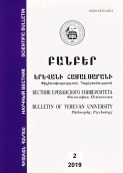
Vol. 10 No. 2 (29) (2019)

Articles

  • Articles

    NATIONAL IDENTITY: THE “WORLD OF GENERATIONS” AND THE “WORLD OF CONTEMPORARIES”

    EDVARD HARUTYUNYAN
    View PDF
    Abstract

    The article deals with the problem of human identity and its architectonics. It is alleged that all identities are structured both horizontally and vertically, scilicet built on logic hierarchy. The past and future story of human life is a text of “how to live” in which we endlessly work and readjust according to our conceptions. In that sense, it is possible to say that every nation forms a special cultural system of life, within which the vertical (time) and the horizontal (spatial) identities of the nation are formed. These principles form a “world of contemporaries” in space and “world of generations” in time. The world organizing the national life is a “world of the community”, which is outstanding by its cultural power but not by its civilizational will, however, to address the challenges of the contemporary world a nation needs civilizational organization and a will to choose.

    References
  • Articles

    THE PROBLEM OF RATIONALIZATION OF SOCIAL INTERACTION IN THE CONTEXT OF POSTMODERN

    GAGIK SOGHOMONYAN
    View PDF
    Abstract

    In the face of uncertainty, the rationalization becomes an objective obligation for the adaptation to global transformations and to new social conditions. In the postmodern society, where uncertainty has become a stable form of life, the rationalization of social interactions is carried out in the following ways: symbolizing the relations of ex-change (replacing reality with the symbols of reality), McDonaldization of social interactions (efficiency, calculation, predictability, control) and the theatricalisation of social interactions (game behavior, which is alien to universal norms and values). Keeping in mind the fact that every way of organizing and regulation social activity reflects a certain rationalization system, which forms a particular culture, the author concludes that the ratio must be cleared from unlawful claims, authoritative ambitions, from all the superficial, witch comes from politic and the struggle of human interests. The process of rationalization should have its own clear sociocultural boundaries and necessarily be inscribed in the wider spiritual and humanistic context of culture. The ultimate goal of rationalization of social interactions should be the provision of a dignified and happy life for the crown of creation – Human.

    References
  • Articles

    GOAL-SETTING AND FREEDOM AS CHATACTERISTICS OF HUMAN ACTIVITY

    MOVSES DEMIRTSHYAN
    View PDF
    Abstract

    The article states that processes at different levels of the organization of life – non-organic, organic and social, are influenced by different laws. Inorganic life proceeds according to the law of necessity, organic life – by the law of expediency, and social – by goal-setting. However, goal-setting as a conscious activity is inherent only to an individual, which means, that social institutions and various spheres of social life continue to “live” according to the law of expediency. This partly explains the wellknown conservatism of such spheres of social life as economics, politics, education, etc. Goal-setting, as the most characteristic feature of an individual's activity, is closely related to such phenomena as freedom and responsibility. It is substantiated that in goalsetting, as in the conscious activity of an individual, the metaphysical content of freedom and responsibility is concretized and finds its “visible” expression.

    References
  • Articles

    THE SCIENTIFICATION OF PSYCHOLOGY: THE PROBLEM OF CONSCIOUSNESS AND UNCONSCIOUSNESS

    GAGIK PETROSYAN
    View PDF
    Abstract

    The problem concerning the subject of psychology in the period of the formation of scientific empirical psychology is examined in the article. The author attempts to show the roots of the psychology of consciousness; its philosophical, theoretical and methodological background. It is shown that both the phenomenological psychology of consciousness and the physiological psychology of consciousness are methodologically inconsistent and have no solid theoretical foundations. And the sole foundation for the psychology of consciousness, according to the author, is the psychology of the unconscious.

    References
  • Articles

    PSYCHODYNAMIC ANALYSIS OF THE FUNCTION OF THE RITUAL IN THE STRUCTURE OF THE NEUROSIS OF OBSESSIVE PERSONALITY STATES

    VLADIMIR MIKAYELYAN, ERIK MIKAYELYAN
    View PDF
    Abstract

    Ritual, as a historical phenomenon, is a certain ceremony or service with a certain meaning. Religious rituals are known to contain a therapeutic function. There is nothing in psychotherapy that previously would not exist in religion. Consciously or unconsciously, ritual participants experience a certain therapeutic effect and, at the same time, they ascribe improvement to their condition to supernatural forces. During the ritual ceremony there is a need to find a mystical connection between words, actions and their effects.

    References
  • Articles

    THE CORRELATION ISSUES BETWEEN BIOGRAPHICAL AND OUTLIVING MEMORY (ON THE EXAMPLE OF HENRIK EDOYAN’S POETRY)

    HRIPSIME ZAKARYAN
    View PDF
    Abstract

    This article is an attempt to analyze reflected in the poetry of the individual Henrik Edoyan's and the unconscious archetypes of the collective unconscious. The inherent peculiarities of Henrik Edoyan's poetic “I” and the poetic world are linked to the problem of the individual's self-recognition and self-determination, one of the main components of it being the problem of proportionating the biographic and outliving memories.

    References