
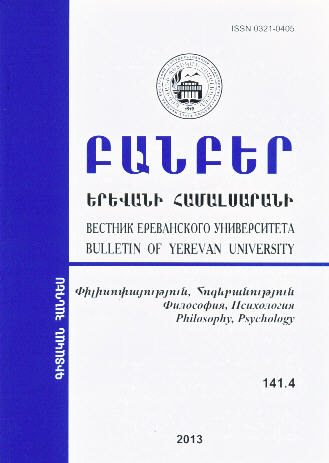
Banber Erevani hamalsarani. P'ilisop'ayut'yun, hogebanut'yun.
| E - ISSN | : | 2738-2621 |
| P - ISSN | : | 1829-4553 |

In liberal democratic societies the Market and the State are two irreplaceable structures, which organize and regulate daily production of stability of social life. If market economy and free competition form the domain of “equality of opportunities”, the state is the guarantor of “balance of interests”. Proceeding from these functions of the Market and the State, the principle of division of economic and political powers is viewed as a precondition for constructing social-economic life on the bases of justice and equality.
The contemporary tendencies of globalization, political and civilization challenges and the attack of mass culture lead to chaos. As a result, nation as a historical subject providing the cultural diversity, finds itself in a peril. Proceeding from the social-philosophical analysis of national identity the author comes to the conclusion that the way of existing of the Armenians as a special ethnoand sociocultural system has permanently been balanced by the moderate contradiction of the individuality and the collectivity. The sociocultural imperative of maintaining the national identity is such a combination of collective-irrational and individual-rational philosophies of existence which aims at pouring into the international ordered life, definitely ordering liberal-democratic mechanisms of functional bonds and interdependences.
Throughout history cynicism has always accompanied human thought as a refusing-denialist attitude towards sociality. In industrial society due to political, economic, historical, social and cultural transformations a new social-cultural space was formed where formerly functioning meaning directives of being are distorted. During the formation of new social-cultural environment new opportunities for cynicism emerge. In the context of modernity cynicism can be described by a number of functional and phenomenological peculiarities. Social-political, social-economic, socialanthropological and moral-psychological functional factors of cynicism are distinguished. When these factors are analyzed it turns out that cynicism, a phenomenon that can surface both on individual and social levels, is such an attitude that contains dangerous obstacles for giving a meaning to being. Overcoming cynicism may become an issue of vital significance for ensuring survival of both each individual and the whole society.
The article reveals the variations of human adaptability to another subject in a multicultural society. In the article the author's definition of a polylogue as a modern type of dialogue is given. Polylogue is an agent of meaning–form interaction of subjects, emerging with an unpredictable outcome and expressing particular logic of an intersubjective event. The author gives a comparative description of polylogue and discourse that helps to identify areas of discourse in the polylogue structure and its value.
Psychological analysis leads us to the idea that the primary function of dissociative personality disorder is insulated from the negative experiences associated with weathered injuries. Dissociation as problem identification with one’s self is a natural state in altered states of consciousness. In such states violation solution of linear perception of time is also formed, moreover, a person feels himself in different autonomous states, or psychophysiological different sub-personalities begin to function in him. The impact of the present and future of the past person is connected with a change of personal history of man, with the introduction of the new psychological content to the actual past.
In this article we investigate the relationship between personality traits and self-regulation strategies. In order to perform the study we selected 201 students. During the research we investigated personal traits, self-regulatory strategies and emotional self-regulation. The results of hierarchical stepwise regression show that certain personality traits have impact on choice of selfregulation strategies. We found out that Extraversion, Conscientiousness and Neuroticism are predictors for emotional self-regulation and Extraversion, Conscientiousness and Openness are predictors for promotion and prevention regulatory strategies. It is interesting that only one personality trait cannot predict self-regulatory behavior. There must be several personality traits to influence on someone’s self-regulatory strategies.
Current globalization processes of contemporary world cultures approach not only each other and integrate into each other but also disengage and disintegrate. In this context the article analyzes tolerance as an important and necessary paradigm of coexistence. The article presents four main manifestations of tolerance: tolerance towards other viewpoints; equality of all cultures and cognitive orientations; tolerance to
ards metaphysical, religious and ideological alternatives; respect for other viewpoints.
