
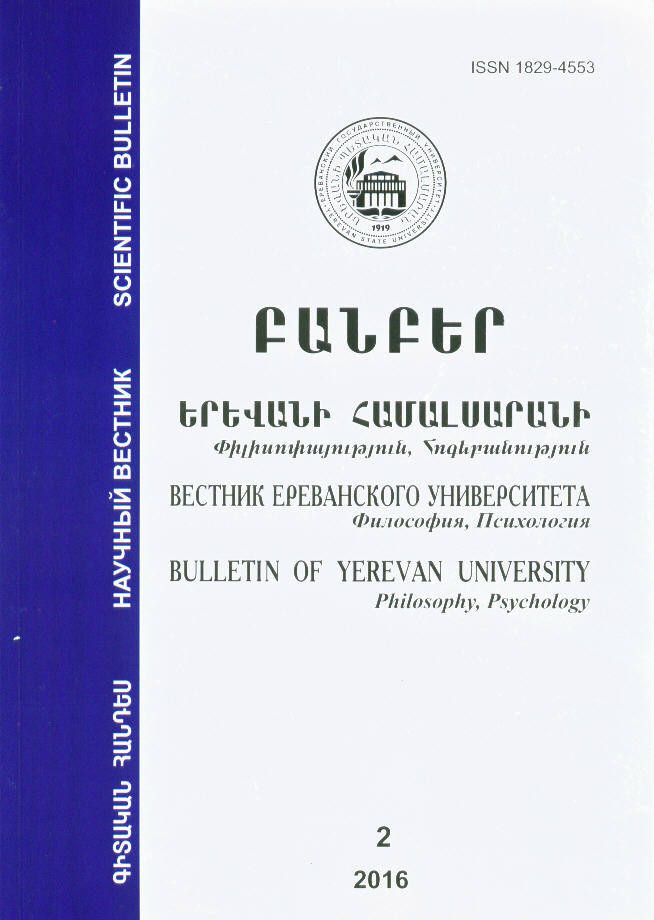
Banber Erevani hamalsarani. P'ilisop'ayut'yun, hogebanut'yun.
| E - ISSN | : | 2738-2621 |
| P - ISSN | : | 1829-4553 |

Nowadays in the modern sociocultural world, the existence of intolerance and mistrust has become a serious problem. As a rule, these destructive processes usually accompanied by violence and other uncontrolled processes. In the context of these problems issues of tolerance, trust and dialogue gained a new theoretical and practical significance. It is obvious that these principles are essential for the optimal functioning of any social system, moreover, the atmosphere of trust and readiness for dialogue are important mechanisms for the reproduction and development of social life
The discussion of philosophical and methodological issues of psychology based on the history of psychology which provides the substantial basis of such researches. However, not every “history of psychology” can handle these tasks. How should be the "history", which underlies the philosophical and methodological researches? The article discusses the criterion and possibility of reconstructing the effective history of psychology.
According to WHO data, over 800 thousand people die every year, and a significantly higher number of people attempt suicide. The article analyses the psychology of suicidal behaviour and the reasons for its active demonstrations in Azerbaijan over the recent years. Cases of neurotic diseases, anxiety disorders and depressions have sharply grown in Azerbaijan. The number of suicides and suicide attempts by citizens of various age and social groups has also seen an increase. In addition, suicides, which get more every day in Azerbaijan, tend to give preference to the method of demonstrative self-immolation. The article analyses the social conditions and psychological problems as causes of suicide in Azerbaijan, as well as the aggressive behaviour of the society displayed in bloody murders and in increased autoaggressive behaviour.
As it is known, in psychoanalysis as well as in analytical psychology, the ritual is seen as a symptom of how repetitive actions or certain forms of behavior, latent containing a therapeutic function. In the psychoanalytic paradigm of ritual, it is also considered as a substitute for the sexual or aggressive activity of the person. a criterion stands in psychoanalysis, according to which, an obsessive ritual becomes in those cases where the impossibility of its fulfillment in the person creates a feeling of anxiety or fear of waiting for something tragic. This distinguishing criterion, despite its obviousness, is still somewhat abstract or devoid of objectivity. While the ritual is complete, anxiety does not go away - so seems the criterion for distinguishing normal ritual of neurotic ritual.
Life is much more significant than moving from one insufficiency to another. Life is an unfinished event and the human is an eternal Faust. The world must be constantly contested so that the life is not deprived of prospect. Contesting is a bid for architectonics of the world. The human has a a metaphysical surplus of energy and the aesthetical creation of the world is his incurable "disease".
Attempts to justify the legitimacy of political power through contract theory are discussed in this article. Contract theory is attractive as it seems to enable to justify the legitimacy of political power. However, it has a number of shortcomings. J. Locke’s theory is problematic for its contradictions and unjustified individualism. The theory of tacit consent and I. Kant’s contract theory, on the other hand, threaten the individual freedom. J. Searle replaces the idea of “contract” with that of “collective intentionality”. He claims that it is not that individuals agree to establish a society and government; rather many individuals collectively accept the existence of institutional facts. J. Searle’s central theses are vague. Moreover, many of his claims are incompatible with historical facts.
Human beings' desire for openness and self-fulfillment in various alternative fields has actualized the problem of virtual reality seen as a transcendental environment for us to relocate our cooperative game in. The fact that this environment is cluttered by singular points, which are widely seen as “existential segments” featuring coincidence (unity) of opposites (coincidentia oppositorum), suggests uncertainty to be its principal characteristic that has a significant impact on our existence at both individual and social levels. It is safe to say that virtual reality grew into an environment that offers us a completely new social experience leading to total social and cultural redesign of the world.
