
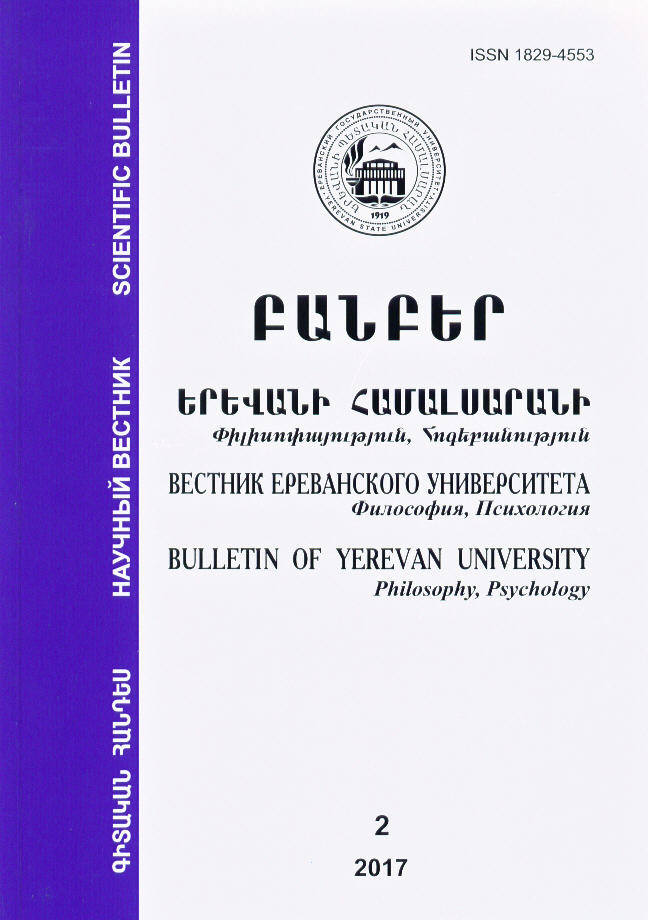
Banber Erevani hamalsarani. P'ilisop'ayut'yun, hogebanut'yun.
| E - ISSN | : | 2738-2621 |
| P - ISSN | : | 1829-4553 |

The feeling of ephemerality makes a person look for the meaning of life. The article discusses the role of philosophy and philosophizes for understanding the meaning relating to contemporary life issues. In particular, it is stressed that if a person «forgets» these issues in household problems, if he or she is not satisfied with the answers that give religions, arts, wealth, power, then philosophy might help him or her understand his or her personal responsibility for his life, as well as for the maintenance of intelligent life on planet Earth.
At the end of the 19th and in the first half of the 20th centuries Armenian social thinkers and historians faced the issues of dealing with the past and with the tradition of past historiography aiming to solve the problems of modernization of Armenian society and its transition to modernity. In this respect and at first glance N. Adonc reveals a paradoxical approach: to rely upon the old historiography and at the same time to break with its tradition. In the proper cognitive position provided by the frame of modernity he constructs a societal-political reality of Armenians in the context of transition from premodernity into modernity. Here, the central role is played by the contradiction between the two political streams which have existed throughout centuries and ahave been embodied in aristocracy. In this way N. Adonc proposes his own unique approach to these issues in comparison to other existing approaches.
The problem of the modernization of the Armenian identity, the spiritual renewal of the nation occupies an important place in the creative heritage of Garegin Nzhdeh, which he solves from the position of the synthetic approach. According to the convictions of the Armenian thinker, the modernization of the Armenian identity should be based both on the achievements of modern "weapons", scientific achievements, and on the viable values of the past. Nzhdeh is against national selfisolation and with regard to the issue of modernization of the Armenian identity rejected the state of becoming a "stranger", rather than the foreign values.
The main problem investigated in the article is the problem of selfidentification of the person in modern conditions of the latest technological developments and, in particular, the Internet and virtual space. Researchers note that the selfexpression in culture (socio-cultural space) and self-expression in the virtual space are fundamentally different, because in the first case, a person is forced to proceed from the realities of his gender, age, nationality, religion, time, etc., while the self-expression in the virtual space is deprived of all these limitations and therefore provides, at first glance, much freedom of self-identification. At the same time, we are aware that a large freedom of choice criteria of self-identification does not imply greater specificity, but on the contrary – the identity of greater uncertainty, because freedom in any of its manifestations involves greater uncertainty than concreteness. The article highlights the contradictory nature of the process of self-identification in the present conditions, because, on the one hand, the virtual space and the latest technological tools are becoming more widely available, and on the other hand, the increasing urgency acquires traditional mechanisms of human identity – culture, history, religion, traditions and so on. As a consequence, we have a modern man with an uncertain, chaotic, eclectic identity, which is also manifested in the social reality, making it more uncertain and aimless.
The symbol has a dual nature: it represents some idea by a material substrate. And traditionally philosophers have emphasized that feature of the symbol. In this sense, the symbol stands as the closest concept with the sign and image. But the image is too generalized. For the sign, the most important thing is its feature of pointing out. The symbol has a difficult and complex structure than the sign, and the symbol is the result of a more complex abstraction. When we say A is the sign of B, it means that A points out B, and when we say that A is the symbol B", here it is already necessary to bear in mind that A is the result of our understanding of B concentrated in A.
Consciousness becomes partially visible through some content, and only an empty consciousness manifests itself in its infinity. Consciousness is seen in the body through behavioral activity, consciousness outside the body is reachable through spiritual experience and transpersonal experiences. A person with a personal consciousness acts under conditions of the limitedness of the created internal and external factors. Transpersonal consciousness is access to the true or divine nature, to hidden possibilities and infinity. Personal consciousness can reject effective development, transpersonal consciousness allows to control normal and productive development by controlling the content of personal consciousness and using transpersonal experience. The instinctive level of the unconscious is equivalent to the lower layers of consciousness. The equivalent of the upper level of consciousness are the symbols of the unconscious. Comparing the mental product of the conscious and unconscious can determine internal conflicts and the degree of harmony. Transpersonal logic or “the logic of the whole” sheds light on conscious or unconscious problems contributing to their solution or transformation. Transpersonal experience and transcendental experiences can be generated through meditation and concentration of attention.
