
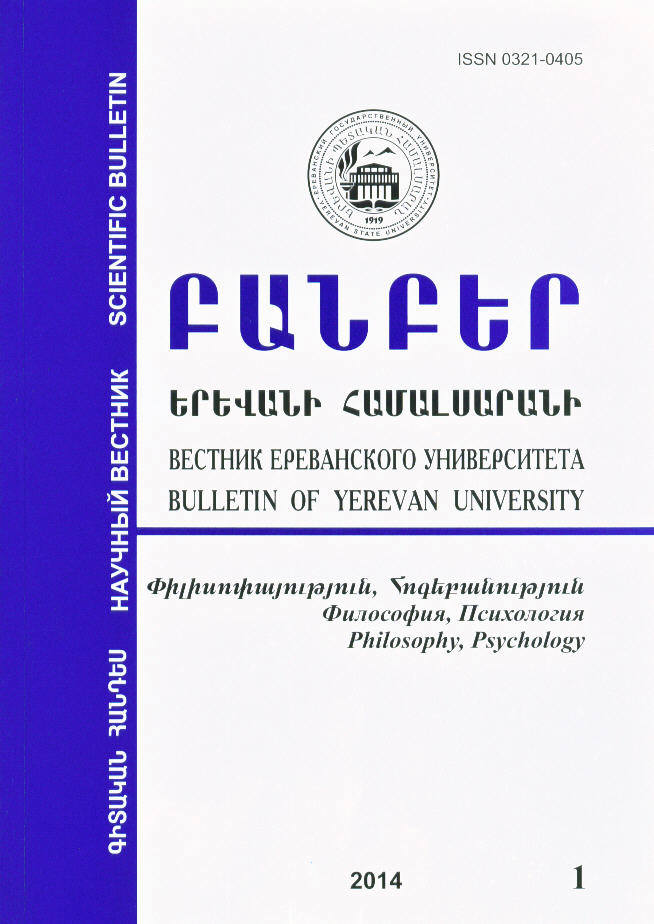
Banber Erevani hamalsarani. P'ilisop'ayut'yun, hogebanut'yun.
| E - ISSN | : | 2738-2621 |
| P - ISSN | : | 1829-4553 |

In this article, some problems of innovation management in the frame of social-philosophical generalization are discussed. According to author, cultural factors are as important for effective innovation process as economical, technological and organizational factors. Both on organizational and societal levels, there must be an adequate cultural climate, which motivates people to desire to seek out new creative ideas, new ways to improve products and technologies, new methods for business and for organization of social life.
The impact of the idea of the “presence of spirit”, which is used as terminus technicus within the mentalist paradigm of Hegel-Heideggerian phenomenology can be represented in the linguistic-pragmatic language of postmodern philosophy by specific heuristic constructions like “conceptual personage” (G. Deleuze and F. Guattari) and “intrigue” (P. Ricoeur). Their methodological application to the critical analysis and transformation of the living traditions in transitional societies can be called Phenomenological Deconstruction of the Living Tradition.
Everyday life as a sphere of social life is initially perceived as an absolute reality, in which dominates the natural attitude and utilitarian orientation of human thought. Despite this, the basics of spiritual values of society are formed in the context of everyday utilitarian relationships. In traditional culture unity of primary-biological and idealized-moral values were accepted as evident. Since the 18th and 19th centuries, the scope of internal transformations of everyday life has led to the condition where everyday life starts to lose the function of the formation of moral and spiritual values, thus the spiritual sphere is replaced by specific signs and consumereconomic interest.
The article seeks to analyze the problem of psychic origin and existence from the perspectives of metaphysical approach. It presents the comparative analysis of three metaphysical concepts of A. E. Mirakian, V. M. Allakhverdov and M. B. Mensky. The article shows that the solution to fundamental problems of psychology inevitably leads to the question of the world structure and reality. A. I. Mirakian’s metaphysical approach is related to the definition and overcoming “product” approach, which leads to the need of going beyond the ranges of reality of psychic phenomena. V. M. Allakhverdova’s metaphysical approach is based on Karl Popper’s “World of Propensities”, while M. B. Mensky’s metaphysical approach generated from the quantum concepts about the world structure, which holds certain place in the consciousness.
Genetic memory is the ability to remember what we should not remember, which was not in the direct experiences. Genetic memory sometimes comes up from the subconsciousness and causes unclear images, impressions and feelings. Genetic memory can occur during sleep. Genetic memory enters into the composition of the collective unconsciousness. One of the most significant phenomena of genetic memory – transgenerational transmission, does not fully resolve the conflict, mystery, the experience of injustice, which is passed on to the unconscious child from the unconscious parent, from generation to generation.
Health problems can lead not only to physical and organic traumas, but can also do much harm to the person’s vital activity. Health can be examined as a multilevel system – on physical, psychological and social levels. The purpose of this article is the theoretical analysis of the phenomenon of health, illumination of the purposes, tasks, issues of experimental practice in health psychology as a young discipline and the analysis of existing problems of the discipline development in Armenia.

