Banber Erevani hamalsarani. Banasirut'yun.
| E - ISSN | : | 2738-2575 |
| P - ISSN | : | 1829-457X |
From the set collocations, only the compound names and phraseological expressions are considered in the article. In connection with the social structure changes in the last decade the necessity to express new establishments and new concepts
with compound names, has considerably increased. The newly-formed collocations with noun value, with full or partial copying, are mostly binary or ternary formations. Among the compound names, there are a large number of names of enterprises,
firms, organizations, parties, etc. In the system of set collocations, the phraseological expressions are unique units. Among the newly-formed phraseological expressions casual, colloquial, jargon structures are also found. Among the newly-formed collocational expressions, there are such, one of the components of which appears in the collocation with a new meaning and that meaning change is visible only in set collocations.
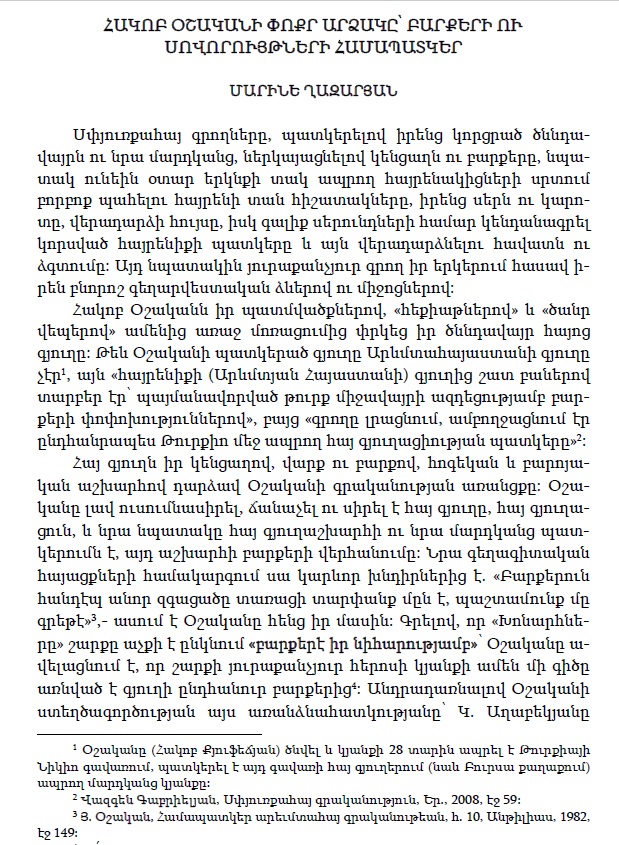
Hakob Oshakan with his stories, "tales" and "serious novels" primarily saved from forgetting his place of birth - Armenian village. Armenian village with its live, behavior and manners, psychological and moral world has become the axis of Oshakan’s literature. The purpose of Oshakan is the description of the rural world and its people, revealing the manners of this world. This was one of the important tasks in the system of his aesthetic views. Each story of Oshakan with its unique and colorful accent became a unified vivid picture of the Armenian rural nature, customs and manners, and their combination – a panorama of the village.
The prose of Oshakan is a panorama of the life, festivals and rituals, manners and customs of a patriarchal Armenian village. Oshakan shows all this not only by descriptions but also with the promptness of mental discovery of heroes. Otherwise, he
would be considered as an eco-collector and ethnographer. Oshakan’s works, which describe the village, become a special triumph not only for people but also for exploring the national forgotten, even celebrated, or typical of some areas holidays. In these works, it can be seen also Oshakan’s great desire of salvation of the spiritual culture of his native village. Even in the description of the beauty of nature Oshakan fills the rural pictures with the description of manners and life of people. Oshakan uses a conversational style, folk proverbs, and sayings to preserve the color in the descriptions of rural life.
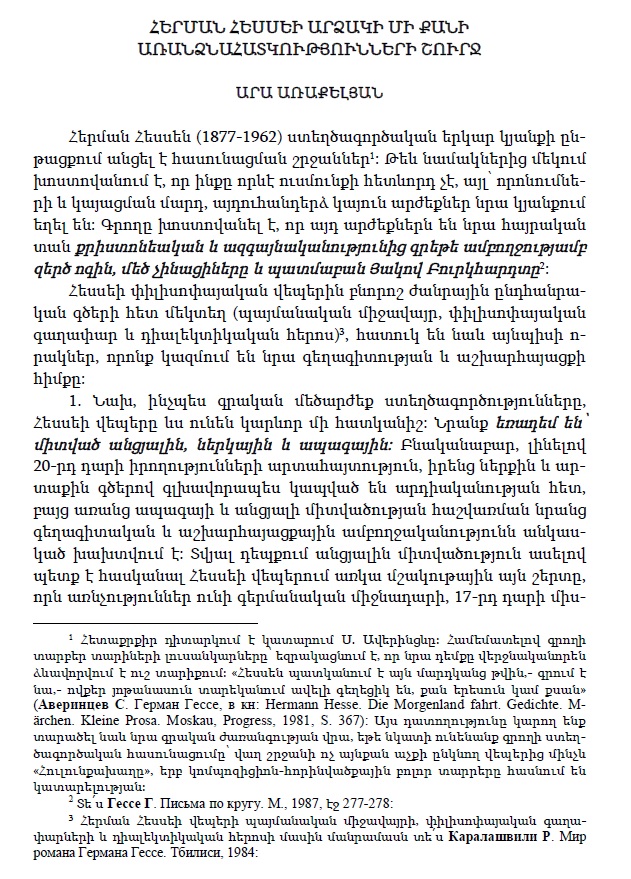
In the present article, the author discusses the problem of Herman Hesse’s creative works and aspects of its poetics.
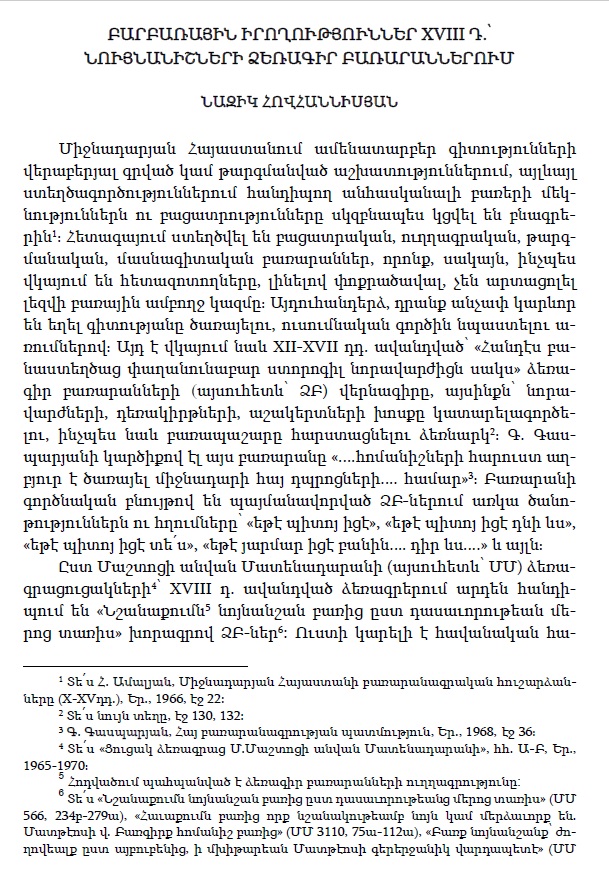
In the manuscript dictionaries, some rows of synonyms end with words, which existed in the Armenian dialects. In this article these words are examined as interferences of the authors of the manuscript dictionaries; they replenished the rows and added some words of their own dialects. The words խզարել “to saw off”, ծիւ ծիւ առնել “to tear to pieces”, տոռնը “rope, cord, thread”, ջաւ (id.), փողպատ “collar”, ծիրանի գօտի “iris, rainbow”, աղեղն ամպոյ (id.) are considered.
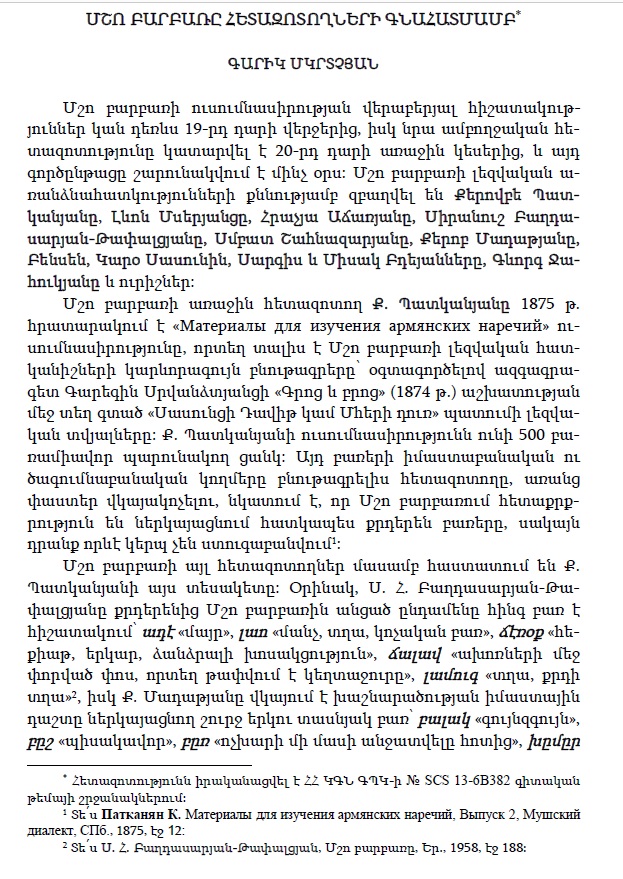
In the present article, the brief history of the dialect of Moush is presented. The studies of the author have shown that structural peculiarities of the dialect of Moush were mainly studied by Qerovbe Patkanyan, Levon Mseryants, Hrachya Acharyan, Siranush H. Baghdasaryan-Tapaltsyan, Smbat Shahnazaryan, Qerob Madatyan, Bense, Karo Sasuni, Sargis and Misak Bdeans, Gevorg Jahukyan. The author comes to the conclusion that the study of the dialect of Moush has begun since the end of the 19th century and that process is still going on. According to G. Jahukyan’s multi-featured statistical classification of Armenian dialects the dialect of Moush is located in the Moush-Tigranakert or south-central dialectical group of the western area of Armenian dialects. It includes sub-dialects of Baghesh, Khlat, Artske, Artchesh, Manazkert, Moush, Bulanekh, Khnous, Alashkert.
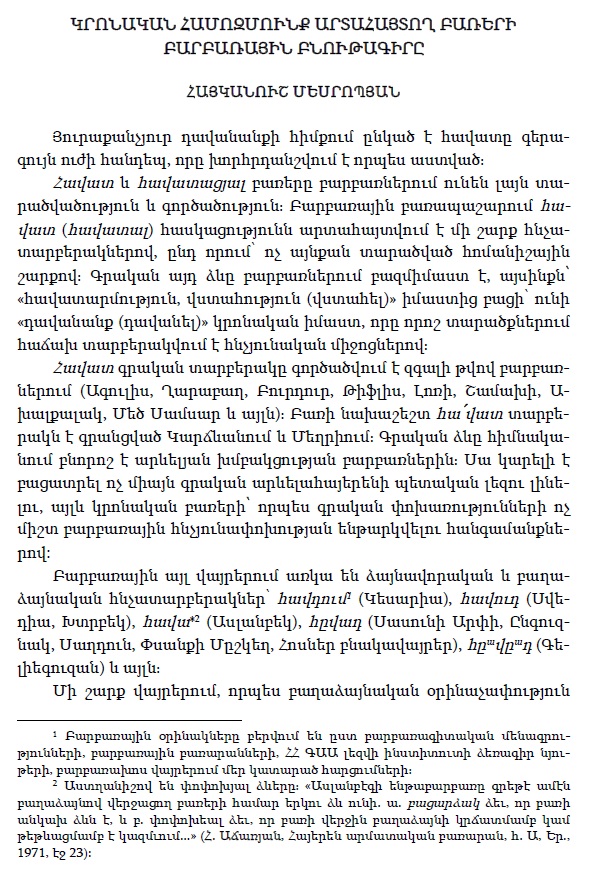
In this article the concepts “to believe” and “belief” and the dialect expressions associating with them are discussed. In the Armenian dialects,these words generally appear in phonetic variations with a limited number of synonyms. The majority of the Armenians dialect speakers (except for those living in the area of Western Armenia, in Chemlihemshin and Middle Asia) are the followers of Jesus Christ and they have religious vocabulary according to this faith. The dialect speakers in a negative way distinguish the fact of instability of the faith and the practice of other beliefs. There are a number of words in the Armenian
dialects which are peculiar to people who have Christian parents and those who follow other beliefs.
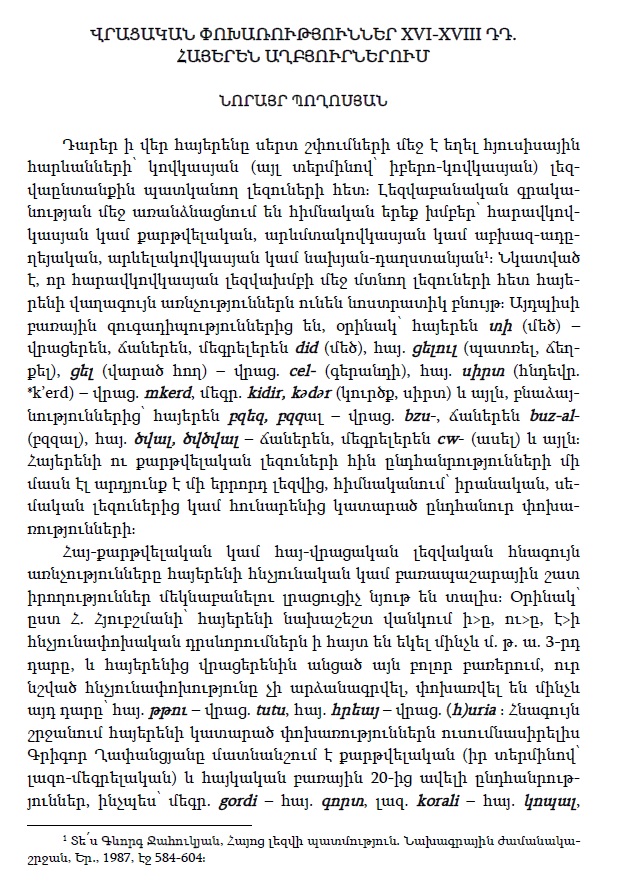
Throughout centuries the Armenian language has been in direct contact with its southern neighbours , especially with Georgian, pertaining to the caucasian language family. There are a large number of linguistic coincidences between these 2 languages,for example, Armenian “ti”, meaning big, and Georgian “did”, Armenian “sirt” (heart) and Georgian “mkerd”.
A number of linguists outline about 50 words that have been passed to Armenian vocabulary from Georgian during the middle ages. These loan-words are mainly concerning craftsmanship, mechanical and administrative sphere. Georgian words have also been found in the Armenian scripts of the 16th to the 18th centuries, e.g. glekhi ( slave), nadjakh( axe), tsil (part, fraction) and so on. As a result of this language intercourse the Armenian language enriched and these borrowed linguistic examples denote cultural and political relations between two nations.
The tradition of differentiating the plot and the fabula has originated from the works by Russian formalists and states the relationship between life material and its elaboration in narrative texts. This very dichotomy gave incentives for the development of narratology as a science. In modern literary theory the usage of such oppositions, as narration and discourse, plot scheme and plot are more widely used. The difference between the plot and fabula must not be reduced to the expression of time succession solely in literary works. The plot is the result of complex transformations of the “raw” material. It involves the narrator’s viewpoint, ideological assessment, emphasizing of the dominant theme and also the means of temporal expression of the events.