Vol. 9 No. 2(26) (2018)

Articles

  • Articles

    The Temporal-Spatial Scope in the Memoir “The Major Events of My Life” by Ghazaros Aghayan

    ANNA TOROSYAN
    View PDF
    Abstract

    In the article, we examine “The Major Events of My Life”, which is part of the memoir legacy of Ghazaros Aghayan. The memoir “The Major Events of My Life”, which covers the events of the 1850s up to the beginning of the 1890s, is not merely a collection of biographical facts, but a piece of writing which gives a comprehensive idea of the Armenian social life of the very period: it depicts Armenian cultural life based on historical documentary materials, revealing a number of events and individuals through different events.

    References
  • Articles

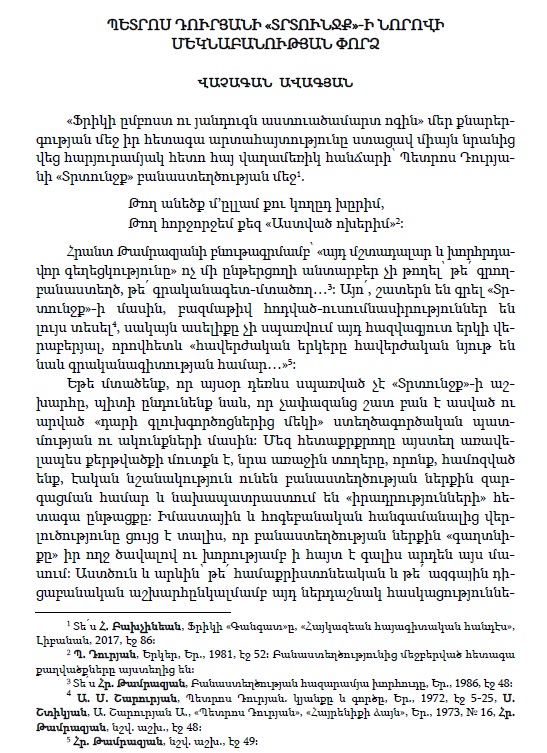
    An Attempt to a New Interpretation of Bedros Tourian’s “Complaints”

    VACHAGAN AVAGYAN
    View PDF
    Abstract

    By detailed content and psychological analysis of the first lines of Bedros Tourian’s well-known poem “Complaints,” the article reveals the great importance of those lines for the poem’s further inner development and highly outlines the direction and nature of its spiritual content.

    References
  • Articles

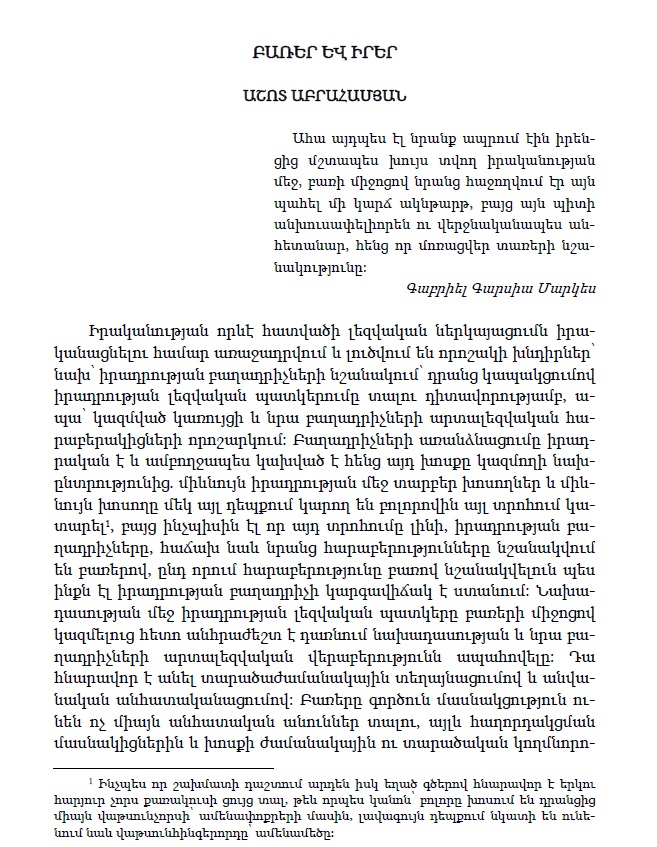
    Words and Things

    ASHOT ABRAHAMYAN
    View PDF
    Abstract

    The main strategic modes of linguistic representation of reality – nomination and deixis – are embodied by nominative and deictic words, nominative words including common names and proper names. The three types of words, distinguished in this way, are often mentioned as means of identification of the referent and are simply enumerated, without substantiating the existence of precisely these types. Meanwhile, the analysis proves that they constitute a regular system, parts of which can be defined and compared with each other, using quantitative characteristics. It is owing to the existence of these three semantic-functional types of words that full semantic coverage of reality and full referential identification of speech components become possible.

    References
  • Articles

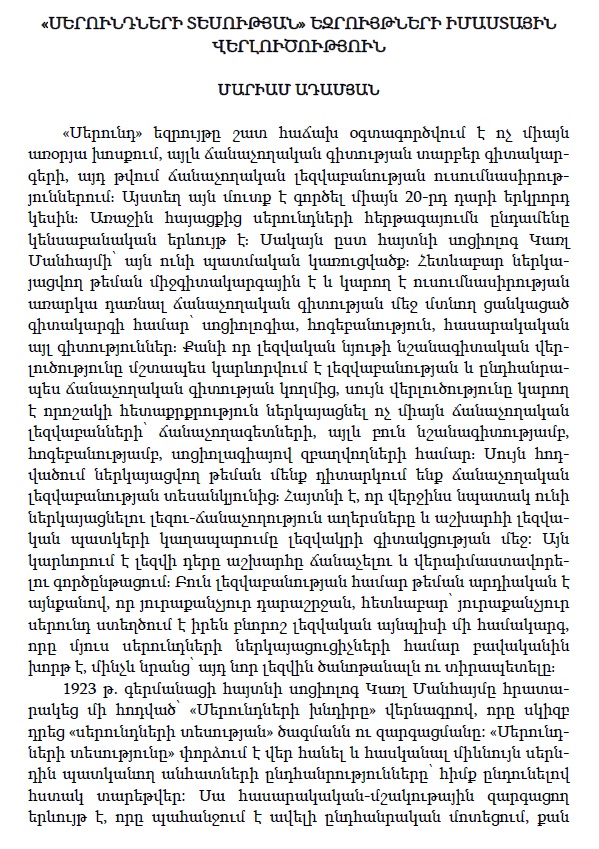
    Semantic Analysis of the Terms of Generational Theory

    MARIAM ADAMYAN
    View PDF
    Abstract

    The generational theory, created by William Strauss and Neil Howe, describes a theorized recurring generation cycle in American history. The theory discusses different values of people who grew up in different historical periods. The basis of the theory was introduced in the book named "Generations" (1991), which helped popularize the idea that people of a certain age group tend to share a particular set of beliefs, attitudes, values, and behaviors, as they grew under the same historical conditions. Hence, human values are formed not only because of upbringing but also under the influence of social facts, the entire context, in which the person grows up. The aforementioned is highly important in the context of cognitive science, especially in cognitive linguistics, since linguosemiotic analysis of the age groups, their verbalization, brings some clarity on the basis of the theory.

    References
  • Articles

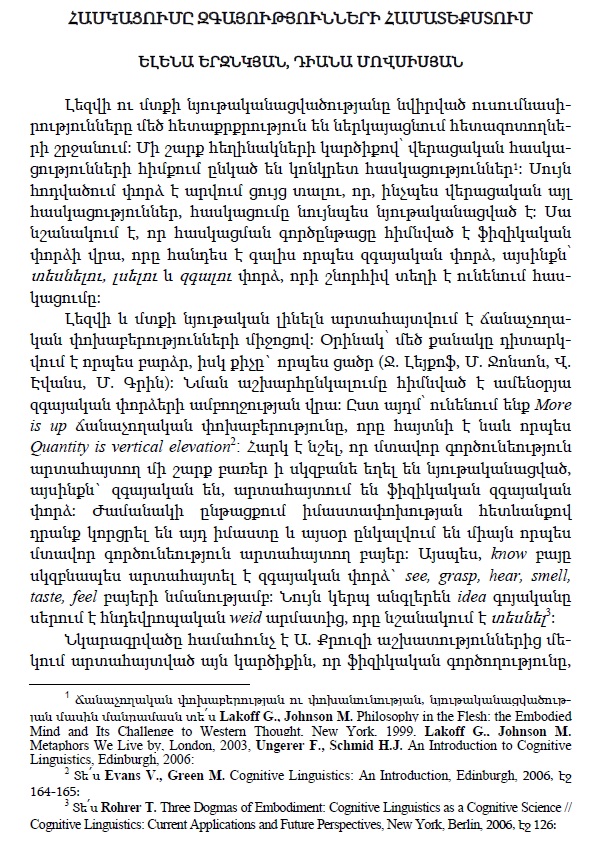
    Understanding in the Context of Sensual Perception

    YELENA YERZNKYAN, DIANA MOVSISYAN
    View PDF
    Abstract

    The article discusses the process of understanding in the light of sensual perceptions. On the basis of both English and Armenian verbs of perception, it is shown that understanding is embodied and is preconditioned by seeing, hearing and sensing. The study also shows that the process of understanding necessarily requires evaluation of the communicated information and is emotionally coloured.

    References
  • Articles

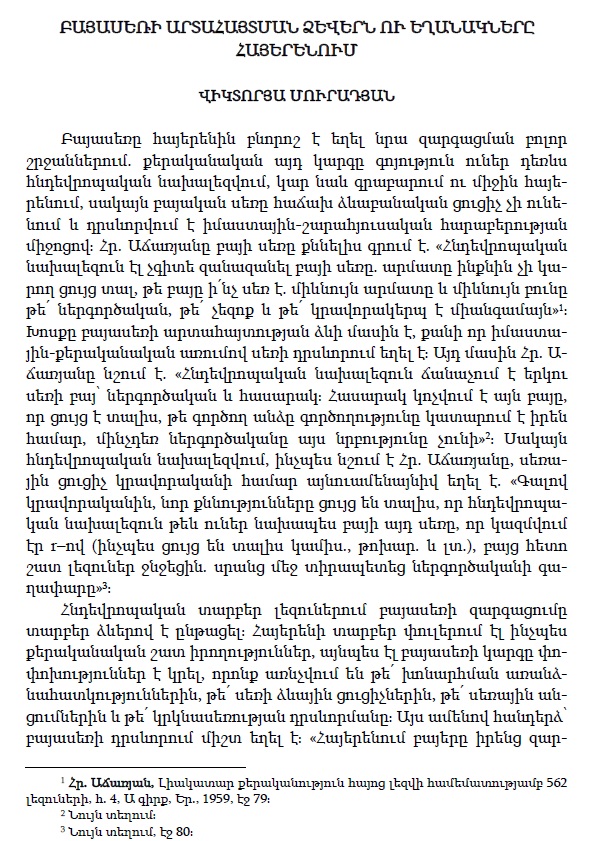
    The Ways and Methods of Expressing Voice in Armenian

    VIKTORYA MURADYAN
    View PDF
    Abstract

    Inheriting voice from Indo-European parent language, Armenian hasn't differentiated it with morphological indicators for a long time. In Old Armenian, it was possible to express the meaning of passive voice with some declination endings. In Middle Armenian the ու/վ/ւ affix was generally used as a passive voice indicator, which continued to be used in that function in New Armenian as well, however in Modern Eastern Armenian while defining the voice, besides ‘վ’ passive indicator, the semantics and the syntactic structure of the sentence also play a significant role. Several bases are concerned while defining the voice – morphological indicator, word-meaning, syntax application, the possibility of getting different, especially direct
    and indirect objects.

    References
  • Articles

    The System of Poetry Translation Strategies in Modern Translation Studies

    HAYK HAMBARDZUMYAN
    View PDF
    Abstract

    The aim of this article is to conduct a comprehensive analysis among pivotal theories and ideologies on poetry translation, outline the strategies effective in poetry translation and sum up the results with a hierarchical model based on faithfulness to the original text. The theories subjected to scrutiny in the article relate to translation studies, as well as interdisciplinary studies. A comparative analysis has been conducted, and the main theoretical directions have been pinpointed. The hierarchical model developed as a result of analyses is applicable as a framework for pre-translation analysis and a tool for translation evaluation.

    References
  • Articles

    The Axiological Layers of the Internal Dialogue in the Armenian Mediatexts

    DAVID PETROSYAN
    View PDF
    Abstract

    Nowadays, mediatext related issues continue to remain in the center of researchers’ attention without losing their relevance. This context involves the study of the axiological layers of the internal dialogue. In the mediatext the internal dialogue begins with the author, whose “I” splits in the text revealing internal addressees. The author thus creates a unique theatrical
    environment and, through dialogical relations with internal addressees, prepares the entry of the text to the external audience.
    The letter of Ch. Chaplin and the essay of K. Surenyan are typical examples in this regard. The comparative analysis of these publications reveals a number of similarities and differences that generally reveal remarkable axiological layers in the internal
    dialogue of the mediatext-intellectual audience.

    References