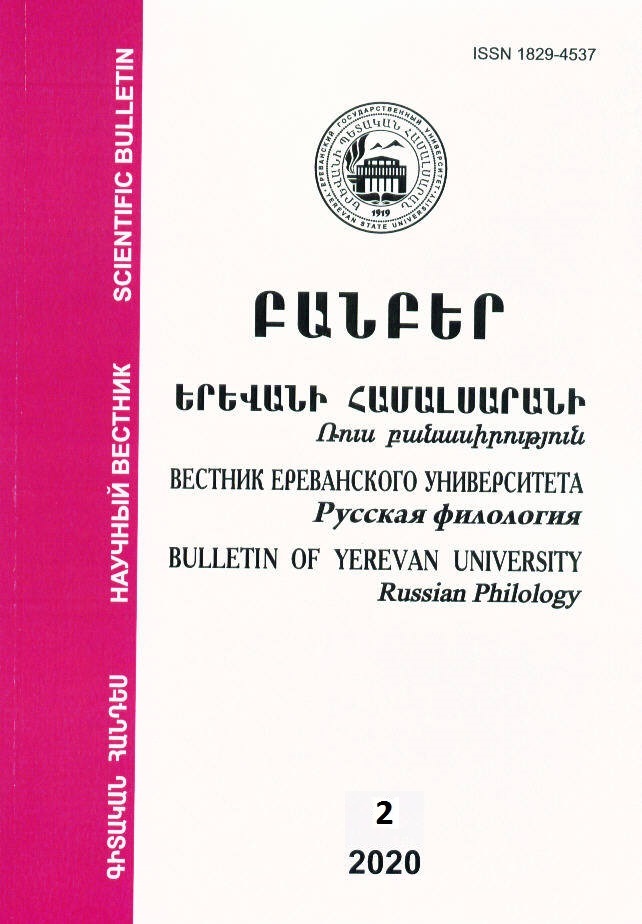
Vol. 6 No. 2 (17) (2020)

Articles

  • Articles

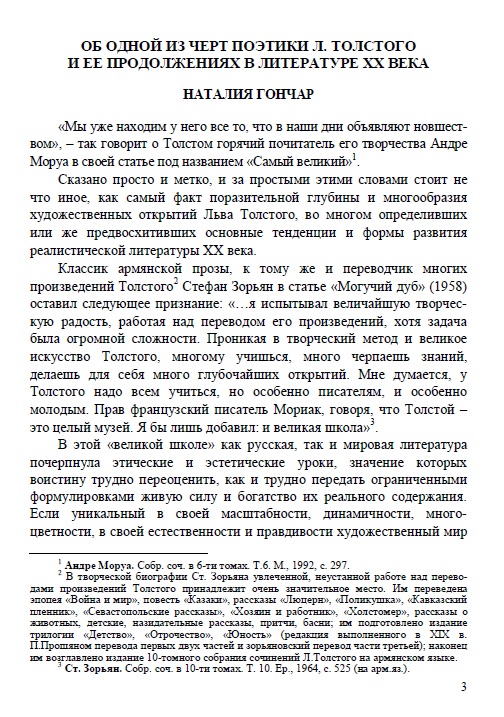
    ON A SPECIFIC FEATURE OF L. TOLSTOY’S POETICS AND ITS SUCCESSORS IN THE LITERATURE OF XX CENTURY.

    NATALYA GONCHAR
    View PDF
    Abstract

    This article has for an object to show the great importance of autobiographical material, writer’s own life, emotional and spiritual experience in Lev Tolstoy’s creative work, poetics, artistic skill, as well as to illustrate how Tolstoy’s model of employing his own life material was echoed in the 20th-century literature. The proposed theses are underpinned by references to many of Tolstoy’s texts (in particular, by observing the history, composition, details of his novel Anna Karenina), as well as to some of his wordings and sayings. Additionally, the article examines the further development of Tolstoy’s model, presents several examples from Russian, American, and Armenian literature.

    References
  • Articles

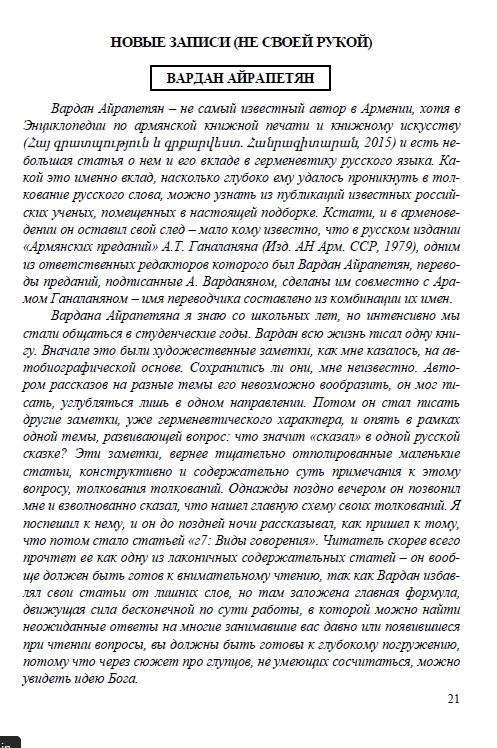
    NEW NOTES (NOT BY OWN HAND) TO THE “INTERPRETING A WORD”

    VARDAN HAYRAPETYAN
    View PDF
    Abstract

    The publication includes recent years’ additions to the author's book “Interpreting a Word: An Attempt of hermeneutics in Russian” published in the second edition in 2011. Questions of the theory and technique of interpretation, relations between natural sciences and humanities, literature and folklore, are considered, and a detailed plan of an unwritten book on general philology is presented. Various aspects of the writings of Pushkin, Dostoevsky, Tyutchev, Mandelshtam, and others are touched upon.

    References
  • Articles

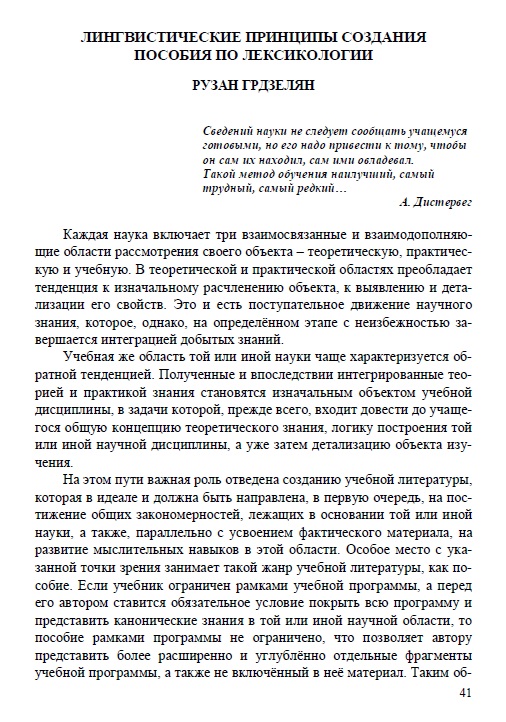
    LINGUISTIC PRINCIPLES OF CREATING A TEXTBOOK ON LEXICOLOGY

    ROUZAN GRDZELYAN
    View PDF
    Abstract

    The article discusses the linguistic principles of creating a textbook on the lexicology of the Russian language: the application of the principles of an active dictionary taking into account the factors of the lexical world and lexical grammar, dynamic description of lexical meaning. The article attempts to apply the modern linguistic methodology and research techniques in the field of educational linguistics.

    References
  • Articles

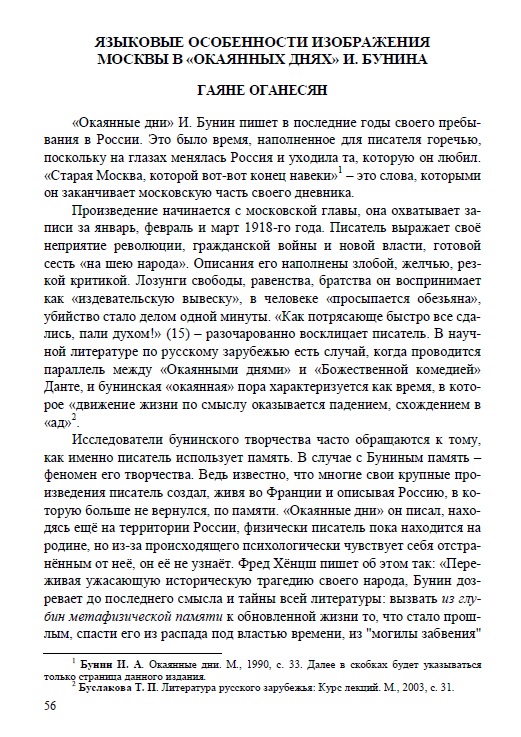
    THE LANGUAGE TOOLS OF MOSCOW DESCRIPTION IN I. BUNIN’S “CURSED DAYS” ESSAY.

    GAYANE HOVHANNESYAN
    Abstract

    This article deals with some features of the language of Ivan Bunin's political essay “Cursed Days”. Much attention is paid to the way the author describes old traditional Moscow in the context of new revolutionary Russia.The research is devoted to the analysis of different grammatical tools that reflects the author's position on the changing system of politics, morality, and religion

    References
  • Articles

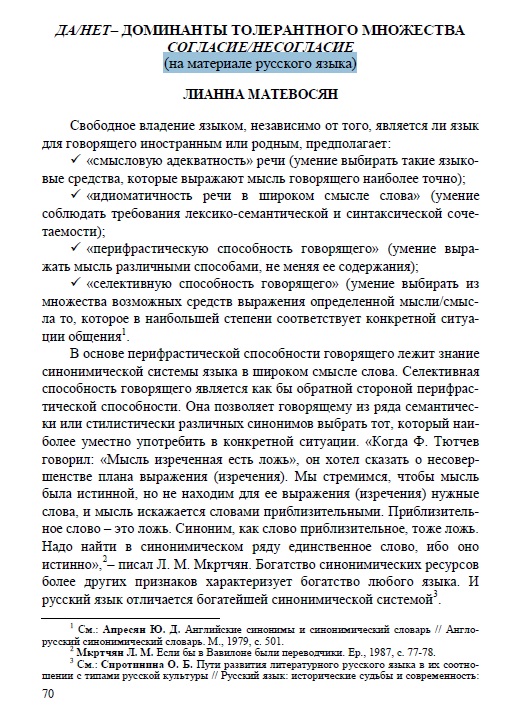
    YES/NO AS DOMINANTS OF THE TOLERANT SET CONSENT/ NON-CONSENT IN RUSSIAN.

    LIANNA MATEVOSYAN
    View PDF
    Abstract

    The paper deals with stereotypical utterances,Yes and No, regarded as dominants of the tolerant set Consent/Non-consent.Members of the tolerant set are close or identical in meaning but different in expression,and they are not always interchangeable. The latter provokes errors in the speech ofnon-native speakers of Russian, which makes it critically important to study and teach Russian as a foreign language.

    References