
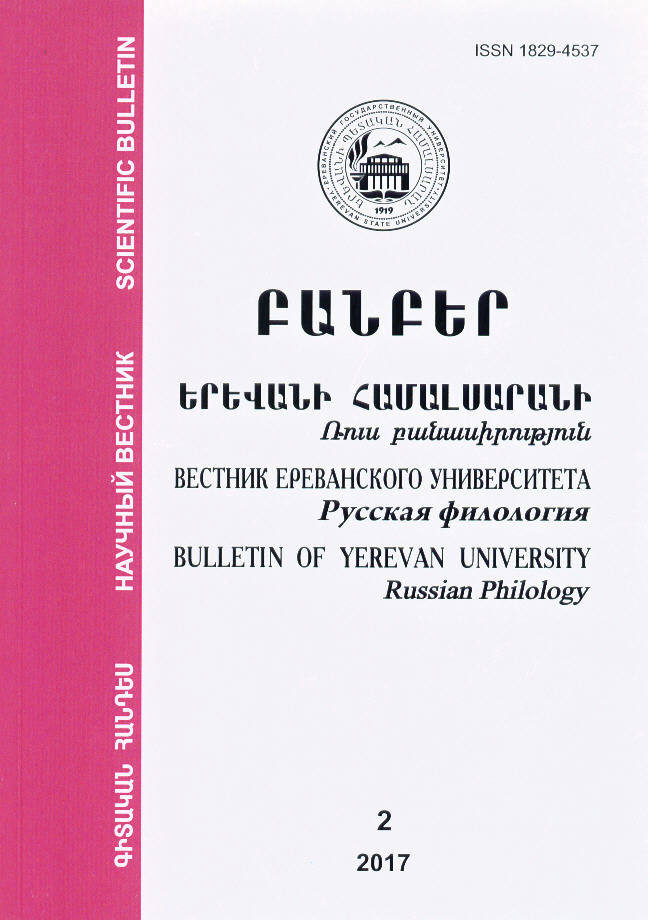
Banber Erevani hamalsarani. Ŗus banasirut'yun.
| E - ISSN | : | 2738-2583 |
| P - ISSN | : | 1829-4537 |

The paper is devoted to the analysis of one of the important linguistic problems within the framework of the dominant anthropocentric paradigm– speech acts, in particular: the speech act of request. The paper describes the verbal strategies of expressing request in Russian linguoculture, particularly, direct ways of expressing requests. The choice of forms of request depends on the situation of communication. According to the results of the research the most common direct forms of request strategies for the mentioned linguoculture are imperative mood structures.
Тhe investigation and interpretation of Marina Tsvetaeva’s life and creative work took the main place in almost half a century literary work of Anna Saakyants. As a devoted companion of poet’s daughter, Ariadna Efron, she made ready first publications and editions of Tsvetaeva in USSR, and subsequently, also up to Tsvetaeva’s collected works in 7 volumes (1996). The fundamental (over 800 pp.) book of A.Sahakyants “Marina Tsvetaeva. The Life and Work” (1997) became the total result of her many years studies and writings on the beloved literary figure. The author of this article presents a long and efficient path traversed by Sahakyants in the indicated direction, evaluates her contribution in Tsvetaeva-sphere, also pays attention on other sides of Sahakyants life and work. Many fragments of letters (1965-2000) are published in the article for illustration.
The author presents N.V.Lartseva as a literary and cultural worker, an expert in Tsvetaeva’s biography and poetry and makes known her speech in Russian-Armenian (Slavonic) University (Yerevan, 2002).
The article covers and characterizes the perception of Sergey Yesenin as “the most Russian poet” by different generations of Armenian poets. Different memoirs, articles and poems, devoted to Sergey Yesenin, show why his poetry was so familiar and liked by Armenian poets. The works disclosed the brightest and most defining features of Yesenin’s lyrics, as well as the influence he had on certain Armenian poets. This article also features translations of several works by Yesenin and his Armenian editions.
Boris Slutsky is a writer of frontline generation, one of the greatest Russian poets of second half of XX century. He translated poems by Armenian poets, published reviews and comments on their work. The article analyzes the Slutsky’s poems on the Armenian theme. They don՛t constitute a single cycle and written at different times, and it indicates a constancy of interest to Armenia. Some of these poems have a high artistic value.
The paper is devoted to the ways of expression of the concept “deception” in S. Dovlatov’s works, to the comparison of the
verbs “обманывать”, “лгать”, “врать” and “молчать” and their meanings in Russian linguoculture and the features of their using in Dovlatov’s stories, where lie is manifested in two forms: active and passive.
