Vol. 9 No. 1(25) (2018)

Articles

  • Articles

    Communication Situation and the Succession Category of Etiquette Formulae

    ZARIK AGHAJANYAN
    View PDF
    Abstract

    Speech formulae form an indivisible part of the etiquette. Their examination should be based on the speech situation. The latter has practically not been studied in Armenian linguistics. Etiquette formulae are divided into different communicative-semantic fields. In the system of speech etiquette, the logical succession is of no minor importance: it is important that one should follow the rules standardizing the category of succession, which, of course, are not inviolable. The formulaic system defined by the speech etiquette is not only the reflection of the present state of any language but also its everlasting guideline.

    References
  • Articles

    On the Way of Discovering the Native Land

    ARTSRUN AVAGYAN
    View PDF
    Abstract

    The article presents Vahan Tekeyan’s diary “Caesarea”, which was written in 1913 and was first published in 1921 in the newspaper “People’s Voice – Zhamanak” in Constantinople. The Diary this time was published as a book in Istanbul in 2016. This work of V. Tekeyan is significant not only for the recognition of some fragments of his biography but also for revealing many aspects of the life of the Armenians in Caesarea.

    References
  • Articles

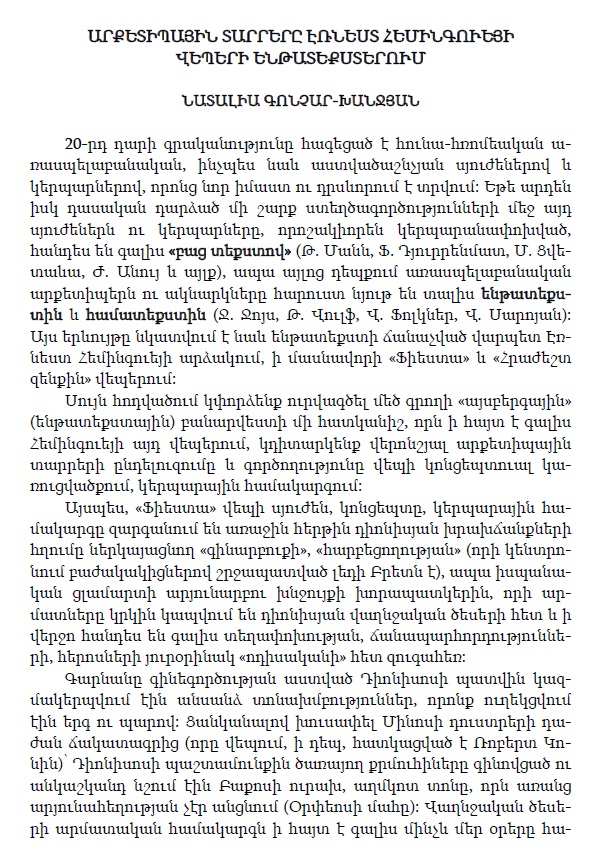
    The Archetypes in the Undercurrent of Ernest Hemingway’s Novels

    NATALYA GONCHAR-KHANJYAN
    View PDF
    Abstract

    The literature of the XX century has involved numerous Greek-Roman mythological, as well as biblical topics and characters, imparting modern meanings to them. These topics and characters, in different modern metamorphoses, are manifested as an “open text” in a series of already classical works; meanwhile, in many other cases, the mythological archetypes, allusions enrich the undercurrent and context (Joice, T. Wolf, Faulkner, Saroyan, etc.). This is what we observe in the prose of the eminent master of undercurrent Ernest Hemingway, in particular: in his novels “Fiesta” and “Farewell to Arms”.

    References
  • Articles

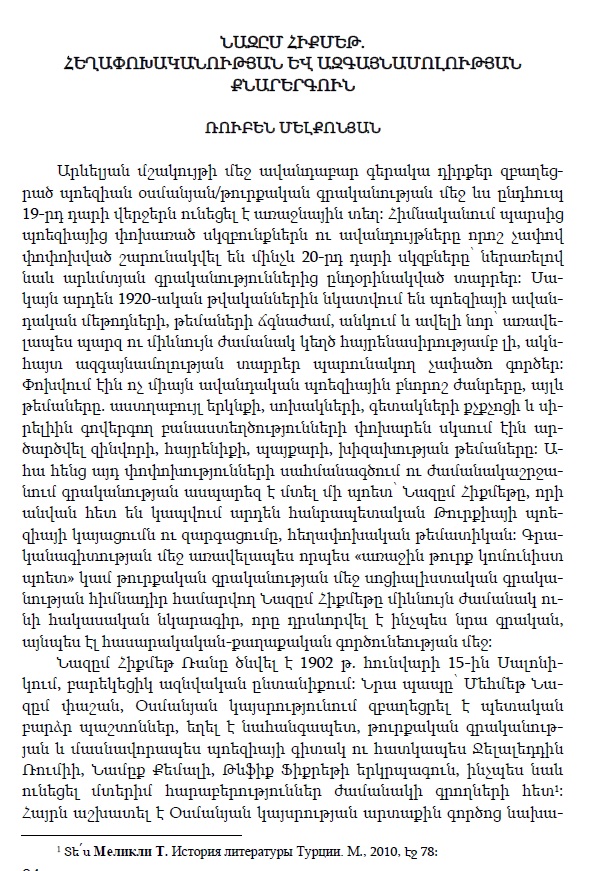
    Nazım Hikmet: Poet of Revolution and Nationalism

    RUBEN MELKONYAN
    View PDF
    Abstract

    Poetry, traditionally having leading positions in Oriental literature, had an important place in the Ottoman/Turkish literature until the end of XIX century, too. Principles and traditions, being mostly adopted from the Persian poetry and also including elementsimitated from Western literature, continued to exist with some slight changes till the beginning of XX century. Formation and development of the poetry in the Republic of Turkey and inclusion of the subject of revolution in it is associated with the name of Turkish poet Nazım Hikmet. Being famous among literary critics as “first Turkish communist” poet or founder of socialist style in Turkish literature, Nazım Hikmet at the same time had a contradictive personality which is reflected in his literary work as well as in public and political activity. Although in his works Nazım Hikmet touched on the problem of equality of nations, opposed social and ethnic discrimination, he kept silence or nearly didn’t speak about genocides, suppressions against non-Turks in Turkey taking place in the past and continuing in his lifetime. Besides, he adopted nationalistic and even racist approaches to the range of problems both in his works and public activity.

    References
  • Articles

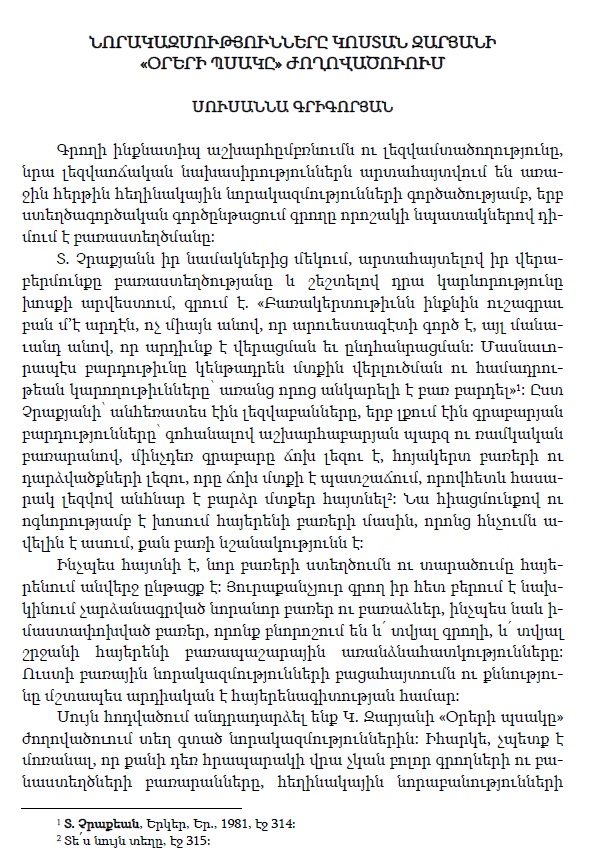
    Neologisms in Kostan Zaryan’s Collection of Works – “The Crown of the Days”

    SUSANNA GRIGORYAN
    View PDF
    Abstract

    The vocabulary of Kostan Zaryan’s poems is rich and multiform. The poet has made use of the whole rich lexical material of our
    language masterly and in case of need, he also used the word-building possibilities of the Armenian language, creating new words and expressions and in this way enriching not only the language of his own works but also the boundaries of the literary language. More than 300 author neologisms are included in Kostan Zaryan’s collection of works- “The Crown of the Days” which are not reflected in any of the dictionaries of neologisms of the Armenian language. Those poetically formed neologisms which are created according to the principle of the complex of ready-made patterns give additional shades of meaning to the speech of the author, have stylistic value and contribute to the greater expressiveness of speech. The compound words created by Kostan Zaryan are made by means of quite different words. The prefixal-suffixal (derivational) neologisms, which are mainly melodious and are formed according to the rules and regulations of word-formation tradition, are not numerous in Kostan Zaryan’s poems.

    References
  • Articles

    Address as a Condition for Ratifying the Advertisements in Armenian Periodicals of Tiflis (1846-1918)

    TARON DANIELYAN
    View PDF
    Abstract

    Address as a condition for ratifying the advertising messages in Armenian Periodicals of Tiflis had some peculiarities in its development that was conditioned by legislative, administrative, and economic reforms, as well as, was the result of improvements in communication channels and means. According to data integrity addresses are combinations of independent
    information units each of which has a different meaning and correlatives and in combination with other units creates new information unit the integrity of which is conditioned by the level of comprehension by which the message recipients get the
    new information unit.

    References