Treatment and Recycling of Heavy Metals-Containing Wastewater and Soil Using Super-Stable Mineralization Materials
DOI:
https://doi.org/10.46991/JISEES.2025.SI1.008Keywords:
LDHs, Super-stable mineralization, Industrial wastewater, Heavy metal, Resource recyclingAbstract
With the rapid industrial development, industrial wastewater poses a significant environmental burden. The prevailing chemical precipitation treatment requires excessive chemicals, leading to substantial sludge production, unstable hydroxides, and limited resource utilization. Addressing these challenges, Duan Xue’s team proposed the super-stable mineralizer technique. LDHs replace heavy metal ions by isomorphous substitution, creating a super stable mineralized structure. This approach effectively reduces heavy metal ion migration and bioavailability. With its versatility in treating Ni, Cu, Cr, and Pb, it also proven effective in real wastewater. Moreover, the super-stable mineralized materials selectively convert trace ionic gold into simpler gold, exhibiting exceptional performance in electrolytic water and CO2PR. This innovation offers new possibilities in clean energy and waste resource recycling. In treating highly concentrated heavy metal wastewater, it successfully transforms Cu, Ni, Pb, and other metals into elemental forms, enabling heavy metal resource recovery and expanding the application of treating heavy metal-polluted wastewater.
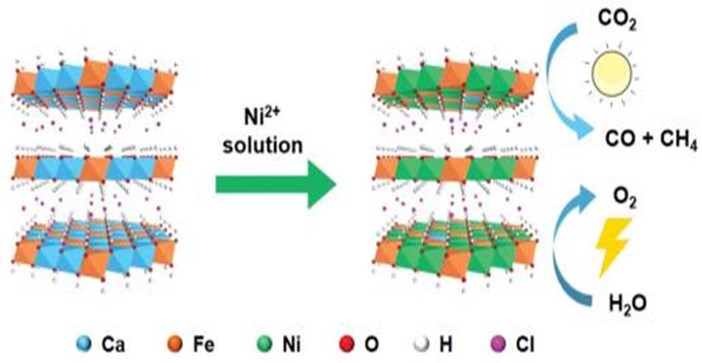
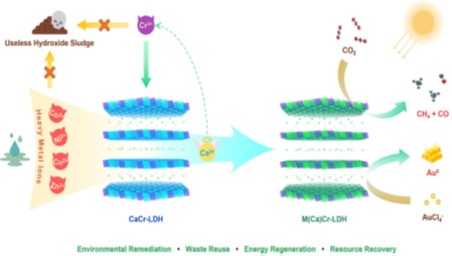
This figure explains mechanism of super-stable mineralization and catalytic application.
References

Downloads
Published
Issue
Section
License
Copyright (c) 2025 Yufei Zhao (Author)

This work is licensed under a Creative Commons Attribution-NonCommercial 4.0 International License.