| E - ISSN | : | 3045-3100 |
| P - ISSN | : |

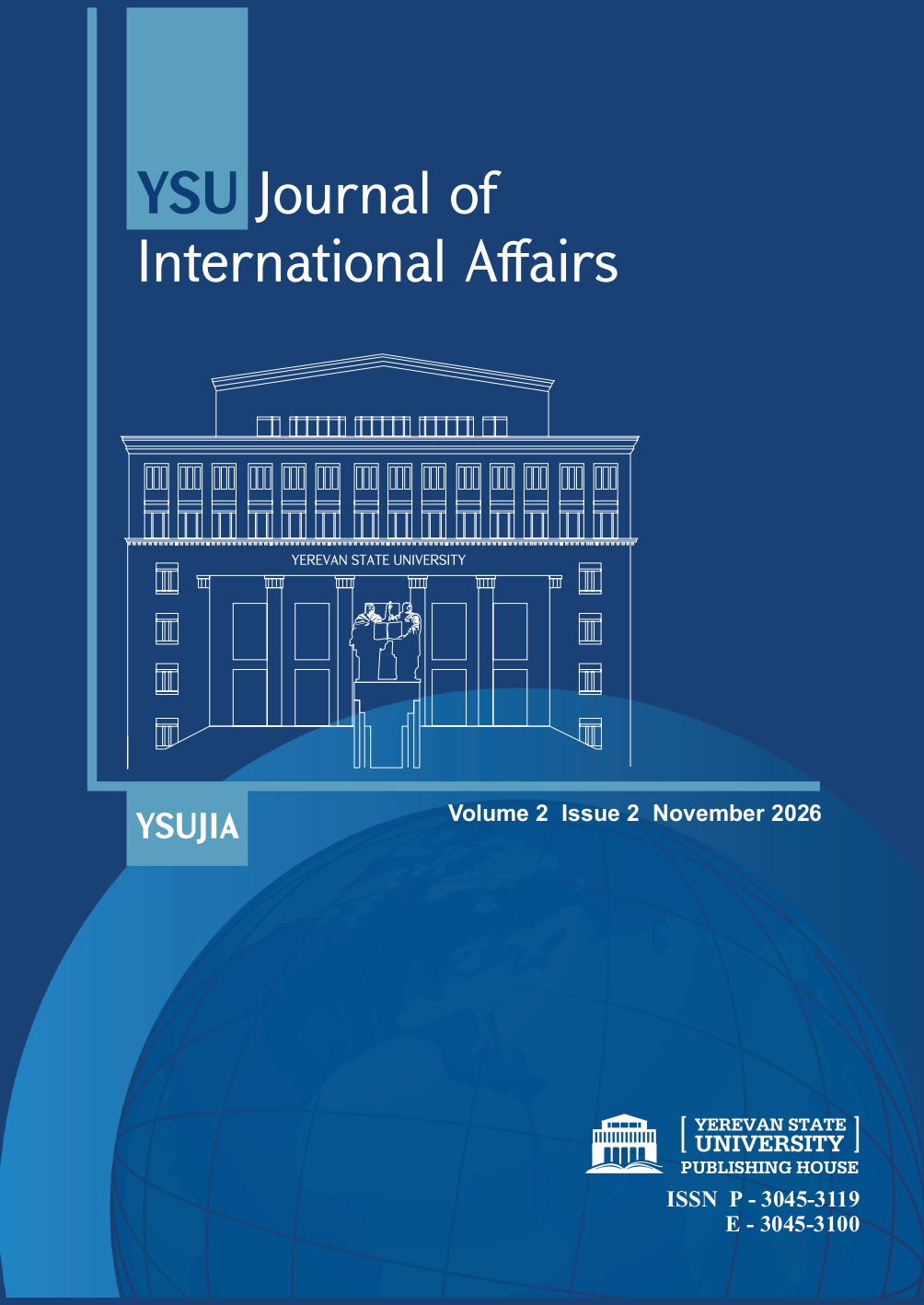
The YSU Journal of International Affairs (YSUJIA) is a peer-reviewed academic journal fostering debate and dialogue on international affairs across humanities and social sciences, including international relations, international history, international law, international political economy, diplomacy, and foreign policies. It aims to link scholars and policymakers while encouraging innovative, interdisciplinary contributions that broaden the scope of current scholarship.
This discussion article examines whether Europe can emerge as a major global power amid profound changes in the international security environment. It argues that the European Union’s capacity to assume greater geopolitical responsibility is shaped by four interrelated developments: Europe’s longstanding structural dependence on the United States and NATO; Washington’s strategic reorientation toward great-power competition, particularly with China; the growing erosion of the liberal international order; and internal political and institutional challenges within the European Union. Against this background, the article explores the increasingly prominent concept of European strategic autonomy. Rather than interpreting autonomy as political or military emancipation from the United States, it presents it as the capacity of European states to act strategically, assume greater responsibility for their security, and exercise greater freedom in defining objectives and choosing partners while preserving the transatlantic relationship. The article discusses both the opportunities and constraints associated with this trajectory, including European military capabilities, defense cooperation, nuclear deterrence, political cohesion, and decision-making mechanisms. It concludes that the European Union possesses significant economic, diplomatic, and emerging military capabilities, but that its transformation into a fully autonomous great power remains constrained by institutional fragmentation, resource limitations, and continued reliance on the United States.
Consolidated Version of the Treaty on European Union. Official Journal of the European Union C 202 (June 7, 2016): 13–46. https://eur-lex.europa.eu/eli/treaty/teu_2016/oj/eng.
Council of the European Union. Council Decision (CFSP) 2022/338 of 28 February 2022 on an Assistance Measure under the European Peace Facility for the Supply to the Ukrainian Armed Forces of Military Equipment, and Platforms, Designed to Deliver Lethal Force. Official Journal of the European Union L 60 (February 28, 2022): 1–4. https://eur-lex.europa.eu/eli/dec/2022/338/oj/eng.
Council of the European Union. “European Defence Industry Programme: Council Gives Final Approval.” December 8, 2025. https://www.consilium.europa.eu/en/press/press-releases/2025/12/08/european-defence-industry-programme-council-gives-final-approval/.
European Union. Shared Vision, Common Action: A Stronger Europe. A Global Strategy for the European Union’s Foreign and Security Policy. June 2016. https://www.eeas.europa.eu/sites/default/files/eugs_review_web_0.pdf.
Macron, Emmanuel. “Speech by the President of the Republic on France’s Nuclear Deterrence.” Île Longue, March 2, 2026. Élysée. https://www.elysee.fr/en/emmanuel-macron/2026/03/02/visit-to-the-ile-longue-operational-base.
North Atlantic Treaty. Signed April 4, 1949. https://www.nato.int/en/about-us/official-texts-and-resources/official-texts/1949/04/04/the-north-atlantic-treaty.
United Nations General Assembly. “Aggression against Ukraine.” Resolution ES-11/1. March 2, 2022. https://docs.un.org/A/RES/ES-11/1.
Zakaria, Fareed. “We Are Witnessing the End of the ‘Pax Americana.’ Russia, Which Has the World’s Largest Nuclear Arsenal, Is Challenging America Head-On.” Interview by Marc-Olivier Bherer. Le Monde, May 2, 2022. In French: [Zakaria, Fareed. “Nous assistons à la fin de la ‘pax americana’. La Russie, qui dispose du plus grand arsenal nucléaire au monde, défie l’Amérique de manière frontale.” Propos recueillis par Marc-Olivier Bherer. Le Monde, 2 mai 2022]. https://www.lemonde.fr/idees/article/2022/05/02/guerre-en-ukraine-nous-avons-quitte-l-ancien-monde-dans-lequel-l-economie-a-pendant-trente-ans-domine-le-politique_6124404_3232.html.
This article analyzes the conditions under which the European Union can convert its considerable demographic, economic, technological, institutional and military potential into the capacity to provide security autonomously. The point of departure is the shifting transatlantic division of responsibilities, driven by the growing salience of the Indo-Pacific in US strategy, the return of high-intensity warfare to Europe and mounting pressure on European defense readiness. Drawing on a qualitative analysis of EU strategic documents and selected official external sources, the article introduces the category of a resource-conversion deficit. The concept explains the disparity between Europe’s aggregate resources and its ability to align them politically, coordinate them institutionally and employ them operationally. The second element of the contribution involves treating values as a conditional strategic resource. They constrain the EU’s short-term flexibility but, when supported by adequate material capabilities and consistent practice, they enhance the predictability, legitimacy and durability of the security provided. Strategic autonomy is presented as the development of European agency within the transatlantic system.
Consolidated Version of the Treaty on European Union. Official Journal of the European Union C 202 (June 7, 2016). https://eur-lex.europa.eu/legal-content/EN/TXT/PDF/?uri=CELEX%3A12016M%2FTXT.
Council of the European Union. A Strategic Compass for Security and Defence – For a European Union That Protects Its Citizens, Values and Interests and Contributes to International Peace and Security. Doc. 7371/22. Brussels, March 21, 2022. https://data.consilium.europa.eu/doc/document/ST-7371-2022-INIT/en/pdf.
Della Sala, Vincent. “Narrating Europe: The EU’s Ontological Security Dilemma.” European Security 27, no. 3 (2018): 266–79. https://doi.org/10.1080/09662839.2018.1497978.
Desmaele, Linde. “America’s ‘China-First’ Grand Strategy and the Transatlantic Bargain: Revisiting the Security–Economics Nexus.” International Politics (published online May 27, 2024): 1–18. https://doi.org/10.1057/s41311-024-00577-6.
European Commission and High Representative of the Union for Foreign Affairs and Security Policy. Joint White Paper for European Defence Readiness 2030. JOIN(2025) 120 final. Brussels, March 19, 2025. https://commission.europa.eu/document/download/e6d5db69-e0ab-4bec-9dc0-3867b4373019_en.
European Commission and High Representative of the Union for Foreign Affairs and Security Policy. Preserving Peace – Defence Readiness Roadmap 2030. JOIN(2025) 27 final. Brussels, October 16, 2025. https://commission.europa.eu/document/download/56143695-ed00-4a70-a1de-c97e0b05ff07_en.
European Defence Agency. Defence Data 2025–2026. Brussels: European Defence Agency, 2026. https://eda.europa.eu/docs/default-source/eda-publications/2026-eda_defencedata_webpublic.pdf.
European External Action Service. 2026 Annual Progress Report on the Implementation of the Strategic Compass for Security and Defence. Brussels, June 5, 2026. https://www.eeas.europa.eu/eeas/2026-annual-progress-report-implementation-strategic-compass-security-and-defence_en.
European Union. Shared Vision, Common Action: A Stronger Europe. A Global Strategy for the European Union’s Foreign and Security Policy. Brussels, June 2016. https://www.eeas.europa.eu/sites/default/files/eugs_review_web_0.pdf.
Eurostat. “Population on 1 January.” Online data code tps00001. https://doi.org/10.2908/tps00001.
Helwig, Niklas. “The Ambiguity of the EU’s Global Role: A Social Explanation of the Term ‘Strategic Autonomy’.” European Foreign Affairs Review 27, special issue (2022): 21–38. https://doi.org/10.54648/EERR2022010.
Helwig, Niklas, and Ville Sinkkonen. “Strategic Autonomy and the EU as a Global Actor: The Evolution, Debate and Theory of a Contested Term.” European Foreign Affairs Review 27, special issue (2022): 1–20. https://doi.org/10.54648/EERR2022009.
Hill, Christopher. “The Capability–Expectations Gap, or Conceptualizing Europe’s International Role.” Journal of Common Market Studies 31, no. 3 (1993): 305–28. https://doi.org/10.1111/j.1468-5965.1993.tb00466.x.
Hyde-Price, Adrian. “‘Normative’ Power Europe: A Realist Critique.” Journal of European Public Policy 13, no. 2 (2006): 217–34. https://doi.org/10.1080/13501760500451634.
Juncos, Ana E., and Sophie Vanhoonacker. “The Ideational Power of Strategic Autonomy in EU Security and External Economic Policies.” Journal of Common Market Studies 62, no. 4 (2024): 955–72. https://doi.org/10.1111/jcms.13597.
Jupille, Joseph, and James A. Caporaso. “States, Agency, and Rules: The European Union in Global Environmental Politics.” In The European Union in the World Community, edited by Carolyn Rhodes, 213–30. Boulder, CO: Lynne Rienner, 1998. https://doi.org/10.1515/9781685854485-012.
Knutsen, Bjørn Olav. “A Weakening Transatlantic Relationship? Redefining the EU–US Security and Defence Cooperation.” Politics and Governance 10, no. 2 (2022): 165–75. https://doi.org/10.17645/pag.v10i2.5024.
Lindvall, Johannes, Magnus Lundgren, and Jan Teorell. “Projecting Power at Home and Abroad: Domestic State Capacity and Military Capability.” Journal of Peace Research 63, no. 4 (2026): 507–20. https://doi.org/10.1093/jopres/xjaf018.
Lundestad, Geir. “Empire by Invitation? The United States and Western Europe, 1945–1952.” Journal of Peace Research 23, no. 3 (1986): 263–77. https://doi.org/10.1177/002234338602300305.
Manners, Ian. “Normative Power Europe: A Contradiction in Terms?” Journal of Common Market Studies 40, no. 2 (2002): 235–58. https://doi.org/10.1111/1468-5965.00353.
Michalski, Anna, and Charles F. Parker. “The EU’s Evolving Leadership Role in an Age of Geopolitics: Beyond Normative and Market Power in the Indo-Pacific.” European Journal of International Security 9, no. 2 (2024): 263–80. https://doi.org/10.1017/eis.2023.34.
Ministry of Foreign Affairs of the People’s Republic of China. China’s Policy Paper on the European Union. December 2018. https://www.mfa.gov.cn/mfa_eng/zy/gb/202405/t20240531_11367378.html.
Ministry of Foreign Affairs of the People’s Republic of China. The Global Security Initiative Concept Paper. February 21, 2023. https://www.mfa.gov.cn/mfa_eng/zy/gb/202405/t20240531_11367484.html.
Ministry of Foreign Affairs of the People’s Republic of China. “Xi Jinping Has a Phone Call with President of the European Council António Costa.” January 14, 2025. https://www.mfa.gov.cn/mfa_eng/xw/zyxw/202501/t20250115_11534500.html.
Ministry of Foreign Affairs of the Russian Federation. The Concept of the Foreign Policy of the Russian Federation. Approved March 31, 2023. https://mid.ru/en/foreign_policy/fundamental_documents/1860586/.
Mitzen, Jennifer. “Anchoring Europe’s Civilizing Identity: Habits, Capabilities and Ontological Security.” Journal of European Public Policy 13, no. 2 (2006): 270–85. https://doi.org/10.1080/13501760500451709.
Rauh, Christian. “International Recognition of European Union ‘Actorness’: Language-Based Evidence from United Nations General Debate Speeches 1970–2020.” International Interactions 51, no. 5 (2025): 792–821. https://doi.org/10.1080/03050629.2025.2530513.
Skare, Erik. “Staying Safe by Being Good? The EU’s Normative Decline as a Security Actor in the Middle East.” European Journal of International Security 8, no. 3 (2023): 337–53. https://doi.org/10.1017/eis.2022.29.
Tellis, Ashley J., Janice Bially, Christopher Layne, and Melissa McPherson. Measuring National Power in the Postindustrial Age. Santa Monica, CA: RAND Corporation, 2000. https://doi.org/10.7249/MR1110.
United States. 2026 National Defense Strategy. Washington, DC, 2026. https://media.defense.gov/2026/Jan/23/2003864773/-1/-1/0/2026-NATIONAL-DEFENSE-STRATEGY.PDF.
Varma, Tara. “European Strategic Autonomy: The Path to a Geopolitical Europe.” The Washington Quarterly 47, no. 1 (2024): 65–83. https://doi.org/10.1080/0163660X.2024.2327820.
White House. “America First Policy Directive to the Secretary of State.” January 20, 2025. https://www.whitehouse.gov/presidential-actions/2025/01/america-first-policy-directive-to-the-secretary-of-state/.
Yang, Na. “How China Perceives European Strategic Autonomy: Asymmetric Expectations and Pragmatic Engagement.” The Chinese Journal of International Politics 16, no. 4 (2023): 482–505. https://doi.org/10.1093/cjip/poad014.
This paper analyzes the evolution of Japan’s foreign policy toward the South Caucasus region since the dissolution of the Soviet Union. It argues that Japan’s regional engagement has evolved through four phases: ad hoc humanitarian assistance (1991–1996); the resource-driven pivot of Hashimoto’s Eurasian Diplomacy (1997–2005); the values-based framing of Asō’s Arc of Freedom and Prosperity (2006–2017); and Kōno’s Caucasus Initiative (2018–present), which frames the South Caucasus as a transport “linchpin” and “gateway” connecting Asia and Europe within the Free and Open Indo-Pacific (FOIP) vision. Drawing on Diplomatic Bluebooks and official development assistance (ODA) records, the article maps this trajectory onto a two-by-two matrix of rhetoric and substantive action. While Tokyo’s rhetoric has become regional and geostrategic, its actions have remained bilateral: energy-centric loans in Azerbaijan, connectivity infrastructure in Georgia, and capacity building in Armenia. This gap is institutional rather than a question of political will. The article asks whether the Takaichi administration’s economic security agenda can close this gap or leave engagement with the region governed by inherited bilateral instruments.
Asō, Tarō. “Arc of Freedom and Prosperity: Japan’s Expanding Diplomatic Horizons.” Speech on the occasion of the Japan Institute of International Affairs Seminar, Tokyo, November 30, 2006. Ministry of Foreign Affairs of Japan. https://www.mofa.go.jp/announce/fm/aso/speech0611.html.
Goginashvili, David. “Japan’s Foreign Policy Towards the South Caucasus States: Policy of ‘Low-Relevance and High Purpose’ on the Crossroad Between Russian and Western Interests.” Journal Global Policy and Governance 5, no. 2 (2016): 51–66. https://doi.org/10.14666/2194-7759-5-2-004.
Hashimoto, Ryūtarō. “Address to the Japan Association of Corporate Executives: The Future Direction of Japan’s Foreign Policy, Focusing on Relations with Russia.” July 24, 1997. Japanese text reproduced in The World and Japan Database. https://worldjpn.net/documents/texts/exdpm/19970724.S1J.html.
Hirose, Tetsuya. “Tai Chūō Ajia gaikō no gaikan: Jitsumu reberu de no seisaku ritsuan-sha no shiten kara” [An Overview of Diplomacy towards Central Asia: From the Perspective of a Working-Level Policymaker]. In Nihon no Chūō Ajia gaikō: Tamesareru chiiki senryaku [Japan’s Central Asian Diplomacy: A Regional Strategy Put to the Test], edited by Tomohiko Uyama, Christopher Len, and Tetsuya Hirose. Sapporo: Hokkaido Daigaku Shuppankai, 2009.
Hirose, Yōko. “Minami Kōkasasu to ‘hazama no chiseigaku’” [The South Caucasus and the ‘Geopolitics of the In-Between’]. In Yūrashia dainamizumu to Nihon [Eurasian Dynamism and Japan], edited by the Japan Forum on International Relations, supervised by Hirotaka Watanabe. Tokyo: Chuo Koron Shinsha, 2022.
Inazawa, Kenichi. FY2015 Ex-Post Evaluation of Japanese ODA Loan: Yerevan Combined Cycle Co-Generation Power Plant Project. Japan International Cooperation Agency, n.d. Accessed October 16, 2026. https://www2.jica.go.jp/en/evaluation/pdf/2015_ARM-P2_4_f.pdf.
Institute of Developing Economies, JETRO. “Ajia dōkō nenpō jūyō nisshi kensaku shisutemu” [Asian Trends Annual Report: Important Events Database]. Accessed August 26, 2026. https://d-arch.ide.go.jp/Doukou/AZ1990.html.
Ishimori, Koichiro. Ex-Post Evaluation of Japanese ODA Grant Aid Project: The Project for Improvement of Fire Fighting Equipment in Yerevan City. Japan International Cooperation Agency, n.d. Accessed October 16, 2026. https://www2.jica.go.jp/en/evaluation/pdf/2013_0867940_4_f.pdf.
Japan Forum on International Relations, ed. Yūrashia dainamizumu to Nihon [Eurasian Dynamism and Japan]. Supervised by Hirotaka Watanabe. Tokyo: Chuo Koron Shinsha, 2022.
Japan International Cooperation Agency. “Armenia × Gunma × Digital: TUMO Gunma, a Partnership between Armenia’s TUMO Center and Gunma Prefecture, Has Opened.” June 2, 2025. https://www.jica.go.jp/information/seminar/2025/1569394_66420.html.
Japan International Cooperation Agency. Ex-Ante Evaluation (for Japanese ODA Loan): Provincial Cities Water Supply and Sewerage Project. 2009. https://www2.jica.go.jp/en/evaluation/pdf/2009_AZB-P4_1_f.pdf.
Japan International Cooperation Agency. “Signing of Japanese ODA Loan Agreement with Georgia: Eliminating a Logistics Impediment and Contributing to Strengthened Transportation Capacity through Improvement of a Major International Corridor.” September 4, 2018. https://www2.jica.go.jp/yen_loan/pdf/en/6975/20180904_01.pdf.
Japan International Cooperation Agency. “Signing of Japanese ODA Loan Agreement with Georgia: Road Infrastructure to Assist with Regional Economic Development and Post-war Rehabilitation.” December 17, 2009. https://www2.jica.go.jp/yen_loan/pdf/en/5978/20091217.pdf.
Japan International Cooperation Agency. “Signing of Japanese ODA Loan Agreement with Georgia: Strengthening Competitiveness as a Regional Logistics Hub by Improving an International Corridor.” March 8, 2016. https://www2.jica.go.jp/yen_loan/pdf/en/6671/20160308.pdf.
Kawato, Akio. “Tai Chūō Ajia seisaku no suii: ‘Shirukurōdo gaikō’ kara ‘Chūō Ajia purasu Nihon’ e” [The Transition of Central Asian Policy: From ‘Silk Road Diplomacy’ to ‘Central Asia Plus Japan’]. In Nihon no Chūō Ajia gaikō: Tamesareru chiiki senryaku [Japan’s Central Asian Diplomacy: A Regional Strategy Put to the Test], edited by Tomohiko Uyama, Christopher Len, and Tetsuya Hirose. Sapporo: Hokkaido Daigaku Shuppankai, 2009.
Kōno, Tarō. “Minister Taro Kono: It Is an Honor for Me to Contribute to Further Development of Azerbaijan-Japan Relations.” AZERTAC, September 5, 2018. Reproduced by the Ministry of Foreign Affairs of Japan. https://www.mofa.go.jp/files/000396796.pdf.
Len, Christopher. “Nihon no Chūō Ajia ni taisuru kanyo o dō rikai suru ka: Kaihatsu senryaku no saihyōka” [Understanding Japan’s Central Asian Engagement: A Reassessment of Development Strategy]. In Nihon no Chūō Ajia gaikō: Tamesareru chiiki senryaku [Japan’s Central Asian Diplomacy: A Regional Strategy Put to the Test], edited by Tomohiko Uyama, Christopher Len, and Tetsuya Hirose, 39–54. Translated by Masaru Suda. Sapporo: Hokkaido Daigaku Shuppankai, 2009.
Ministry of Foreign Affairs of Japan. “Chiikibetsu enjo no dōkō” [Trends in Assistance by Region]. In Wagakuni no seifu kaihatsu enjo no jisshi jōkyō (1997-nendo) ni kansuru nenji hōkoku [Annual Report on the Implementation of Japan’s Official Development Assistance (FY1997)]. 1998. https://www.mofa.go.jp/mofaj/gaiko/oda/shiryo/hakusyo/nenji97/nji97_2.html#2_1_3.
Ministry of Foreign Affairs of Japan. “Diplomatic Bluebook.” Japanese-language archive. Accessed October 16, 2026. https://www.mofa.go.jp/mofaj/gaiko/bluebook/index.html.
Ministry of Foreign Affairs of Japan. “Japan-Armenia Foreign Ministers’ Meeting.” September 3, 2018. https://www.mofa.go.jp/erp/ca_c/am/page6e_000137.html.
Ministry of Foreign Affairs of Japan. “Japan-Georgia Foreign Ministers’ Meeting.” September 4, 2018. https://www.mofa.go.jp/erp/ca_c/ge/page6e_000136.html.
Ministry of Foreign Affairs of Japan. Japan’s Caucasus Initiative. 2018. https://www.mofa.go.jp/files/000436761.pdf.
Ministry of Foreign Affairs of Japan. “Japan’s ODA Data by Country.” Accessed August 26, 2026. https://www.mofa.go.jp/policy/oda/data/index.html.
Ministry of Foreign Affairs of Japan. “Kōkasasu kakkoku to no gaikō kankei juritsu sanjū-shūnen ni saisuru shunō-kan oyobi gaishō-kan no shokan no kōkan ni tsuite” [Exchange of Letters between Leaders and Foreign Ministers on the Occasion of the 30th Anniversary of the Establishment of Diplomatic Relations with the Caucasus Countries]. September 28, 2022. https://www.mofa.go.jp/mofaj/erp/ca_c/shin4_000064.html.
Ministry of Foreign Affairs of Japan. “Kōno gaimu daijin no Arumenia, Jōjia, Azerubaijan oyobi Doitsu hōmon” [Foreign Minister Kōno’s Visit to the Three Caucasus Countries and Germany]. September 6, 2018. https://www.mofa.go.jp/mofaj/erp/ca_c/page24_000954.html.
Ministry of Foreign Affairs of Japan. Seifu kaihatsu enjo (ODA): Kunibetsu dēta bukku 2002 [Official Development Assistance (ODA): Databook by Country 2002]. 2002. https://www.mofa.go.jp/mofaj/gaiko/oda/shiryo/kuni/02_databook/caj/top_caj.html.
Ministry of Foreign Affairs of Japan. Seifu kaihatsu enjo (ODA): Kunibetsu dēta bukku 2004 [Official Development Assistance (ODA): Databook by Country 2004]. 2004. https://www.mofa.go.jp/mofaj/gaiko/oda/shiryo/kuni/04_databook/03_c_asia/c_asia_06/c_asia_06_t08.html.
Ministry of Foreign Affairs of Japan. “The Updated ‘Free and Open Indo-Pacific (FOIP).’” May 2, 2026. https://www.mofa.go.jp/policy/pageite_000001_01612.html.
Ministry of Foreign Affairs of Japan. Wagakuni no seifu kaihatsu enjo no jisshi jōkyō (1997-nendo) ni kansuru nenji hōkoku [Annual Report on the Implementation of Japan’s Official Development Assistance (FY1997)]. 1998. https://www.mofa.go.jp/mofaj/gaiko/oda/shiryo/hakusyo/nenji97/index.html.
Obuchi, Keizō. “Dai 53-kai Kokuren Sōkai ni okeru Obuchi sōri daijin ippan tōron enzetsu: Fukudai Heiwa to kaihatsu, sono tame no kaikaku” [Address by Prime Minister Keizō Obuchi at the 53rd Session of the General Assembly of the United Nations: Peace and Development, and Reforms to These Ends]. September 21, 1998. Ministry of Foreign Affairs of Japan. https://www.mofa.go.jp/mofaj/press/enzetsu/10/eos_0921.html.
Overseas Economic Cooperation Fund. “First Yen Loan to Georgia: Japan Assists Modernization of Two Hydro-Power Plants.” January 19, 1998. https://www2.jica.go.jp/yen_loan/pdf/en/4637/19980119.pdf.
Takahashi, Hisae. FY2019 Ex-Post Evaluation of Japanese ODA Loan: Shimal Gas Combined Cycle Power Plant Project (Second Unit). Japan International Cooperation Agency, n.d. Accessed October 16, 2026. https://www2.jica.go.jp/en/evaluation/pdf/2019_AZB-P3_4_f.pdf.
Takahata, Yōhei. “‘Yūrashia gaikō’ to iu Nihon no sentaku” [Japan’s Choice of ‘Eurasian Diplomacy’]. In Yūrashia dainamizumu to Nihon [Eurasian Dynamism and Japan], edited by the Japan Forum on International Relations, supervised by Hirotaka Watanabe, 129–61. Tokyo: Chuo Koron Shinsha, 2022.
Takaichi, Sanae. “Press Conference by Prime Minister Takaichi.” December 17, 2025. Prime Minister’s Office of Japan. https://japan.kantei.go.jp/104/statement/202512/17kaiken.html.
Uyama, Tomohiko. “Tai Chūō Ajia gaikō no rekishiteki bunmyaku to tenbō: Ajia shugi to Nichibei kankei no hazama de” [The Historical Context and Outlook of Central Asian Diplomacy: Between Asianism and Japan-US Relations]. In Nihon no Chūō Ajia gaikō: Tamesareru chiiki senryaku [Japan’s Central Asian Diplomacy: A Regional Strategy Put to the Test], edited by Tomohiko Uyama, Christopher Len, and Tetsuya Hirose. Sapporo: Hokkaido Daigaku Shuppankai, 2009.
Uyama, Tomohiko, Christopher Len, and Tetsuya Hirose. “Jo” [Introduction]. In Nihon no Chūō Ajia gaikō: Tamesareru chiiki senryaku [Japan’s Central Asian Diplomacy: A Regional Strategy Put to the Test], edited by Tomohiko Uyama, Christopher Len, and Tetsuya Hirose. Sapporo: Hokkaido Daigaku Shuppankai, 2009.
Uyama, Tomohiko, Christopher Len, and Tetsuya Hirose, eds. Nihon no Chūō Ajia gaikō: Tamesareru chiiki senryaku [Japan’s Central Asian Diplomacy: A Regional Strategy Put to the Test]. Sapporo: Hokkaido Daigaku Shuppankai, 2009.
Vasilyan, Syuzanna. “Japan’s Policy towards the South Caucasus: Pragmatic Even If Enigmatic.” Asia Europe Journal 15, no. 1 (2017): 55–73. https://doi.org/10.1007/s10308-016-0462-1.
The changing international order has altered how the United States exercises global power. This article examines how the US strategic priorities have adapted to the diffusion of military, economic, technological, and institutional power and asks whether contemporary policy represents a restoration of post-Cold War primacy or an adaptation of American leadership to a more competitive international system. Drawing on realist and liberal institutionalist perspectives and soft power, the article develops the concept of “transformed hegemony.” Using qualitative comparative case analysis and process tracing, it examines US support for Ukraine, NATO enlargement and burden-sharing, and US controls on strategically significant technologies and outbound investment involving China. The analysis finds that US influence increasingly operates through alliance mobilization, institutional coordination, economic statecraft, technological regulation, and diplomatic networks rather than through unilateral action alone. These mechanisms convert US capabilities into collective strategic capacity while distributing costs among allies and partners. At the same time, their effectiveness is conditional on allied cohesion, technological leadership, domestic political continuity, and the responses of competing states. The article concludes that US strategy is better understood as a networked and adaptive form of strategic primacy than as a restoration of classical unipolar hegemony.
Acharya, Amitav. “After Liberal Hegemony: The Advent of a Multiplex World Order.” Ethics & International Affairs 31, no. 3 (Fall 2017): 271–85. https://doi.org/10.1017/S089267941700020X.
Allen, Gregory C. Understanding the Biden Administration’s Updated Export Controls. Washington, DC: Center for Strategic and International Studies, December 11, 2024. https://www.csis.org/analysis/understanding-biden-administrations-updated-export-controls.
Baldwin, David A. “Power Analysis and World Politics: New Trends versus Old Tendencies.” World Politics 31, no. 2 (January 1979): 161–94. https://doi.org/10.2307/2009941.
Barnett, Michael, and Raymond Duvall. “Power in International Politics.” International Organization 59, no. 1 (Winter 2005): 39–75. https://doi.org/10.1017/S0020818305050010.
Brooke-Holland, Louisa. NATO Enlargement: Finland and Sweden. Research Briefing 9574. London: House of Commons Library, March 11, 2024. https://researchbriefings.files.parliament.uk/documents/CBP-9574/CBP-9574.pdf.
Brooks, Stephen G., and William C. Wohlforth. “The Rise and Fall of the Great Powers in the Twenty-First Century: China’s Rise and the Fate of America’s Global Position.” International Security 40, no. 3 (Winter 2015/16): 7–53. https://doi.org/10.1162/ISEC_a_00225.
Clark, Joseph. “Biden Meets with Fellow NATO Leaders at Washington Summit.” US Department of Defense, July 10, 2024. https://www.defense.gov/News/News-Stories/Article/Article/3834908/.
Collier, David. “Understanding Process Tracing.” PS: Political Science & Politics 44, no. 4 (October 2011): 823–30. https://doi.org/10.1017/S1049096511001429.
Farrell, Henry, and Abraham L. Newman. “Weaponized Interdependence: How Global Economic Networks Shape State Coercion.” International Security 44, no. 1 (Summer 2019): 42–79. https://doi.org/10.1162/isec_a_00351.
George, Alexander L., and Andrew Bennett. Case Studies and Theory Development in the Social Sciences. Cambridge, MA: MIT Press, 2005.
Hafner-Burton, Emilie M., Miles Kahler, and Alexander H. Montgomery. “Network Analysis for International Relations.” International Organization 63, no. 3 (Summer 2009): 559–92. https://doi.org/10.1017/S0020818309090195.
Ikenberry, G. John. “Liberal Internationalism 3.0: America and the Dilemmas of Liberal World Order.” Perspectives on Politics 7, no. 1 (March 2009): 71–87. https://doi.org/10.1017/S1537592709090112.
Ikenberry, G. John. Liberal Leviathan: The Origins, Crisis, and Transformation of the American World Order. Princeton, NJ: Princeton University Press, 2011.
Kiel Institute for the World Economy. “Ukraine Support after 3 Years of War: Aid Flows Remain Low but Steady—Shift towards Weapons Procurement.” February 14, 2025. https://www.kielinstitut.de/media/news/ukraine-support-after-3-years-of-war-aid-flows-remain-low-but-steady-shift-towards-weapons-procurement/.
Mazarr, Michael J., and Ivana Ke. Integrated Deterrence as a Defense Planning Concept. PE-A2263-1. Santa Monica, CA: RAND Corporation, June 2024. https://doi.org/10.7249/PEA2263-1.
Mearsheimer, John J. The Tragedy of Great Power Politics. New York: W. W. Norton & Company, 2001.
NATO. “Finland Joins NATO as 31st Ally.” April 4, 2023. https://www.nato.int/en/news-and-events/articles/news/2023/04/04/finland-joins-nato-as-31st-ally.
NATO. NATO 2022 Strategic Concept. Brussels: NATO, 2022. https://www.nato.int/content/dam/nato/webready/documents/publications-and-reports/strategic-concepts/2022/290622-strategic-concept.pdf.
NATO. The Secretary General’s Annual Report 2024. Brussels: NATO, April 2025. https://www.nato.int/content/dam/nato/legacy-wcm/media_pdf/2025/4/pdf/sgar24-en.pdf.
NATO. “Sweden Officially Joins NATO.” March 7, 2024. https://www.nato.int/en/news-and-events/articles/news/2024/03/07/sweden-officially-joins-nato.
NATO. “Washington Summit Declaration.” July 10, 2024. https://www.nato.int/en/about-us/official-texts-and-resources/official-texts/2024/07/10/washington-summit-declaration.
NATO Allied Command Transformation. “Advancing NATO-Ukraine Defence Cooperation and Interoperability.” May 30, 2025. https://www.act.nato.int/article/nsatu-jatec/.
Nye, Joseph S., Jr. The Future of Power. New York: PublicAffairs, 2011.
Nye, Joseph S., Jr. “Soft Power and American Foreign Policy.” Political Science Quarterly 119, no. 2 (Summer 2004): 255–70. https://doi.org/10.2307/20202345.
Nye, Joseph S., Jr. Soft Power: The Means to Success in World Politics. New York: PublicAffairs, 2004.
Seawright, Jason, and John Gerring. “Case Selection Techniques in Case Study Research: A Menu of Qualitative and Quantitative Options.” Political Research Quarterly 61, no. 2 (June 2008): 294–308. https://doi.org/10.1177/1065912907313077.
Simón, Luis, Alexander Lanoszka, and Hugo Meijer. “Nodal Defence: The Changing Structure of U.S. Alliance Systems in Europe and East Asia.” Journal of Strategic Studies 44, no. 3 (2021): 360–88. https://doi.org/10.1080/01402390.2019.1636372.
Slaughter, Anne-Marie. “America’s Edge: Power in the Networked Century.” Foreign Affairs 88, no. 1 (January/February 2009): 94–113. https://www.jstor.org/stable/20699436.
Snyder, Glenn H. “The Security Dilemma in Alliance Politics.” World Politics 36, no. 4 (July 1984): 461–95. https://doi.org/10.2307/2010183.
Stoltenberg, Jens. “Press Conference.” NATO, July 10, 2024. https://www.nato.int/en/news-and-events/events/transcripts/2024/07/10/press-conference.
Sullivan, Jake. “Remarks by National Security Advisor Jake Sullivan on Renewing American Economic Leadership at the Brookings Institution.” The White House, April 27, 2023. https://bidenwhitehouse.archives.gov/briefing-room/speeches-remarks/2023/04/27/remarks-by-national-security-advisor-jake-sullivan-on-renewing-american-economic-leadership-at-the-brookings-institution/.
Sullivan, Jake. “The Sources of American Power: A Foreign Policy for a Changed World.” Foreign Affairs 102, no. 6 (November/December 2023): 8–29. https://www.foreignaffairs.com/united-states/sources-american-power-biden-jake-sullivan.
Sutter, Karen M. U.S. Export Controls and China: Advanced Semiconductors. CRS Report R48642. Washington, DC: Congressional Research Service, August 22, 2025. https://www.congress.gov/crs_external_products/R/PDF/R48642/R48642.2.pdf.
US Department of Commerce, Bureau of Industry and Security. “Commerce Strengthens Export Controls to Restrict China’s Capability to Produce Advanced Semiconductors for Military Applications.” December 2, 2024. https://media.bis.gov/press-release/commerce-strengthens-export-controls-restrict-chinas-capability-produce-advanced-semiconductors-military.
US Department of Defense. 2022 National Defense Strategy of the United States of America. Washington, DC: US Department of Defense, October 27, 2022. https://media.defense.gov/2022/Oct/27/2003103845/-1/-1/1/2022-NATIONAL-DEFENSE-STRATEGY-NPR-MDR.PDF.
US Department of State, Bureau of Political-Military Affairs. “U.S. Security Cooperation with Ukraine.” January 9, 2025. https://2021-2025.state.gov/bureau-of-political-military-affairs/releases/2025/01/u-s-security-cooperation-with-ukraine/.
US Department of the Treasury. The Treasury 2021 Sanctions Review. Washington, DC: US Department of the Treasury, October 2021. https://home.treasury.gov/system/files/136/Treasury-2021-sanctions-review.pdf.
US Department of the Treasury. “Treasury Issues Regulations to Implement Executive Order Addressing U.S. Investments in Certain National Security Technologies and Products in Countries of Concern.” October 28, 2024. https://home.treasury.gov/news/press-releases/jy2687.
US Government Accountability Office. Ukraine: U.S. Agencies Should Improve Tracking of Authorized U.S.-Origin Defense Article Transfers Requested by Foreign Donors. GAO-24-106745. Washington, DC: US Government Accountability Office, August 2024. https://www.gao.gov/assets/gao-24-106745.pdf.
Wallander, Celeste A. “Institutional Assets and Adaptability: NATO after the Cold War.” International Organization 54, no. 4 (Autumn 2000): 705–35. https://doi.org/10.1162/002081800551343.
The White House. National Security Strategy. Washington, DC: The White House, October 2022. https://bidenwhitehouse.archives.gov/wp-content/uploads/2022/10/Biden-Harris-Administrations-National-Security-Strategy-10.2022.pdf.
Wilson, Ernest J., III. “Hard Power, Soft Power, Smart Power.” The Annals of the American Academy of Political and Social Science 616, no. 1 (March 2008): 110–24. https://doi.org/10.1177/0002716207312618.
Wohlforth, William C. “The Stability of a Unipolar World.” International Security 24, no. 1 (Summer 1999): 5–41. https://doi.org/10.1162/016228899560031.
Wright, Thomas. All Measures Short of War: The Contest for the Twenty-First Century and the Future of American Power. New Haven, CT: Yale University Press, 2017.
Climate change is one of the most pressing global challenges facing humanity today, affecting all countries, particularly vulnerable developing nations. Although international climate finance mechanisms have evolved over the years, their scale and effectiveness remain inadequate to address the growing impacts of the climate crisis. The BRICS New Development Bank (NDB) represents a significant departure from traditional climate finance structures, offering an alternative approach to climate governance through its focus on development and sustainability. Established by Brazil, Russia, India, China, and South Africa, the NDB aims to promote sustainable economic growth by catalyzing investment in renewable energy, green infrastructure, and climate-resilient projects. Grounded in an integrated framework combining global governance theory, climate finance architecture, and systemic ecological pressures, this study examines the NDB’s role in reshaping multilateral climate governance. It evaluates the Bank’s operational effectiveness in terms of institutional agility, mobilization of nonconcessional and local-currency resources, and alignment with national development priorities, with particular attention to South–South financial cooperation.
Abdenur, Adriana Erthal. “Climate and Security: BRICS and the Global South.” SAGE Open 7, no. 3 (2017): 1–12.
Andronova, Inna V., and Andrey V. Shelepov. “Potential for Strengthening the NDB’s and AIIB’s Role in the Global Financial System.” International Organisations Research Journal 14, no. 1 (2019): 39–54. In Russian: [Андронова И. В., Шелепов А. В. “Возможности усиления влияния НБР и АБИИ в глобальной финансовой системе.” Вестник международных организаций: образование, наука, новая экономика 14, № 1 (2019): 39–54]. https://doi.org/10.17323/1996-7845-2019-01-03.
Babb, Sarah. “The Washington Consensus as Transnational Policy Paradigm: Its Origins, Trajectory and Likely Successor.” Review of International Political Economy 20, no. 2 (2013): 268–97. https://doi.org/10.1080/09692290.2011.640435.
Batista, Paulo Nogueira, Jr. The BRICS and the Financing Mechanisms They Created: Progress and Shortcomings. London: Anthem Press, 2021.
Bond, Patrick. “BRICS and the Tendency to Sub-Imperialism.” Pambazuka News, April 10, 2014. https://www.pambazuka.org/governance/brics-and-tendency-sub-imperialism.
Bond, Patrick, and Ana Garcia, eds. BRICS: An Anti-Capitalist Critique. London: Pluto Press, 2015. https://www.plutobooks.com/product/brics/.
BRICS. “Agreement on the New Development Bank.” Fortaleza, July 15, 2014. https://www.ndb.int/wp-content/themes/ndb/pdf/Agreement-on-the-New-Development-Bank.pdf.
BRICS. “Treaty for the Establishment of a BRICS Contingent Reserve Arrangement.” Fortaleza, July 15, 2014. https://www.gov.br/mre/pt-br/canais_atendimento/imprensa/notas-a-imprensa/atos-assinados-por-ocasiao-da-vi-cupula-do-brics-fortaleza-15-de-julho-de-2014.
Chin, Gregory T. “The BRICS-Led Development Bank: Purpose and Politics beyond the G20.” Global Policy 5, no. 3 (2014): 366–73. https://doi.org/10.1111/1758-5899.12167.
Cooper, Andrew F. The BRICS: A Very Short Introduction. Oxford: Oxford University Press, 2016.
Daldegan, William, and P. Carvalho. “The BRICS New Development Bank: Assessing Its Impact on Global Financial Governance.” International Journal of Economic Policy 18, no. 3 (2022): 102–18.
Daldegan, William, and Vitória de Borba. “The Development Concept in BRICS: An Analysis of Projects Financed by the NDB.” International Organisations Research Journal 18, no. 4 (2023): 7–33. In Russian: [Далдеган У., де Борба В. “Концепция развития БРИКС: Анализ проектов, финансируемых НБР.” Вестник международных организаций: образование, наука, новая экономика 18, № 4 (2023): 7–33]. https://doi.org/10.17323/1996-7845-2023-04-01.
Desai, Radhika. “The BRICS Are Building a Challenge to Western Economic Supremacy.” Guardian, April 2, 2013. https://www.theguardian.com/commentisfree/2013/apr/02/brics-challenge-western-supremacy.
Duggan, Niall, and R. Azalia. “BRICS and the Reform of Global Economic Governance.” International Studies Review 22, no. 1 (2020): 95–112.
Gallagher, Kevin P., and Richard Kozul-Wright. The Case for a New Bretton Woods. Cambridge: Polity Press, 2022.
Griffith-Jones, Stephany. “The BRICS Development Bank: Challenges and Opportunities.” Global Policy 6, no. 3 (2015): 28–40.
Hochstetler, Kathryn. “The BRICS and Global Climate Governance.” In The BRICS and Coexistence: An Alternative Vision of World Order, edited by Cedric de Coning, Thomas Mandrup, and Liselotte Odgaard, 135–56. London: Routledge, 2015.
Hooijmaaijers, Bas. “The New Development Bank and Its Role in Global Economic Governance.” Journal of Global Governance Studies 29, no. 2 (2021): 75–92.
Hopewell, Kristen. Breaking the WTO: How Emerging Powers Disrupted the Neoliberal Project. Stanford, CA: Stanford University Press, 2016.
Kragelund, Peter, and Pádraig Carmody. “BRICS’ New Development Bank and the ‘New’ Financial Architecture.” Review of African Political Economy 43, no. 149 (2016): 487–99.
Leksyutina, Yana V. “The BRICS Efforts to Modify the International Monetary and Financial System.” Digest Finance 24, no. 4 (2019): 448–65. In Russian: [Лексютина Я. В. “Усилия БРИКС по изменению мировой валютно-финансовой системы.” Дайджест-финансы 24, № 4 (2019): 448–465]. https://doi.org/10.24891/df.24.4.448.
Namwani, T. “The Role of BRICS Development Bank in Sustainable Financing.” Journal of International Economics and Development, no. 2 (2023): 45–62.
Narlikar, Amrita. New Powers: How to Become One and How to Manage Them. London: Hurst Publishers, 2010.
New Development Bank. “All Projects.” Accessed September 28, 2026. https://www.ndb.int/projects/all-projects/.
New Development Bank. Annual Report 2024. Accessed November 12, 2026. https://www.ndb.int/annual-report/2024/overview/.
New Development Bank. “Canara Renewable Energy Financing Scheme Project.” Project summary for public disclosure. Financing approved April 13, 2016. Accessed November 8, 2026. https://www.ndb.int/wp-content/uploads/2017/01/Canara-Cancelled.pdf.
New Development Bank. Environment and Social Framework. Shanghai: New Development Bank, 2016. https://www.ndb.int/wp-content/uploads/2017/02/ndb-environment-social-framework-20160330.pdf.
New Development Bank. General Strategy for 2022–2026: Scaling Up Development Finance for a Sustainable Future. Shanghai: New Development Bank, 2022. https://www.ndb.int/wp-content/uploads/2022/07/NDB_StrategyDocument_Eversion-1.pdf.
New Development Bank. “SABESP Investment Program.” Project summary for public disclosure. Financing approved July 18, 2022. Accessed November 8, 2026. https://www.ndb.int/wp-content/uploads/2017/01/SABESP-Water-00085.pdf.
New Development Bank. “SAEL 300MW Renewable Energy Project.” Financing approved December 27, 2024. Accessed November 8, 2026. https://www.ndb.int/project/sael-300mw-renewable-energy-project/.
New Development Bank. “Ufa Eastern Exit Project.” Financing approved November 20, 2017. Accessed November 8, 2026. https://www.ndb.int/project/ufa-eastern-exit/.
O’Neill, Jim. The Growth Map: Economic Opportunity in the BRICs and Beyond. New York: Portfolio/Penguin, 2011.
Park, Susan. “Institutionalizing Environmental Norms in the Multilateral Development Banks.” Global Environmental Politics 14, no. 4 (2014): 117–34.
Qobo, Mzukisi, and Mills Soko. “The Rise of Emerging Powers in the Global Development Finance Architecture: The Case of the BRICS and the New Development Bank.” South African Journal of International Affairs 22, no. 3 (2015): 277–88. https://doi.org/10.1080/10220461.2015.1089785.
Roberts, Cynthia, Leslie Elliott Armijo, and Saori N. Katada. The BRICS and Collective Financial Statecraft. Oxford: Oxford University Press, 2017.
Schulz, Brigitte. “BRICS and Global Climate Governance.” Journal of Environmental Policy & Planning 19, no. 5 (2017): 601–15.
Shelepov, Andrey V. “The Role of the NDB and AIIB in Catalyzing Private Infrastructure Financing.” Vestnik RUDN. International Relations 18, no. 3 (2018): 656–72. In Russian: [Шелепов А. В. “НБР и АБИИ как катализаторы частных инвестиций в инфраструктуру.” Вестник РУДН. Серия: Международные отношения 18, № 3 (2018): 656–672]. https://doi.org/10.22363/2313-0660-2018-18-3-656-672.
Smakotina, Natalia L., and Maria A. Egorenkova. “Global Governance or Global Regulation?” Social and Humanitarian Knowledge, no. 4 (2021): 118–30. In Russian: [Смакотина Н. Л., Егоренкова М. А. “Глобальное управление или глобальное регулирование?” Социально-гуманитарные знания, № 4 (2021): 118–130]. https://doi.org/10.34823/sgz.2021.4.51636.
Stepanova, Alena O. “Analysis and Prospects of the New BRICS Development Bank.” Skif. Questions of Student Science, no. 1 (77) (2023): 29–39. In Russian: [Степанова А. О. “Анализ и перспективы нового банка развития стран БРИКС.” Скиф. Вопросы студенческой науки, № 1 (77) (2023): 29–39]. https://sciff.ru/analiz-i-perspektivy-novogo-banka-razvitija-stran-briks/.
Stephen, Matthew D. “Rising Powers, Global Capitalism and Liberal Global Governance: A Historical Materialist Account of the BRICs Challenge.” European Journal of International Relations 20, no. 4 (2014): 912–38. https://doi.org/10.1177/1354066114523655.
Stuenkel, Oliver. The BRICS and the Future of Global Order. Lanham, MD: Lexington Books, 2015.
Suchodolski, Sergio Gusmão, and Julien Marcel Demeulemeester. “The BRICS Development Bank: An Alternative to the Bretton Woods Institutions?” Review of International Political Economy 25, no. 4 (2018): 612–30.
United Nations Framework Convention on Climate Change (UNFCCC). “Adoption of the Paris Agreement.” Decision 1/CP.21. FCCC/CP/2015/10/Add.1, January 29, 2016. https://unfccc.int/resource/docs/2015/cop21/eng/10a01.pdf.
Viola, Eduardo, and Matías Franchini. Brazil and Climate Change: Beyond the Amazon. New York: Routledge, 2018.
Wang, Hongying. “The New Development Bank and the Asian Infrastructure Investment Bank: China’s Ambiguous Approach to Global Financial Governance.” Development and Change 50, no. 1 (2019): 221–44. https://doi.org/10.1111/dech.12473.
Woods, Ngaire. The Globalizers: The IMF, the World Bank, and Their Borrowers. Ithaca, NY: Cornell University Press, 2006.
Zhu, Jiejin. “The New Development Bank and Its Institutional Innovation.” Fudan Journal of the Humanities and Social Sciences 12, no. 1 (2019): 109–25.
This article examines power in international relations through realist constructivism, focusing on conceptual boundaries between soft, smart, hard, and sharp power. While sharp power has often been associated with authoritarian regimes, this article questions whether regime type alone suffices to identify and explain its use. It argues that sharp power should instead be assessed through the contexts of informational influence, particularly where manipulation, concealment, or the exploitation of informational and institutional vulnerabilities may undermine autonomous political judgment. Such influence remains defensive sharp power unless it evolves into offensive sharp power, which seeks to undermine a target state’s internal stability and influence its decision-making through disinformation, cyberattacks, the deliberate exacerbation of internal divisions, and manipulation disguised as soft-power initiatives. The article applies this framework to a comparative analysis of Armenia, Azerbaijan, and Georgia, examining how their geopolitical positions and domestic political environments shape their approaches to information, strategic communication, and external influence. It considers the relationship between institutional trust, media environments, and information vulnerability, proposing an exploratory framework for assessing these factors. The article contributes to debates on sharp power by offering a differentiated framework for analyzing informational influence in the geopolitically contested South Caucasus.
Associated Press. “US Secretly Created ‘Cuban Twitter’ to Stir Unrest and Undermine Government.” The Guardian, April 3, 2014. https://www.theguardian.com/world/2014/apr/03/us-cuban-twitter-zunzuneo-stir-unrest.
Bagirova, Nailia. “Azerbaijan at ‘Real Peace’ with Armenia but Wants It to Change Constitution.” Reuters, July 16, 2026. https://www.reuters.com/world/azerbaijan-real-peace-with-armenia-wants-it-change-constitution-2026-07-16/.
Białoskórski, Robert. “The Theoretical Concept of Information Warfare: A General Outline.” Humanities and Social Sciences 30, no. 4, part 1 (2023): 7–24. https://doi.org/10.7862/rz.2023.hss.39.
Borrell, Josep. “Georgia: Statement by the High Representative Josep Borrell on the Latest Developments Following the Parliamentary Elections.” European External Action Service, October 29, 2024. https://www.eeas.europa.eu/eeas/georgia-statement-high-representative-josep-borrell-latest-developments-following-parliamentary_en.
Caucasus Research Resource Centers. “Caucasus Barometer 2013 Azerbaijan: Trust in President (TRUPRES).” Accessed August 11, 2026. https://caucasusbarometer.org/en/cb2013az/TRUPRES/.
Caucasus Research Resource Centers. “Caucasus Barometer 2024 Regional Dataset: Trust – Executive Government (TRUEXEC).” Accessed August 11, 2026. https://caucasusbarometer.org/en/cb2024/TRUEXEC/.
Chafer, Tony. Review of Colonialism Devours Itself: The Waning of Françafrique, by Gérard Prunier. Modern & Contemporary France 34, no. 2 (2026): 281–82. https://doi.org/10.1080/09639489.2025.2595059.
Coppedge, Michael, John Gerring, Carl Henrik Knutsen, et al. V-Dem Codebook v16. Gothenburg: V-Dem Institute, 2026. https://www.v-dem.net/documents/70/codebook_v16.pdf.
Dahl, Robert A. “The Concept of Power.” Behavioral Science 2, no. 3 (1957): 201–15. https://doi.org/10.1002/bs.3830020303.
Economist Intelligence Unit. Democracy Index 2025: Democracy Stabilises after Eight Years of Decline. London: Economist Intelligence Unit, 2026. https://www.eiu.com/n/campaigns/democracy-index-2025/.
Edelman Trust Institute. 2026 Edelman Trust Barometer: Global Report. Edelman, January 21, 2026. https://www.edelman.com/sites/g/files/aatuss191/files/2026-01/2026%20Edelman%20Trust%20Barometer%20Global%20Report_01.21.26_0.pdf.
European Parliament. Election Observation Delegation to the Presidential Elections in Azerbaijan (9 October 2013). Report by Pino Arlacchi. Brussels: European Parliament, 2013. https://www.europarl.europa.eu/cmsdata/212630/Azerbaijan-presidential-elections_09-October-2013_European-Parliament-report.pdf.
European Stability Initiative. “Caviar Diplomacy: Why Every European Should Care.” Accessed March 9, 2026. https://www.esiweb.org/proposals/caviar-diplomacy.
Farrell, Henry, and Abraham L. Newman. “Weaponized Interdependence: How Global Economic Networks Shape State Coercion.” International Security 44, no. 1 (2019): 42–79. https://doi.org/10.1162/isec_a_00351.
The Fund for Peace. “About SRI.” State Resilience Index. Accessed October 11, 2026. https://fundforpeace.org/SRI/about.html.
Global Disinformation Index. Disinformation Risk Assessment: The Online News Market in the United States. London: Global Disinformation Index, December 2022. https://reason.com/wp-content/uploads/2023/02/gdi_us-mmr-22.pdf.
Global Disinformation Index. Accessed August 11, 2026. https://www.disinformationindex.org/.
Global Disinformation Index. Media Market Risk Ratings: Germany. London: Global Disinformation Index, 2020. https://www.disinformationindex.org/files/Germany-Risk-Ratings-Report_ENGLISH.pdf.
Hoffman, Frank G. Conflict in the 21st Century: The Rise of Hybrid Wars. Arlington, VA: Potomac Institute for Policy Studies, 2007. https://www.potomacinstitute.org/images/stories/publications/potomac_hybridwar_0108.pdf.
Jervis, Robert. Perception and Misperception in International Politics. New ed. Princeton, NJ: Princeton University Press, 2017. https://doi.org/10.2307/j.ctvc77bx3.
Kempf, Justin, host. “Christopher Walker Revisits Sharp Power.” Democracy Paradox, April 15, 2026. Podcast episode. https://democracyparadox.com/2026/04/15/christopher-walker-revisits-sharp-power/.
Leloup, Damien, and Florian Reynaud. “Azerbaijan’s Interference Operations in New Caledonia Are Only Part of the Story.” Le Monde, May 17, 2024. https://www.lemonde.fr/en/pixels/article/2024/05/17/azerbaijan-s-interference-operations-in-new-caledonia-is-only-part-of-the-story_6671708_13.html.
Martirosyan, Hayastan A. “Azerbaijan’s Policy of Forced Cultural Appropriation after the Second Artsakh War: The Case of Dadivank Monastery.” International Journal of Armenian Genocide Studies 7, no. 2 (2022): 91–135. https://doi.org/10.51442/ijags.0035.
McKeigue, Paul, David Miller, Jake Mason, and Piers Robinson. “Briefing Note on the Integrity Initiative.” Working Group on Syria, Propaganda and Media, December 21, 2018. https://research-information.bris.ac.uk/en/publications/briefing-note-on-the-integrity-initiative.
Mearsheimer, John J. The Tragedy of Great Power Politics. New York: W. W. Norton & Company, 2001.
Morgenthau, Hans J. Politics among Nations: The Struggle for Power and Peace. 5th ed. New York: Alfred A. Knopf, 1978.
National Endowment for Democracy. Sharp Power: Rising Authoritarian Influence. Washington, DC: National Endowment for Democracy, 2017. https://www.ned.org/sharp-power-rising-authoritarian-influence-forum-report/.
Nye, Joseph S., Jr. “China’s Soft and Sharp Power.” Project Syndicate, January 4, 2018. https://www.project-syndicate.org/commentary/china-soft-and-sharp-power-by-joseph-s--nye-2018-01.
Nye, Joseph S., Jr. “How Sharp Power Threatens Soft Power: The Right and Wrong Ways to Respond to Authoritarian Influence.” Foreign Affairs, January 24, 2018. https://www.foreignaffairs.com/articles/china/2018-01-24/how-sharp-power-threatens-soft-power.
Nye, Joseph S., Jr. Soft Power: The Means to Success in World Politics. New York: PublicAffairs, 2004.
Organski, A. F. K., and Jacek Kugler. The War Ledger. Chicago: University of Chicago Press, 1980.
OSCE Office for Democratic Institutions and Human Rights. Republic of Azerbaijan, Presidential Election, 9 October 2013: ODIHR Election Observation Mission Final Report. Warsaw: OSCE/ODIHR, 2013. https://www.osce.org/institutions/110015.
OSCE Office for Democratic Institutions and Human Rights. Republic of Azerbaijan, Early Presidential Election, 11 April 2018: ODIHR Election Observation Mission Final Report. Warsaw: OSCE/ODIHR, 2018. https://odihr.osce.org/odihr/elections/azerbaijan/388580.
OSCE Office for Democratic Institutions and Human Rights. Republic of Azerbaijan, Early Presidential Election, 7 February 2024: ODIHR Election Observation Mission Final Report. Warsaw: OSCE/ODIHR, 2025. https://odihr.osce.org/odihr/586281.
Our World in Data. “Trust in Government.” Dataset, data adapted from OECD. Accessed August 11, 2026. https://ourworldindata.org/grapher/oecd-average-trust-in-governments.
Pariser, Eli. The Filter Bubble: What the Internet Is Hiding from You. New York: Penguin Press, 2011.
Pomerantsev, Peter. This Is Not Propaganda: Adventures in the War against Reality. New York: PublicAffairs, 2019.
Ross Arguedas, Amy, Craig T. Robertson, Richard Fletcher, and Rasmus Kleis Nielsen. Echo Chambers, Filter Bubbles, and Polarisation: A Literature Review. Oxford: Reuters Institute for the Study of Journalism, 2022. https://doi.org/10.60625/risj-etxj-7k60.
Santos, Edmarverson A. “The Concept of Soft Power in International Relations.” Diplomacy and Law, November 30, 2023. https://www.diplomacyandlaw.com/post/the-concept-of-soft-power-in-international-relations.
Shpunt, Alexander. Conflict between the Authorities of Armenia and the Armenian Apostolic Church: Causes, Participants, Chronology and Development Scenarios. PSCRP-BESA Reports, no. 202. Begin-Sadat Center for Strategic Studies, May 12, 2026. https://besacenter.org/conflict-between-the-authorities-of-armenia-and-the-armenian-apostolic-church-causes-participants-chronology-and-development-scenarios/.
Simchayoff, Elad. “Operation Infektion.” Lessons from History (blog), Medium, July 30, 2020. https://medium.com/lessons-from-history/operation-infektion-a1485fe85443.
Sterling-Folker, Jennifer. “Realist-Constructivism and Morality.” International Studies Review 6, no. 2 (2004): 341–43. https://doi.org/10.1111/j.1521-9488.2004.419_3.x.
Szafarczyk, Daria. “Between Soft and Sharp Power: The Role of Disinformation in International Politics on Selected Case Studies.” In Disinformation, Security, and Social Resilience, edited by Marietta Gieroń and Duncan Thomson, 40–48. Amsterdam: IOS Press, 2025. https://doi.org/10.3233/NICSP250036.
VIGINUM. UN-notorious BIG: A Digital Information Manipulation Campaign Targeting French Overseas Departments, Regions, Territories and Corsica. Paris: Secrétariat général de la défense et de la sécurité nationale, December 2, 2024. In French: [VIGINUM. UN-notorious BIG: une campagne numérique de manipulation de l’information ciblant les DROM-COM et la Corse. Paris: Secrétariat général de la défense et de la sécurité nationale, 2 décembre 2024]. https://www.sgdsn.gouv.fr/publications/un-notorious-big-une-campagne-numerique-de-manipulation-de-linformation-ciblant-les.
Virtual Western Azerbaijan. “The Western Azerbaijan Community.” Accessed June 2, 2026. https://qerbiazerbaycan.com/en/the-western-azerbaijan-community/.
Walker, Christopher. “What Is ‘Sharp Power’?” Journal of Democracy 29, no. 3 (2018): 9–23. https://www.journalofdemocracy.org/articles/what-is-sharp-power/.
Walker, Christopher, and Jessica Ludwig. “From ‘Soft Power’ to ‘Sharp Power’: Rising Authoritarian Influence in the Democratic World.” In Sharp Power: Rising Authoritarian Influence, 8–25. Washington, DC: National Endowment for Democracy, 2017. https://www.ned.org/wp-content/uploads/2017/12/Sharp-Power-Rising-Authoritarian-Influence-Full-Report.pdf.
Waltz, Kenneth N. Theory of International Politics. Reading, MA: Addison-Wesley, 1979.
Wendt, Alexander. Social Theory of International Politics. Cambridge: Cambridge University Press, 1999.
Witko, Christopher, Jana Morgan, Nathan J. Kelly, and Peter K. Enns. Hijacking the Agenda: Economic Power and Political Influence. New York: Russell Sage Foundation, 2021. https://www.russellsage.org/publications/book/hijacking-agenda.
This paper examines Gabonese and Franco-British diplomacy during the Nigerian Civil War. The study adopts a historical narrative approach and uses primary sources, including archival materials and newspapers from The National Archives, Kew, London, and secondary sources, including books and journal articles for data analysis. The recognition of the Republic of Biafra marked Gabon’s entry into the diplomatic arena of the civil war. Gabon actively participated in the Anglo-French-inspired diplomatic initiative to resolve the civil war, even though it was designated as the international entrepôt for arms exports to Biafra. The paper argues that, while Gabon was guided by its national interests during the civil war, particularly its desire to be heard globally, it considered the Biafran drama a global issue on which African countries ought to have taken an uncompromising stand. Gabon served as a channel through which the great powers maintained diplomatic contact with the Biafran authorities. The Gabonese episode in the Nigerian Civil War brought Africa more closely into the geopolitics of the 1960s. Biafra was regarded as a security issue that required a peaceful diplomatic settlement, which never materialized because of the overbearing influence of the great powers during the civil war.
Achebe, Chinua. There Was a Country: A Personal History of Biafra. London: Allen Lane, 2012.
Adefuye, Ade. Culture and Foreign Policy: The Nigerian Experience. Lagos: Nigerian Institute of International Affairs, 1992.
“Aid to Rebels: Flagrant Contradiction.” Daily Telegraph, September 1968.
Akresh, Richard, Sonia R. Bhalotra, Marinella Leone, and Una O. Osili. “War and Stature: Growing Up during the Nigerian Civil War.” IZA Discussion Paper No. 6194. Bonn: Institute for the Study of Labor, 2011.
Amucheazi, E. C., ed. Readings in Social Sciences: Issues in National Development. Enugu: Fourth Dimension Publishers, 1980.
Amuwo, Kunle. “The Historical Roots of the Nigerian Civil War.” In Perspectives on the Nigerian Civil War, edited by Siyan Oyeweso. Lagos: OAP Publications, 1992.
Anderson, G. D. Report on Decrees, Gazette Notifications of Appointments from the Eastern Nigerian Government. United Kingdom: British Government Printer, 1967.
Azikiwe, Nnamdi. Origins of the Nigerian Civil War. Apapa: Nigerian National Press, 1969.
BBC. “Gabonese President Sees Couve de Murville: Not Afraid of Nigerian Threats.” November 14, 1968.
Central Intelligence Agency. National Intelligence Survey: Nigeria—The Society. 50B/GS/S. Washington, DC: Central Intelligence Agency, 1973. CIA-RDP01-00707R000200100006-9.
Central Intelligence Agency, Office of National Estimates. The Outlook for Nigeria. Special Memorandum No. 2-68. January 26, 1968. CIA-RDP79R00967A000800010018-4.
Cronjé, Suzanne. The World and Nigeria: The Diplomatic History of the Biafran War, 1967–1970. London: Sidgwick and Jackson, 1972.
Doron, Roy Samuel. “Forging a Nation While Losing a Country: Igbo Nationalism, Ethnicity, and Propaganda in the Nigerian Civil War 1968–1970.” PhD diss., University of Texas at Austin, 2011.
Eastern Nigeria, Ministry of Information. January 15: Before and After. Nigerian Crisis 1966, vol. 7. Enugu: Government Printer, 1966.
Eastern Nigerian Government. Nigerian Crisis 1966. Enugu: Ministry of Information, Eastern Nigeria Government Printer, 1966.
Ediagbonya, Michael, John Uzoma Nwachukwu, William Abiodun Duyile, and Buhari Lateef Oluwafemi. “The Organisation of African Unity: The Dilemma of Nigerian Civil War, 1967–1970.” International Journal of Innovative Research and Knowledge 5, no. 4 (2020): 38–49.
Ezeani, Emefiena. In Biafra Africa Died: The Diplomatic Plot. 3rd ed. London: Veritas Lumen Publishers, 2013.
Fafowora, Oladapo Olusola. Pressure Groups and Foreign Policy: A Comparative Study of British Attitudes and Policy towards Secessionist Moves in the Congo (1960–1963) and in Nigeria (1966–1969). Ibadan: Heinemann Educational Books (Nigeria) Ltd., 1990.
Federal Republic of Nigeria. Text of a Message Sent to All Heads of States and Government. Lagos: Ministry of Information, 1967.
Forsyth, Frederick. The Biafra Story. Harmondsworth: Penguin Books, 1969.
“Gabon Denial on Biafra-Exile Government.” Daily Telegraph, September 17, 1968, 1.
Goetz, Nathaniel H. “Humanitarian Issues in the Biafra Conflict.” New Issues in Refugee Research. Working Paper No. 36. Geneva: UNHCR, April 2001.
Government of the Republic of Biafra. From the Military Governor: Grant of Exploitation. Enugu: Ministry of Information, Government of the Republic of Biafra, 1967.
Hamilton, Thomas J. “5,000 Children Evacuated from Biafra in Civil War Will Be Repatriated from Gabon and Ivory Coast.” The New York Times, October 11, 1970. https://www.nytimes.com/1970/10/11/archives/5000-children-evacuated-from-biafra-in-civil-war-will-be.html.
Ige, Bola. “Civil War in Nigeria.” The Multi-Media Album 4, no. 3 (1969): 6.
Johnson, Segun. “Franco-Nigerian Relations during the War Years, 1967–1970.” In Perspectives on the Nigerian Civil War, edited by Siyan Oyeweso. Lagos: OAP Publications, 1992.
Julius-Adeoye, Rantimi Jays. “The Nigerian-Biafran War.” African Studies Centre Leiden, 2017. Accessed March 11, 2024. https://www.ascleiden.nl/content/webdossiers/nigerian-biafran-war.
Kirk-Greene, Anthony Hamilton Millard. Crisis and Conflict in Nigeria: A Documentary Sourcebook, 1966–1969. Vol. 1, January 1966–July 1967. London: Oxford University Press, 1971.
LaFeber, Walter. America, Russia, and the Cold War, 1945–1984. 5th ed. New York: Alfred A. Knopf, 1985.
Lawal, O. A. “Britain and Decolonization in Nigeria, 1945–1960.” PhD diss., University of Ibadan, 1991.
Markpress News Feature Services. Statement on the Recognition of the Republic of Biafra by Gabon Following a Cabinet Meeting under the Presidency of the Head of State Albert Bongo. Geneva: Biafran Overseas Press Division, 1968.
Mgonja, Chediel Yohane. Press Statement: Statement by the Minister of State for Foreign Affairs at State House on Tanzania’s Recognition of Biafra, Saturday, 13 April 1968. Dar es Salaam: Information Service Division, Ministry of Information and Tourism, 1968.
The National Archives (TNA), Kew, London. FCO 25/234; FCO 38/233; FCO 38/244; FCO 38/245; FCO 38/247; FCO 38/249; FCO 38/350; FCO 65/269; FCO 65/272; FCO 65/306; FCO 65/347; PREM 13/1041.
Nigerian Army Education Corps and School. History of the Nigerian Army, 1863–1992. Abuja: Nigerian Army Headquarters, 1992.
Nwankwo, Arthur Agwuncha, and Samuel Udochukwu Ifejika. The Making of a Nation: Biafra. London: C. Hurst, 1969.
Olusanya, Gabriel Olakunle. “Constitutional Development 1861–1960.” In Groundwork of Nigerian History, edited by Obaro Ikime. Ibadan: Heinemann, 1980.
Onuaguluchi, Gilbert. The Giant in Turbulent Storms: The Story of Nigeria, 1944–1987. New York and Los Angeles: Vantage Press, 1990.
Oyeweso, Siyan. “Kaduna Nzeogwu, the Coup and Prelude to the Nigerian Civil War.” In Perspectives on the Nigerian Civil War, edited by Siyan Oyeweso. Lagos: OAP Publications, 1992.
Posibi, Alore Preye, and Anna Canale. “Historical Analysis of the Position of African Countries in the Nigerian Civil War, 1967–1970.” Vestnik of Saint Petersburg University. Asian and African Studies 12, no. 2 (2020): 302–11. https://doi.org/10.21638/spbu13.2020.210.
Report of the Tribunal of Inquiry into the Atrocities and Other Inhuman Acts Committed against Persons of Eastern Nigeria Origin in 1966. Enugu: Eastern Nigeria Ministry of Information, 1967.
Stremlau, John J. The International Politics of the Nigerian Civil War, 1967–1970. Princeton, NJ: Princeton University Press, 1977.
Utuk, Efiong Isaac. “Britain’s Colonial Administrations and Developments, 1861–1960: An Analysis of Britain’s Colonial Administrations and Developments in Nigeria.” Master’s thesis, Portland State University, 1975. https://doi.org/10.15760/etd.2521.
Uwechue, Raph. Reflections on the Nigerian Civil War: Facing the Future. New York: Africana Publishing Corporation, 1971.
Waugh, Auberon, and Suzanne Cronjé. Biafra: Britain’s Shame. London: Michael Joseph, 1969.