
| E - ISSN | : | 3045-3100 |
| P - ISSN | : |

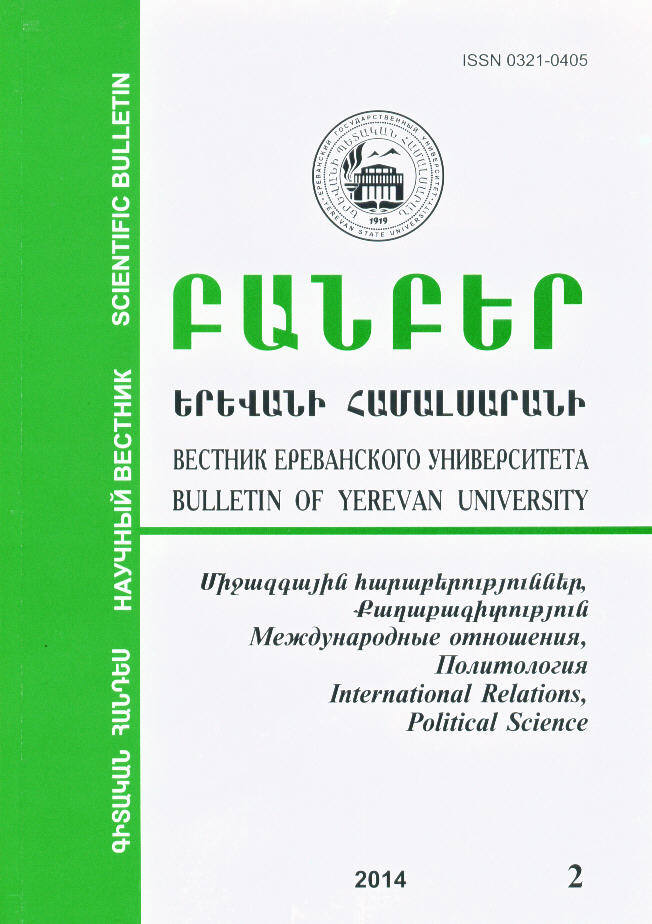
“Bulletin of Yerevan University. International Relations, Political Science” is a scientific journal devoted to the development processes of post-Soviet countries, the processes of European and Eurasian integration, and topical issues in international relations and diplomacy. The Bulletin publishes scientific articles and studies on the comparative study of contemporary political events, the democratization of political systems, the formation of civil society organizations, political ideology and culture, as well as public administration, geopolitics, civilizational interaction and humanitarian cooperation. The Bulletin is devoted to the study of a complex of problems of development and interaction of post-Soviet countries. The Bulletin accepts original articles and comprehensive studies not previously published.
In the period of the existence of the First Republic of Armenia one of the factors distorting the Armenian-Georgian relations, was the dispute around Ardahan. This was a new phenomenon in the history of the Armenian-Georgian territorial disputes and was due to the struggle of Armenia for the exit to the sea. Having claims for the districts of Ardahan and Olti, Georgia was depriving Armenia from the own exit to the sea in the direction of Batum or Lazistan, thus Armenia was appearing in the complete dependence from Georgia regarding the communication, which could create an opportunity to make the Armenian side to make concessions in case of other border disputes. The dispute around Ardahan continued throughout 1919. Only in October the dispute was resolved. The Georgian side agreed to withdraw troops from the territories of Ardahan, located to the south of Kura River, which belonged to Armenia, and the Armenian side agreed that the personnel of Georgian garrison in the northern part of Ardahan town would become 100 instead of previous 50 (according to the agreement reached in April the territories located to the north of the Kura river in Ardahan region passed to Georgia, and the southern part – to Armenia; the size of the garrison was also defined). In January 1920 the Georgian government offered Armenia to form a militarypolitical alliance against the Turks; instead they demanded the northern part of Alaverdi and pits and increase of the Georgian garrison up to 300 soldiers. This proposal was rejected by the diplomatic representative of Armenia in Tiflis T. Bekzadyan. In the process of these negotiations in the end of February the Georgian government, without any consent, moved the troops into southern Ardahan. This step justified the distrust of the Armenians towards the proposed alliance, as it was used as bait by the Georgians. On June 29 the Georgian-Armenian conference was organized to discuss the Armenian-Georgian contentious issues. Here the Georgian delegation officially demanded the Ardahan province, substantiating the rights of Georgia in historical, ethnographic aspects, as well as in the context of security of Batumi. This demand, which was justified with poor arguments, was rejected by the Armenian delegation. So, the Ardahan issue, as well as other contentious issues in the context of the Armenian-Georgian relations received no resolution up to September. The TurkishArmenian War began in September and Ardahan issue received new manifestations.
The mass grave discovered in 2007 in the town of Guba in Azerbaijan became the reason for the ruling regime of formation of a new political myth
about the "Guba genocide", the originators of which are allegedly the Armenians. The refusal of the Azerbaijani side to conduct an independent examination as well as the contradictions presented during the information campaign that had aroused around these events give a reason to claim that this political myth is artificially created in order to plant stereotype in the Azerbaijani society about the negative role of Armenians in connection with these events.
Disintegration of the USSR in 1991, represented himself not only as the end of an era, but also provided impetus for the new created subjects of international
law to reunite on a new level and to create a new geopolitical formation in Eurasian area. However, despite a great number of objective and subjective factors, which dic-tated the necessity of integration, post-Soviet countries came face to face with a powerful counterweight of disintegration factors, largely hindering the development of integration processes within the Commonwealth, which united post-Soviet countries (except the Baltic).
Ever since the Commonwealth did not provide full cooperation, the necessity of deeper and multilateral integration arose, which led to a considerable activation of integration processes in the region. Actually, still on the first stage, since the moment of formation of the CIS, integration processes of independent countries on international basis were interfaced with deeper problems, contradictions and difficulties in the economic, military, political and other spheres.
In the post-Soviet period the territory of the South Caucasus has become an arena of geopolitical battles for regional states and extra-regional power centers. This article examines the current tendencies of Turkish foreign policy towards Armenia, Turkish foreign policy from the perspective of the doctrine of "zero problems with neighbors", as well as its transformation in response to recent events around Ukraine. The author analyzes of Turkey’s foreign policy in connection with the approaching centennial of the Armenian Genocide in 2015, in particular, Prime Minister Recep Tayyip Erdogan’s statement, on the eve of the 99th anniversary of the start of mass deportations of Armenians in 1915.
The idea of civil society was still famous among ancient Greek and Roman thinkers.
The success of the transition to democracy or political modernization has always been at
the center of interest of political scientists and not only. It is distinguished by its public institutions and functions of important public policy organization – the existence of the state. Different thinkers from different historical periods defined, described and analyzed the term “political society” sometimes overestimating, sometimes underestimating its role and importance in the life of society. In parallel to Political and civil ideas the definitions of civil society were transformed, especially depending on the state political regime. According to contemporary perceptions being the result of the development of western civilization it includes an entire system of civil, democratic, legal values.
The article examines the reforms in the civil administration in Armenia and the conceptual model of public service in particular. A comparative analysis of the programs and activities of the Armenian government is made by separately considering the actions planned for each time period, and the expected results. In addition, the article lists the concept of public service and strategic direction of the exercise of its functions.
Policy making is the key of the political processes. In order to understand the policy of the state, first of all it is necessary to know how decisions are being
made. As during decision making-policy the level of uncertainty is very high, so a number of methods have been developed, which are specific tools. In the framework of this article those forecasting techniques of political decision-making were classified (the Delphi technique, Scenario building, SWOT Analysis, Wild cards), which are more applicable to the decision-making policy in the legislative bodies. As a tool, these techniques may be used during a comprehensive analysis of decision-making policy. Totally, using above mentioned techniques, first of all solves the problem of uncertainty, and then the most important issue of political decision-making process: making effective and actual decision. Today in the political decision-making process only rational thought, intuition, the
experience are not enough for making effective decisions. The knowledge of forecasting techniques of political decision-making becomes more demanded.
This article focuses on antimilitaristic discourse studies based on the example of the "Reflections of a Nonpolitical Man" by T. Mann. Particular attention is paid to
the analysis of such oppositions used by the author as spirit / politics, culture / civilization, soul / society, arts / literature, cosmopolitanism / internationalism, German spiritual values, humanity / bourgeois democrat, etc. The author of the article also critically analyzes the articles of such Russian thinkers as Vladimir Ern and Sergei Bulgakov. After the assassination of the Foreign Minister Walter Rathenau (1923), Thomas Mann rethought his own political views and became an ardent pacifist. In the article the axiological "revolution" of Mann’s ideas is demonstrated on the basis of a few examples of his reports, essays and articles ("My Time", "Culture and Politics", etc.).