| E - ISSN | : | 3045-3100 |
| P - ISSN | : |

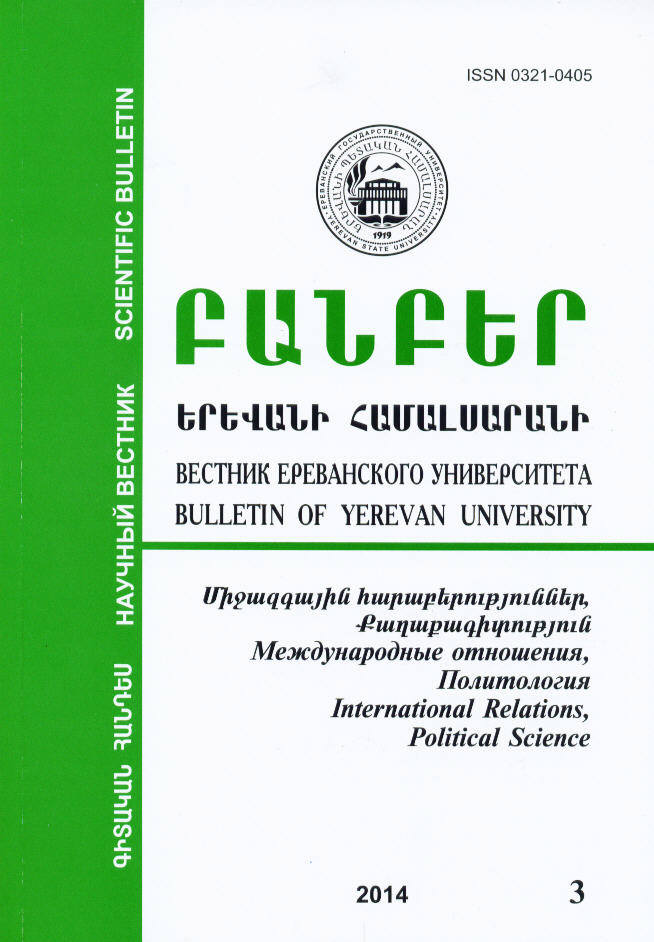
“Bulletin of Yerevan University. International Relations, Political Science” is a scientific journal devoted to the development processes of post-Soviet countries, the processes of European and Eurasian integration, and topical issues in international relations and diplomacy. The Bulletin publishes scientific articles and studies on the comparative study of contemporary political events, the democratization of political systems, the formation of civil society organizations, political ideology and culture, as well as public administration, geopolitics, civilizational interaction and humanitarian cooperation. The Bulletin is devoted to the study of a complex of problems of development and interaction of post-Soviet countries. The Bulletin accepts original articles and comprehensive studies not previously published.
This article focuses on the theoretical aspects of the International Military Cooperation. As a result of analysis of official documents and theoretical literature we have tried to define a concept, and framework of its aims and activities. It is stated that though some defense diplomacy activities were part of interstate relations during the centuries, in the past two decades the framework of defense diplomacy has essentially been enlarged. Some changes, regarding the character of defense diplomacy, have also taken place. Special attention is paid to the problem of aims of International Military Cooperation of Armenia. Amongst them the following ones have central importance: creation of favorable conditions for the State Security, assistance to the reforms of defense sphere and the participation in the strengthening of International Security.
In Russian social life the idea of activating the conservative approaches towards the social processes is being strengthened. The conservative ideological system, which is becoming dominant in Russia, is definitely close to the post-Soviet societies and, in the future, it will be estimated as a dominant system in Eurasian Union as well. However, contrary to the main argument of the Eurasian integration, it is pushing forward not the economic but the spiritual-moral aspects of social development which have always beensignificantly different among the people who live in post-Soviet area. Therefore, there can appear some difficulties in the ideological field of already new union. The conservative liberalism could be considered as the most acceptable ideological system for the post-Soviet societies which, first and foremost, has a liberal orientation. At the same time it underlines the significance of moral norms, the social progress observes as a necessary process of human community development, but without shocks and excesses.
This article has a deal with the role of India in the system of defence of the British Empire on the eve of the Second World War. The Indian Ocean was Mediterranean Sea of the British Empire and played an important role in the defence capability of Britain. India was the heart of the English military strategy
at the area of the Indian Ocean. The military doctrine of Great Britain has formed basically under geographical situation and centuries-old process of development of this colonial Power. The main tasks of the empire strategy were safeguarding of security sea communications, inadmissibility of their passing to the enemy; the defence Great Britain, the main arsenal, from the air attacks; the defence of land border of the Empire. All the countries, the members of the Empire, had to take part in these tasks. All this determined the military strategy of Britain to India. The defence of sea borders of India was realized by the Navy of common empire. During the war the strategic and geopolitics importance of India for the British Empire strongly increased.
The estimation of Armenian-Mongol Contract in 1254 is one of the main problems of the history of Armenia. We have represented in the work how the Mongols conquered many countries and came to the borders of Kilikia. We have mentioned about the travelling of king Hetum and his negotiations with khan Mangu. We have thoroughly presented the sources of information about the contract in 1254. At the end of the work we have presented the estimations of different scientists concerning the problem mentioned above. Fot that we have combined the views of various investigators mentioning our point of view as well.
In this article the main issues of democratization of the political system of Armenia contributes to the realization of the constitutional rights and fundamental freedoms, basic values and interests of the individual and the legalconsolidation of civiliarchic institutions. The article also reveals the necessity of gender
social partnership and dialogue in the process of democratization. At the present stage of democratic reform takes center stage analysis of the socio-political status of the Armenian women, as well as a comparative analysis of the legal mechanisms to protect their rights. In this context, particular importance is the formation of an effective strategy to promote gender equality and social harmonization, which may be relevant in the regulation of social and labor relations, with the involvement of trade unions and women's NGOs. Particular attention is paid to the social dimension of legal activities and social orientation of public organizations is to protect the rights and freedoms of women, thereby contributing to the formation of the welfare state in Armenia. Effective protection of social rights and freedoms of women is an important characteristic of contemporary reality, which has an impact on the democratic integration of the Armenian society at national, European and global level. At this stage of European integration the legal framework for the protection of rights and freedoms of women is gradually formed in Armenia, and legislation complies with international legal standards in the field of gender policy. However, it is necessary that the relevant legal provisions have been implemented to ensure the socio-political development of women and consolidation of civiliarchic mechanisms for gender equality. In the conclusion, based on research by the author is invited to make a number of institutional reforms in Armenia.
Political and ideological principles are one of the main criteria for the typology of political parties. According to the classification by political and ideological principles, the first group consists of doctrinal parties with certain and officially proclaimed ideology. The second group includes parties with uncertain ideology, which we prefer to regard as pragmatic ones. Classification of political parties can be based either on the ideological specifics of political parties, or on the essence of developed policies /liberal, socialist, conservative, religious, nationalist, etc./.
Contemporary democratic developments around the world make a need for processing tools to evaluate, to compare and to explain democratization processes
across countries and over the time. The following article presents the model for assessing democracy (Index of Democracy Level-IDL), based on the method of indexconstruction. This approach gives an opportunity to analyze the level of democracy of the given country in its different periods as well as to compare different countries by democracy level. In the article Armenian democracy in the time span between 1998 and 2012 is modeled and is estimated as well as factors mostly influencing democracy in Armenia by means of regression analysis are determined in order to reveal conditions and means for development of democracy.