| E - ISSN | : | 3045-3100 |
| P - ISSN | : |

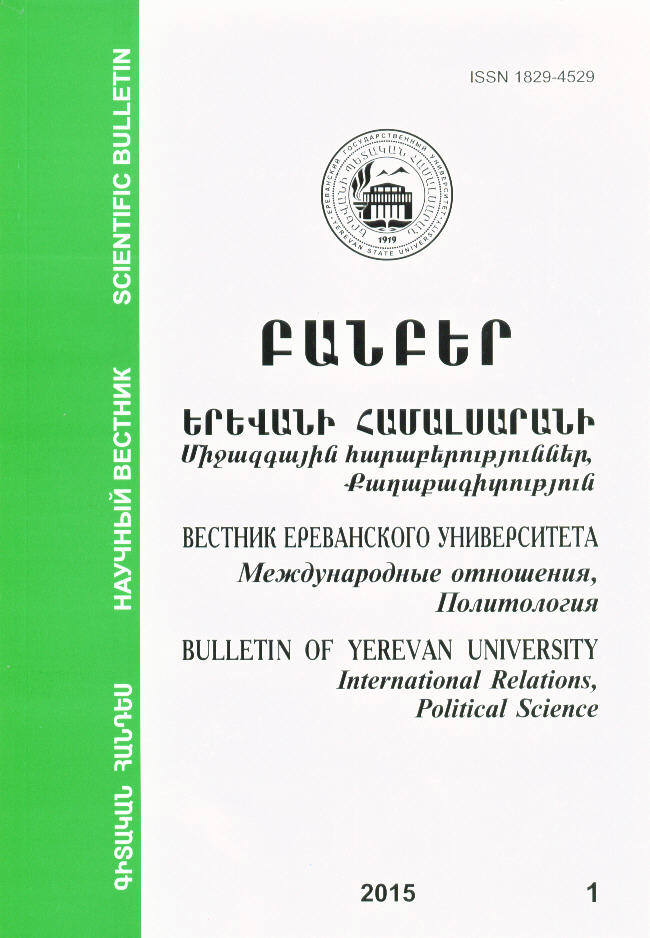
“Bulletin of Yerevan University. International Relations, Political Science” is a scientific journal devoted to the development processes of post-Soviet countries, the processes of European and Eurasian integration, and topical issues in international relations and diplomacy. The Bulletin publishes scientific articles and studies on the comparative study of contemporary political events, the democratization of political systems, the formation of civil society organizations, political ideology and culture, as well as public administration, geopolitics, civilizational interaction and humanitarian cooperation. The Bulletin is devoted to the study of a complex of problems of development and interaction of post-Soviet countries. The Bulletin accepts original articles and comprehensive studies not previously published.
In this article, the author refers to two antagonistic blocs of political and diplomatic struggle in the process of the creation of a new world order after
the collapse of the Soviet Union and the Cold War. In this context, the author tries to analyze an important question which was missed from the politicians’ attention: it is the position of small and especially newly independent countries to the abovementioned superpower conflict and the century challenges. It is mentioned that the erosion of the empires brings with it latent ethnic animosity of the liberated sovereign small countries causing clashes and military operations in different regions. Some authors areinterested in the possible elimination of borders of internal and foreign policy of countries and the opponents’ opinions of that bill. Stopping on the aspiration of seeing the world unipolar by the USA and multipolar by Russia, China and a number of countries, the author believes, that the establishment of a multi-polar world will promote the national interests of the Armenian Republic.
Armenian-French relations are based not only on political and cultural, but also economic and trade cooperation. The first steps in the development of economic relations with France date from the late 1990s. In the implementation of economic ties, including Armenia, France has limited them to certain obligations related to its EU membership. In the bilateral trade and economic relations investment, the number of established companies is constantly changing depending on
market requirements. Armenian-French economic and trade cooperation has gradually emerged to include a number of branches of the economy: agriculture, trade, communications, energy, services, telecommunications, tourism, mining and banking.
Having both historical and religious background, the problem of anti-Semitism and anti-Zionism in Azerbaijan officially is silenced and replaced by actively promoted thesis of tolerance and multiculturalism. However, the frequency of anti-Israeli speeches and anti-Semitism at domestic, social level reveals the existence of the problem in the country, the denial attempts of which reveal the hypercompensation – an attempt to hide the drawback at a domestic level, applying too much effort for persuasion of foreign audiences in its absolute absence.
On the eve of the Armenian Genocide centennial Turkey’s government consistently continues its denial policy and makes efforts against recognition and towards suspension of recognition processes of the underlying activities, that are carried out with new approaches and initiatives in both political and academic spheres.
This is evidenced when, ahead of the year 2015, Turkey carries out an action plan with segments deepening and strengthening of its recent public diplomacy of usage of some “unfortunate relocation” and “shared pain” thesis, thus, aiming at lowering thepublic tough stand against Turks in Armenian society; carrying out some covert activities with the Diaspora representatives thus creating a gap between Armenia and Diaspora; to counteract and cast a shadow to the Armenian Genocide commemoration activities by carrying out synchronous and mass events; denial of the Armenian Genocide and counteraction to Armenian Diaspora efforts of the Armenian Genocide recognition via activation of Turkish lobby abroad and Azerbaijani propaganda opportunities.
Within the framework of this article, the author examines the basic models of political communications, identifies the characteristics and functional features of the application of dialogue forms of communication in the political space of modern society. In particular, highlighting the basic principles of building dialogue relationships in the communication field, the author offers an original - a dialogue oriented model of political PR Communications (DOPR), as the most effective mechanism to prevent political conflicts and building long-term PR communications in the political system of modern society.
2002-2005, Committee for Political Affairs of the Parliamentary Assembly of the Council of Europe was discussing Nagorno-Karabakh conflict. Initially, the reporter on this issue has been appointed a member of the socialist faction Terry Davis, then a member of the Democratic faction David Atkinson. January
25, 2005, after lengthy discussions PACE, adopted a resolution on Nagorno-Karabakh conflict, based on Atkinson's report /resolution No. 1416 /. Despite the fact, that this document includes some favorable points for Azerbaijan, it evidences the importance ofprotecting the separation of a particular territory from the State by democratic methods.
The article reviews theoretical and contemporary significant problems concerning public opinion formulation through mass media in democratic conditions. As mass media is the main source for the public opinion in Armenia, it is obvious how significant the concepts of the freedom and productive activity of mass media, which are important for political processes. Meanwhile, the article reviews the principle concepts and conditions of productive activities of mass media, which plays the main role in the formulation of public opinion.
The subjects of the article are the problem of the formation of oppositional political parties in Armenia andthe features of bipolar political systems. The situation in the final period of the USSR’s history is presented during which anti-Soviet political groups leaded by Karabakh committee struggled against Communist party and Soviet Regime. The concept of constitutional reforms adopted by the Specialized Commission for Constitutional Amendments adjunct to the RA President is also analyzed in the article. Particularly the attention is focused on the issues of the principle of separation of power, checks, and balances, electoral systems as well as the role of political opposition.
Գրքերի տեսություն