
| E - ISSN | : | 3045-3100 |
| P - ISSN | : |

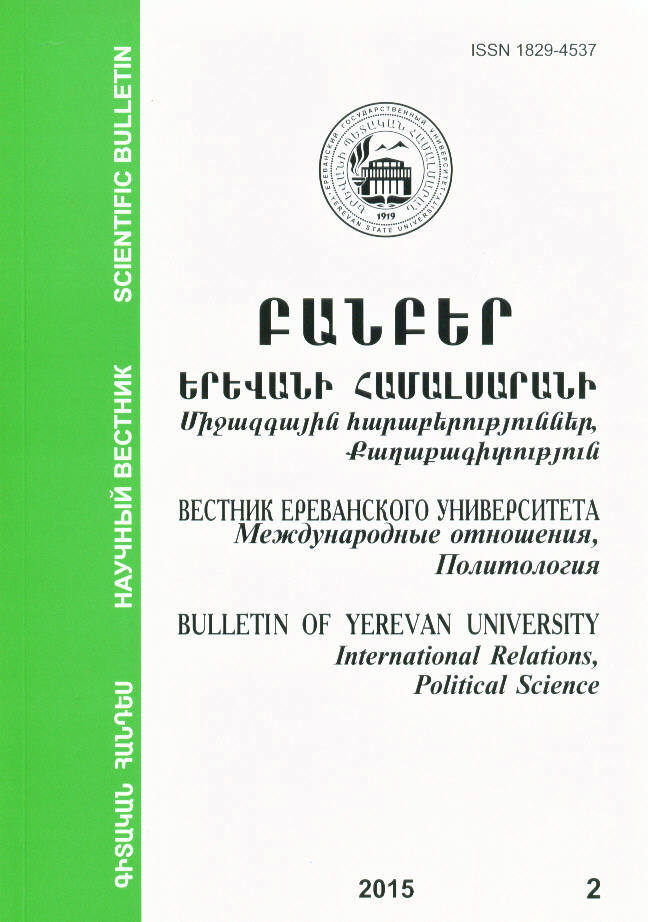
“Bulletin of Yerevan University. International Relations, Political Science” is a scientific journal devoted to the development processes of post-Soviet countries, the processes of European and Eurasian integration, and topical issues in international relations and diplomacy. The Bulletin publishes scientific articles and studies on the comparative study of contemporary political events, the democratization of political systems, the formation of civil society organizations, political ideology and culture, as well as public administration, geopolitics, civilizational interaction and humanitarian cooperation. The Bulletin is devoted to the study of a complex of problems of development and interaction of post-Soviet countries. The Bulletin accepts original articles and comprehensive studies not previously published.
In World War I, each participating country had its own motivation. The Ottoman Empire, from the viewpoint of a deep understanding of the prevailing
geostrategic realities around him, which carefully concealed, had its own motivation. As a result of the Balkan wars, finally thrown out of Europe, and later, the ItalianTurkish War, banished from the Mediterranean region, the Ottoman Empire was trying to find its own center of the strategic balance in Minor Asia and in the Armenian Highlands. This led to the empire’s ambitions to destroy Armenia and Armenians. Russian reform program and contradictions of major powers on the Turkish issue intensified the formed trend. This is evidenced also the choice of Germany as an ally. The First World War gave the opportunity to do so. Thus, the Ottoman Empire entered the First World War to solve the Armenian question in the Turkish understanding. The idea of Armenocide and its execution has been a matter of time.
It is known that military actions are preceded or at least followed by information and psychological activities. They are aimed to pressure the addressee and to influence it. Such actions could lead to the cleavage of the main forces of the counterparts, their demoralization. Nowadays the rapid growth of modern communication and information technologies enables the state which “sets the rules” of the game to present its counterpart countries as discredited, representing a threat, non-democratic and so forth. For these reasons, it is more than urgent to explore information warfares and the resemblances between the main principles of those warfares that were conducted against Iraq, Libya and Syria.
The article studies the geopolitical concept of Middle Europe of Friedrich Naumann and Joseph Partch. This concept had a huge turnover in the German political circles during the First World War. In fact, this concept is characteristic for empires and for their passionate spirit, which describes the geostrategic position of Germany in the Middle Europe. Mitteleuropa – a concept of establishment of an empire due to occupied territories through the expansion of the concept, which will be created by the merger of Austro-Hungary with Germany.
The recent reforms concerning activities of Media in the system of public administration of RA were marked by high efficiency. One of the most important
elements of public administration system in any country is the Media. At the same time, it is one of the most important institutions of the democratic system and civil society as it assumes the possibility of receiving and sending information. The Media are open and complicated structures that possess targeted adaptation as a result of changing realms, and self-government, with its self-regulative features. Thus, besides the clarification and enhancement of the Media’s public administration procedures, it will be possible to contribute in the state government efficiency of the RA, widening the civic rationality scale. Despite recent reforms, yet there are some problems of efficiency in the Media governing process in the public administration system of RA, especially in the legislative aspects, which is much more important for improving the governance.
In this paper we show that conservatism is extremely broad, multifaceted concept that includes many levels of meaning, some of which have existed throughout the development of the entire human civilization, and some arose under the influence of specific historical events. The highest form of manifestation of this phenomenon is the presence in the heart of any civilization, a universal mechanism for performing the functions of experience in the form of specific information, transferring it from the present to future generations, as well as the perception of new information and adaptation to it, which can be characterized as conservative.
In the article, the reference is made to the concepts, political culture, and civic culture. Through the comparative analysis of different authors’ approaches, the article attempts to demonstrate the existing differences in the meanings of the two concepts: political culture and civic culture. Consequently, the article brings forward the thesis according to which political culture, as a relatively stable system of this or that society’s ideas and perceptions on political life, is constantly present in the evolutionary process of that particular society. And this is true notwithstanding the type of regime that rules in that particular society. In case of civic culture the thesis, emphasized in the article, deals with a specific type of regime: a democratic model. To put it otherwise, this is the case, when the representatives of a society do not only possess perceptions on type of political system as well as on their place and role in that system, but on the basis of those perceptions they also possess efficient and effective mechanisms necessary for civic participation.
The democratic political systems of the modern world is closely linked with civil society and legal system of the state. After the collapse of the Soviet
Union, the former Soviet states were in an entirely new social, political, post-Soviet reality. Naturally, in each of them, including Armenia, together with the institutions of the political system, some institutions of the social system were formed and developed. Ideas about the political society of the third sector have been put forward; the laws governing this area have been developed. In connection with both political and non-political factors existing in Armenia nowadays social organizations present a number of structural and functional features that have positive and sometimes negative impact on the development and formation of the civil society of Armenia.