| E - ISSN | : | 3045-3100 |
| P - ISSN | : |

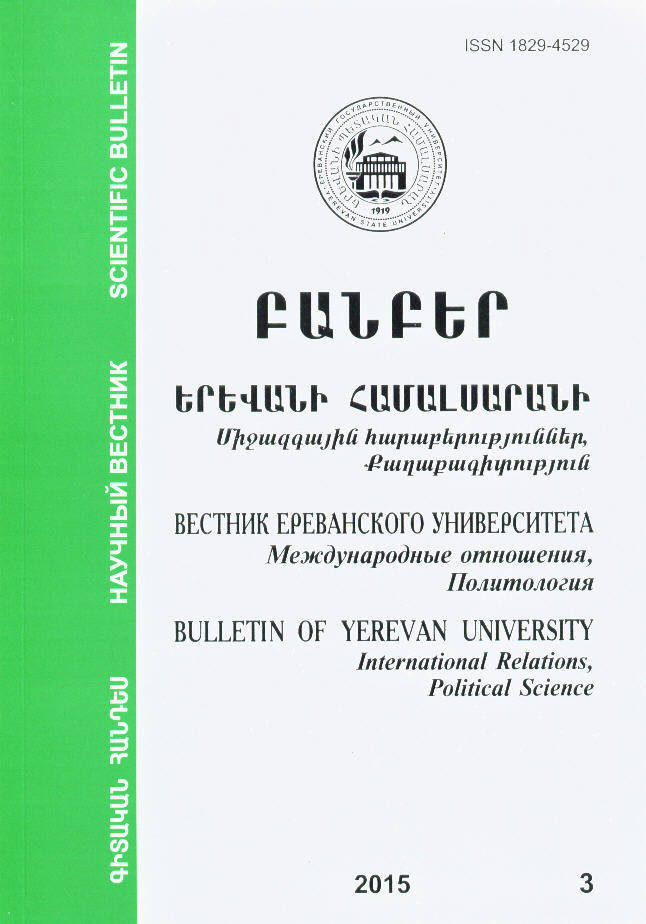
“Bulletin of Yerevan University. International Relations, Political Science” is a scientific journal devoted to the development processes of post-Soviet countries, the processes of European and Eurasian integration, and topical issues in international relations and diplomacy. The Bulletin publishes scientific articles and studies on the comparative study of contemporary political events, the democratization of political systems, the formation of civil society organizations, political ideology and culture, as well as public administration, geopolitics, civilizational interaction and humanitarian cooperation. The Bulletin is devoted to the study of a complex of problems of development and interaction of post-Soviet countries. The Bulletin accepts original articles and comprehensive studies not previously published.
On the basis of rich factual data the nonmaterial resources of the Russian Federation and their criteria are analyzed in this article, and it is stated that they can act as determining factors only in case of the presence of political will and organizational resources of the political elite. At the same time, it highlights the fact that the presence of resources is not directly proportional to the influence of the state and that scarce resources of the foreign policy of the state can be supplemented by effective diplomacy. At present, the Russian Federation ineffectively utilizes its resources in foreign policy. The absence of a single ideology in the Russian political and social circles does not allow to use the potential of the nation at it’s best. Currently, the Russian Federation that is possessing existing resources in foreign policy can not have global influence, but having such geographical position and potential this state should definitely play a more important role than other states of the region
Civil-military relations in Turkey have been an everlasting debate since the foundation of the republic in 1923. In order to maintain political order and protect these institutions, the military found it necessary to intervene five times in 1960, 1971, 1980, 1997 and 2007. This article looking at the period between 1997 and
2007 and analyzing the civil-military dynamics in Turkey in the context of National Security policy making process and in the framework of EU integration process.
Furthermore, in terms of the roles and missions of the military in Turkey, the article discussing the problems of “civilianization” of army institution, the specific features of National Security discourse in that country as an obstacle on the road of consolidating democracy.
The paper comparatively analyzes and illustrates the transition of European politics from the medieval universal world order to the modern international relations system. The Peace of Westphalia (1648) was a turning point in the history of international relations. It symbolized the transformation from the system of political rule based on the hierarchical structures of medieval Christendom to the horizontal system of sovereign territorial states. Throughout the middle ages, the postRoman myth of the empire still had a great significance. The rising sense of national individualism was promoted by the Renaissance and Reformation, which replaced the Papacy and Empire upon which the hierarchies of western Christendom had been centered. As a result, after the Peace of Westphalia formalized relations between modern states based on mutual recognition of sovereignty displaced the criss-crossing relations between heterogeneous feudal and non-state actors organized by the hierarchical claims of the Empire and the Church. With the consolidation of the means of violence by sovereigns and the emergence of territorially bounded states, the European politics was differentiated into distinct domestic and international spheres. Thus, sovereign states
became the only legitimate political actors which were governed by sovereign rulers, acknowledging no rival authorities above them and none below. These processes affected the international dimension of conflict by furthering the fragmentation of Europe into distinct states. Around the states a new kind of political life – international politics– started to develop. The start of the secularization and its adjacent idea of selfdetermination entailed the principle of peaceful coexistence among legally equal members of international society. However, the concept of a universal world order remained on the political agenda, but it meant only the preeminence of a monarch within a system of fragmented and overlapping sovereignty rather than direct rule over a European super-state.
The system of international security consists of a number of components. Tangible resources are allocated for maintenance of collective security. Collective security is a system of joint activities of countries in a given geographical region or around the world, with the aim to eliminate and prevent the threats to peace and suppress the acts of aggression. Discharging in international tension, reached in the second half of the 1960s and the first half of 1970s, helped to establish
political guarantees for international security. The main result of this process was the Conference on Security and Cooperation in Europe.
Political parties are important actors of political process and appear as an intermediary between the state and citizens. They are also the basic object for research in political science. In the article by the correlation analysis, aspects of political parties of Armenia are studied. On the basis of elections of the National Assembly of RA in 2007 and 2012, the author analyzes the differences and similarities of the party electorates and makes a comparative analysis.
Nowadays we witness many cases of sex-based discrimination in different spheres of our society that seem to compile our “quasi” reality. A situation created in
Armenia from the first sight is seen as: the laws are adopted according to democratic procedures and the rights of sexes are not violated, also, it can be said that the legislation provides equal opportunities for both sexes. But in reality thousands of problems are accumulated that are emerging from the discrepancies between the reality and the legal framework. Women’s political activism and political participation are from one side an important consistency of a post-conflict society, from the other side it is the key indicator of a democratic political system. A social and political situation in contemporary Armenia is of a kind that regardless of women’s wishes they are pushed back to the second and third plans and are considered to be derivatives of masculine culture. Women constitute nearly the half of the world’s and more than 53% of Armenia’s population. Consequently, the political potential of this social group is quite enormous and it
would be luxurious to ignore this fact in relation to a country like ours is. The abovementioned issues are discussed in the article.