
| E - ISSN | : | 3045-3100 |
| P - ISSN | : |

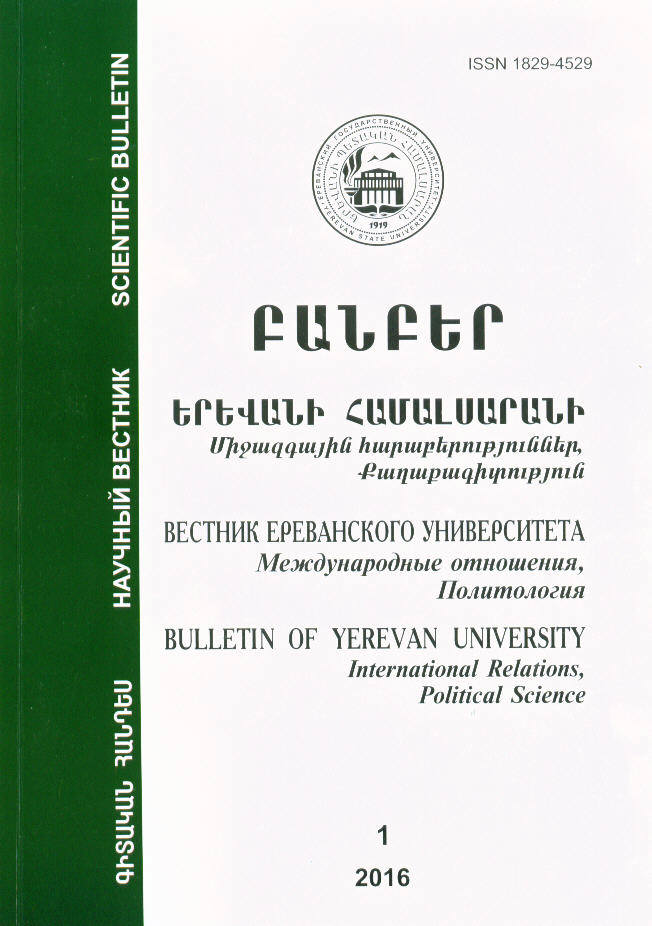
“Bulletin of Yerevan University. International Relations, Political Science” is a scientific journal devoted to the development processes of post-Soviet countries, the processes of European and Eurasian integration, and topical issues in international relations and diplomacy. The Bulletin publishes scientific articles and studies on the comparative study of contemporary political events, the democratization of political systems, the formation of civil society organizations, political ideology and culture, as well as public administration, geopolitics, civilizational interaction and humanitarian cooperation. The Bulletin is devoted to the study of a complex of problems of development and interaction of post-Soviet countries. The Bulletin accepts original articles and comprehensive studies not previously published.
One of the most important issues in the foreign policy of the First Republic of Armenia was the question of the access to the sea, and one of the
possible solutions to this issue the Batumi port was considered. This article addresses the issue of Batumi in the context of the Armenian-Georgian, Russian-Georgian, AngloRussian and Kemalo-Bolshevik relations. According to the agreement signed between Soviet Russia and Menshevik Georgia on 7 May of 1920, the Bolsheviks recognized the Batumi region as an integral part of Georgia, in return for which the Mensheviks promised to withdraw the British garrison from there. On July 7, the British handed over the command of Batumi to Georgia and left this place. Armenia’s interests were again ignored, as the British did not fulfill their promise regarding the declaration of Batumi free port. However, in the Treaty of Sevres, there was referred to the status of Porto franco for Batumi. At the end of 1920 and beginning of 1921, there were contradictions between the Kemalists and Bolsheviks with respect to Batumi. In the end, Russia insisted on that Batumi should receive the status of the territory of the Soviet Georgia, which was recorded in the Moscow Treaty of March 16, 1921. During the Lausanne Conference, which revised the Treaty of Sevres there was said nothing regarding Batumi. Thus, the right of Armenia to have access to the sea was grossly violated.
This paper analyzes the role of key actors in the making of German foreign policy towards Russia. The positions of leading parties on German political spectrum, top government figures and business circles are presented. The effects of the Ukrainian crisis on the shift in the approaches of those actors are discussed. The differences in the positionsof top German business unions on sanctions policy are explored. Hypothesis testing and cross-tabulation method are applied to demonstrate the limited nature of energy dependence factor in constraining the application of economic sanctions.
In this article, the author considers the problem of political dialogue through the prism of democratic transitions. In the context of the "third wave" of democratization analyzes the countries that have moved to the democratic form of government through a "big political dialogue", "round tables" and discussions. In the case of post-Soviet transformation, considering the experience of democratic transition in Armenia, the author emphasizes, that democracy in Armenia is in a
consolidation stage of its development. And in this process becomes important active introduction of dialogue forms of political communication and the creation of a culture of political dialogue.
The alliances and their policy traditionally played an important role in international relations. They were often part of national security and national interest. And it is natural that the concept of alliances has been widely discussed, interpreted and defined by different theories of international relations (realism neorealism, idealism, constructivism and institutionalism), as well as by different authors, who developed the concept by using the structural and functional analysis method. As a result, we have a variety of definitions that contradict each other and lead to misunderstanding of the concept. In this article, we try to define the fundamental
characteristics of the concept of alliances by analyzing the western scientific literature about the topic. We also suggest a new comprehensive definition of the concept of alliance, which is theoretically thorough and concurrently practical.
The article has analyzed the methodological foundations of parliamentary culture in the context of socio-cultural and political discourse. The development of modern parliamentarism shows that its boundaries have expanded considerably. In the framework of parliamentary culture transformation processes, sustaining of the national dialogue between the state and society has become an urgent issue. While considering the current political developments within the state, it is necessary to find a system of checks and balances that will give us an opportunity to equalize the national, social and political needs of the state and society. After studying the scientific definitions of parliamentary culture and reviewing its mutual interaction with its constituent elements and associated political categories, the article has proposed a new definition of parliamentary culture; the one which will best reflect the current problems and peculiarities of the parliamentary culture-sustaining process.
In the political life of modern society needs and interests of citizens can not be realized only through the institutions of the state or political
parties. In the process of implementation of these demands, the important role played citizens' associations - non-governmental organizations, associations, charitable organizations, etc. For the political modernization in the country, active horizontal ‘waves’ are very important. These ''waves'' for smaller and flexible resources implements civil society: the world enters a new stage of social and political relations, changing issues on the political agenda of the day and the national security of the country stopped be only care of the state.