
| E - ISSN | : | 3045-3100 |
| P - ISSN | : |

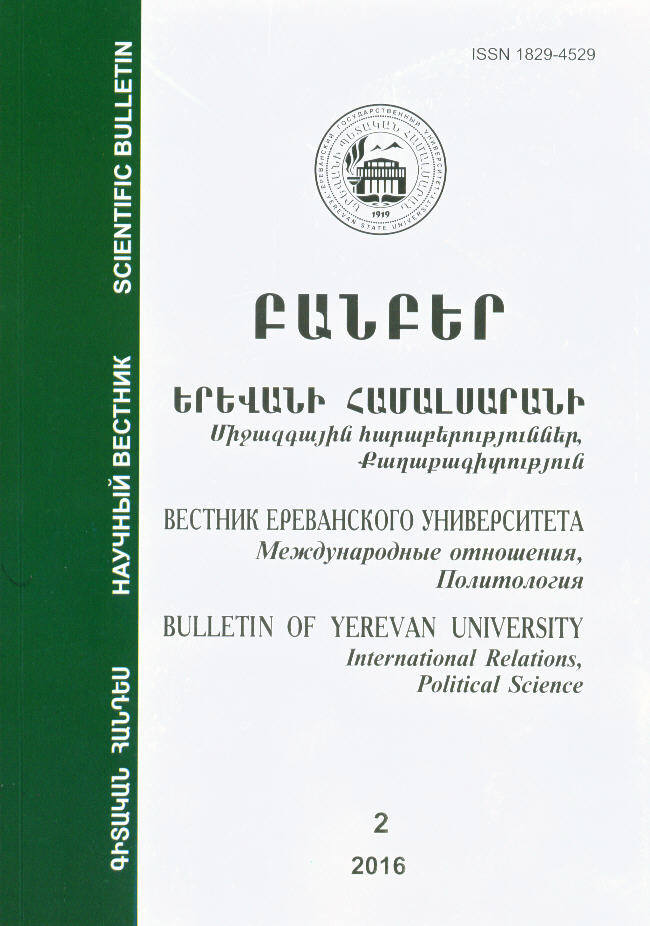
“Bulletin of Yerevan University. International Relations, Political Science” is a scientific journal devoted to the development processes of post-Soviet countries, the processes of European and Eurasian integration, and topical issues in international relations and diplomacy. The Bulletin publishes scientific articles and studies on the comparative study of contemporary political events, the democratization of political systems, the formation of civil society organizations, political ideology and culture, as well as public administration, geopolitics, civilizational interaction and humanitarian cooperation. The Bulletin is devoted to the study of a complex of problems of development and interaction of post-Soviet countries. The Bulletin accepts original articles and comprehensive studies not previously published.
This article examines the issues of domestic and foreign policy of the Transcaucasian region. The Bolshevik Revolution in 1917 brought new conflicts in Russia, which pose a serious threat to the country's division. The February Revolution had rejected the monarchy, but at that time still did not represent a serious threat to the unity of Russia. The three Transcaucasian countries deepened internal conflicts caused by the external pressure of the Ottoman Empire. The Russian-Turkish war turned into a Turkish-Transcaucasian war.
In the current complex geopolitical processes the civilizational identification of the Russian Federation is highlighted. It will contribute to the consolidation of the government and the society and will simplify the overcoming of the challenges that the country faces. In terms of foreign policy, the civilizational identification assumes the selection of the development vector of the country, the formation of a new image in the current international arena, as well as the assurance of
sovereignty and national security. Russia is neither Europe nor Asia nor Eurasia, but simply Russia, which at the same time is a unique civilization. Only in this way it can preserve its historical individuality and through cooperation with other civilizations it can continue to stay as an important factor of the world civilization.
The development of economic relations with Iran has always been an active part of Armenia's foreign policy agenda. In the conditions of dual blockade, Iran is important as a transit country for Armenia. On the other hand, the strengthening of economic ties with Iran allows having some alternatives in the energy sector. Armenia also has some economic importance for Iran. It ultimately depends on the implementation of energy transit projects, as well as the necessity of realization of Iran's traditional interests in the region. Today, the role of locomotive between the relations of two countries continues to take economic direction. Moreover, these relations have a tendency to become larger cooperation. The Armenian-Iranian economic relations prepared a solid foundation for further development of political relations between the two countries.
After the declaration of the Third Republic of Armenia, among the pivotal questions were the Armenian-Diaspora relations and the issue of the reunification of the two Catholicosates within the Apostolic Armenian Church. The collapse of the Soviet Union gave Armenia new opportunities to communicate on a horizontal level with Armenian Diasporas, as well as to make attempts to reunite the divided Armenian Church. However, new obstacles hindering the successful solution to the mentioned issues within a short time arose. One of the problems was the realpolitik policy conducted by the Republic of Armenia, which was not accepted by most bodies of the Diaspora, including the Catholicosate of the Great House of Cilicia, which, taking into account the issue of the “Hay Daht” (Armenian Cause) tended to make decisions and conduct policy concerning the issues of Armenians independently. The 1990s attempts to improve the Armenia-Diaspora relations, as well as the efforts at reunion of the two Catholicosates, namely the Catholicosate in Etchimiadzin and the Catholicosate in Antelias, failed mostly due to the unwillingness of the sides to make concessions on matters of national importance, or, even to recognize and accept the decisions of the other side.
The article analyzes the methodological basis of the index of civiliarchy and popular in sociopolitical studies major indexes of democracy. The article discusses the possibility of building a multilevel theoretical model of civiliarchy, which describes the qualitative aspects of political, social, economic and cultural processes. Main indicators of the model of democracy are political, economic, social and cultural rights and freedoms, the effective protection of which provides security, participation, representation, control, accountability, transparency, dialogue, partnership, and development. The index of civiliarchy determines the appropriate levels of civiliarchic institutions. Comparative analysis of data democracy indices demonstrates the potential of a new civiliarchic approach.
Modern public relations are more complicated and have a huge impact on current human interrelationships. Since the very beginning of human society, many have interested in governing the masses and made them oblige to their interests. So there are many mechanisms for that purpose, including the violence, threats, enforcement and etc., at the same time using the ideological impact and charisma. In the modern world, there are more subtle tricks to influence the minds of large social masses, which are not seen and perceived. Manipulation is used almost in all spheres of public life. It should be considered both as a negative and positive phenomenon and a necessary element of the social development process. But mainly, it is carried out in three areas: ideological (propaganda), economic (campaign), and social.
The rapid development of information and communication technologies as a result of the global development of the information society inevitably affects the state of society and in all areas, including foreign policy. Currently, many countries in the field of foreign policy and diplomacy are widely using digital applications. In the context of new challenges, new requirements aimed at strengthening the soft power in various fields of cooperation are needed in the field of the foreign policy of Armenia.