
| E - ISSN | : | 3045-3100 |
| P - ISSN | : |

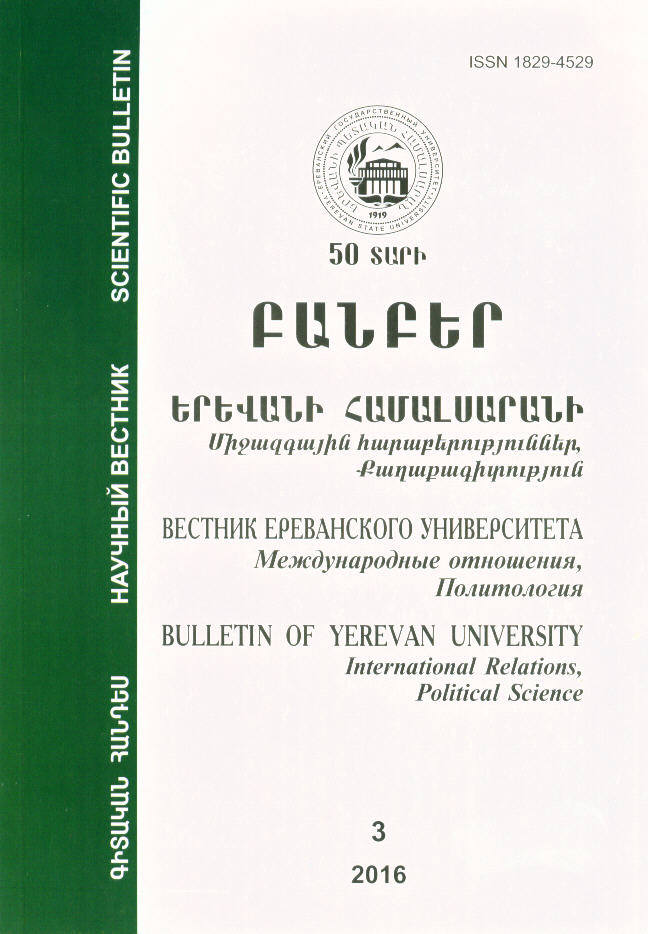
“Bulletin of Yerevan University. International Relations, Political Science” is a scientific journal devoted to the development processes of post-Soviet countries, the processes of European and Eurasian integration, and topical issues in international relations and diplomacy. The Bulletin publishes scientific articles and studies on the comparative study of contemporary political events, the democratization of political systems, the formation of civil society organizations, political ideology and culture, as well as public administration, geopolitics, civilizational interaction and humanitarian cooperation. The Bulletin is devoted to the study of a complex of problems of development and interaction of post-Soviet countries. The Bulletin accepts original articles and comprehensive studies not previously published.
The article analyzes the main features of the new role of Diaspora in political science, Diaspora studies, and why not, cooperation with international organizations. The prospects of development of the diaspora, the role and importance of Diaspora studies, as a new branch in the sciences and in this context the approaches and definitions of the term "diaspora" put forward by various scientists.
The province of Ardahan was important for the First Republic of Armenia, as it was the only way to the Black Sea via the Black Sea neighboring areas. In April 1919, by the decision of the British occupation authorities Shura - the so-called interim government of South West Caucasian Republic was disbanded and the province of Ardahan, except for its northern part was given to Armenia (territory north of the Kura and Potskhovi site). The British allowed Georgian troops to occupy the northern part. Despite the decision of the British, the Georgians continued baseless claims to the areas of Ardahan and Olti of Kars province. From mid-April to May and until the autumn the Armenian-Georgian dispute over Ardahan continued. The withdrawal of Georgian troops from the region was largely resolved at the end of Septemberbeginning of October 1919, via the mediation of the High Commissioner of the Entente Colonel Haskell. However, as the events of 1920 showed, the Menshevik government of Georgia not only abandoned its claims to Ardahan, but also taking advantage of the Turkish-Armenian War, captured the entire Ardahan.
The quickly developing Asia-Pacific region represents itself as an interest and importance in the 21st century. Not as other countries do, RF always takes part in ascertaining an economic and political influence in the region taking into the consideration the fact that the main part of the RF is located in that region. The
study is divided into 2 parts – the activity of the RF authorities in participating the regional integrative organizations, and the problems, connected with the development of the strategy, that exist in the region.
The paper aims at researching the main components of Turkey-Georgia-Azerbaijan trilateral military cooperation in the aforementioned period. Based on the analysis of main developments it is concluded that despite the considerable progress the trilateral cooperation has been of limited nature. The research defines the foreign policy goals that Turkey, Georgia and Azerbaijan have pursued through trilateral military cooperation.
This papers deals with the comparative analysis of German political reactions to the military-political crises involving Russia that occurred in Georgia (2008) and Ukraine (2014). The role of mutual perceptions of foreign political goals of Germany and Russia in stipulating the strategic course towards each other has been discussed. The current stalemate phase of the Ukrainian crisis was modeled with the application of game theoretic analysis. A model-based forecast was made regarding the future trajectory of developments in Russo-German relationship in the context of the Ukrainian conflict.
The article discusses the problem of institutionalization of the political dialogue in the Republic of Armenia. In the context of democratic transformation reveals the basic regularities of constitutional construction, institutionalization of political conflicts and dialogical practices, endogenous and exogenous factors of constitutional reforms, as well as new opportunities of institutionalization of the constitutional political dialogue in Armenia.
The article analyzes the contemporary processes of modernization and globalization as a way to spread global risk due to mismatch of modernist and traditional values. "Technological" model of modern social and political relations considers culture as an instrument for achieving certain political objectives. The logic of the development of modern non-Western societies is also based on the values of good governance and, as a rule, formulated on the basis of the simulation elements of the political project of Modernity. There is also a modern technocratic society, the problem of man and the need to create conditions for rethinking the role and man's place in the global world of the future.