
| E - ISSN | : | 3045-3100 |
| P - ISSN | : |

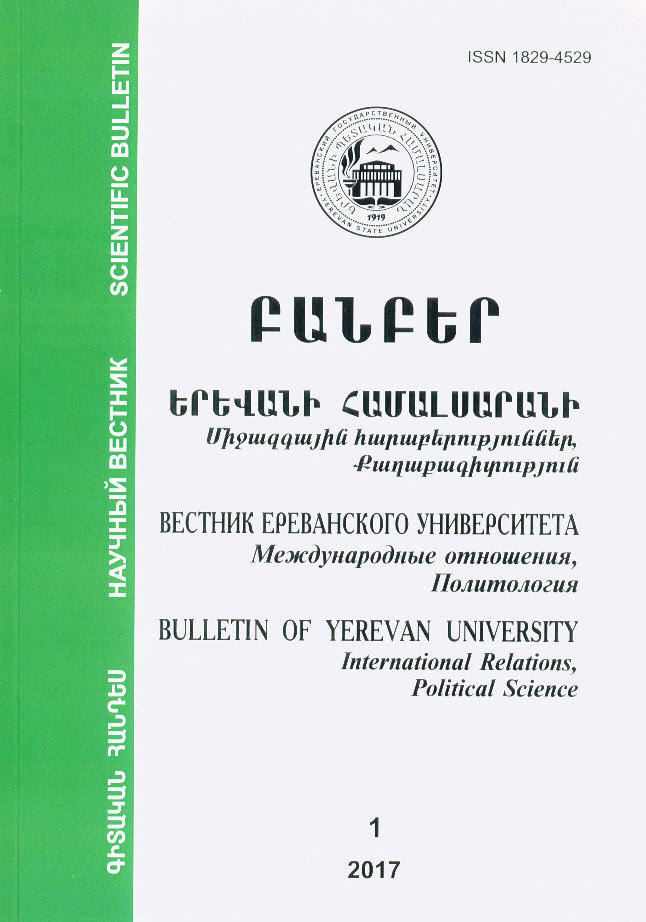
“Bulletin of Yerevan University. International Relations, Political Science” is a scientific journal devoted to the development processes of post-Soviet countries, the processes of European and Eurasian integration, and topical issues in international relations and diplomacy. The Bulletin publishes scientific articles and studies on the comparative study of contemporary political events, the democratization of political systems, the formation of civil society organizations, political ideology and culture, as well as public administration, geopolitics, civilizational interaction and humanitarian cooperation. The Bulletin is devoted to the study of a complex of problems of development and interaction of post-Soviet countries. The Bulletin accepts original articles and comprehensive studies not previously published.
Mediation missions play an important role in international relations in regulation and resolution of conflicts. The general framework of the incurred responsibilities and key challenges are discussed in the article according to the adopted international standards and principles by the example of Minsk group cochairmen around Artsakh conflict regulation as efforts, made by mediation countries.
The paper analyzes the Turkey-GeorgiaAzerbaijan cooperation in the context of the Baku-Tbilisi-Kars railway and defines both foreign and domestic policy goals that each of the three states has associated with the mentioned initiative, as well suggests a periodization of the Turkey-Georgia-Azerbaijan cooperation within the framework of the railway project. The article also presents the steps, taken by Turkey, Georgia and Azerbaijan towards the realization of the Model Highway Initiative Baku-Tbilisi-Batumi-Trabzon.
In 1999 after the Istanbul summit, noOSCE summit was held for about 11 years. During its chairmanship, Kazakhstan initiated holding a new OSCE summit. Throughout the summit, both meetings of experts and the adoption of the final declaration were maintained up to the tense atmosphere. The most sensitive issues were related to the unresolved conflicts. The summit, which works based on consensus system, faced with the problem of failure because of a small number of states had sought to introduce preferential conditions for the final declaration. Finally, member states were able to accept a compromise to adopt the final declaration.
In the article, SWOT-analysis was used to assess the role of e-government as a tool in Public Administration. Transformation of egovernment was studied according to the UN Global e-government Surveys. A comparative analysis of the evolution of electronic government as the Public Administration technologies on the example of the E-Government Development Index, E-Participation Index of the Russian Federation, Republic of Kazakhstan, the Republic of Armenia, Belarus and Ukraine was done. On the basis of the comparative analysis, the author makes a conclusion that the trend of e-government development is the provision of electronic services, providing online transaction and feedback from citizens to government institutions which make their activities more open and transparent.
Contemporary societies are characterized by information and communication technologies, which become an essential unifying factor for both state and public organizations. The impact of information touches all of society. These days it’s hard to imagine life without the Internet, social communication, social and electronic media. The spread of Internet is faster than ever. The rapid spread of information and communication technologies states the distinct role of electronic and social media which effecting the information governance systems of any country. The introduction of the Internet and new information technologies in the system of state governance of the Republic of Armenia is a testament to the need to modernize the existing system in order to improve management efficiency.
The article analyses the main directions of Azerbaijani information policy, based on mass media publications and information in social networks. Along with military operations, Azerbaijani propaganda was active in the internal audience showing that the resources it wasted for decades were not in vain: playing the external threat card, it prevented the growing discontent in the country and drew the attention of the society from Aliyevs’ offshore affairs. Azerbaijan targeted the international community in order to present Armenia as an aggressor, undermine Artsakh’s image and cause tensions in Armenia by disseminating false information. The article consists of several parts: Azerbaijani information policy in internal, international and Armenian audiences. The analysis of information flows shows that spreading disinformation, appearing as a “victim”, circulation of unfavorable information flows by biased analysts are the basic tools of the Azerbaijani propaganda.
In the current phase of the information revolution, under the conditions of formulating information society, issue of information security is increasingly getting an important designation. Along with their huge advantages, brought forth new forms and means of communication, spreading quickly, give birth and will be giving new threats and challenges. Ensuring the information security has become a matter of national security. The article is an attempt to represent the Republic of Armenia's domestic and international developments in the context of the global dimension of the challenges facing the sector of information security, the resolution of which is necessary for the national security support of the republic.
In the modern information society in the context of regulation of social and political relations, state information policy plays an important role. Its effective implementation is especially relevant in the Republic of Armenia, where the creation of an information society takes place in difficult situations in the region, as well as in many domestic problems of the country, such as the contradictions and not advanced legal regulation of public relations in the information sphere, unequal support for the interests of the individual, society and State, non-competitiveness of Armenian news agencies and mass media.