| E - ISSN | : | 3045-3100 |
| P - ISSN | : |

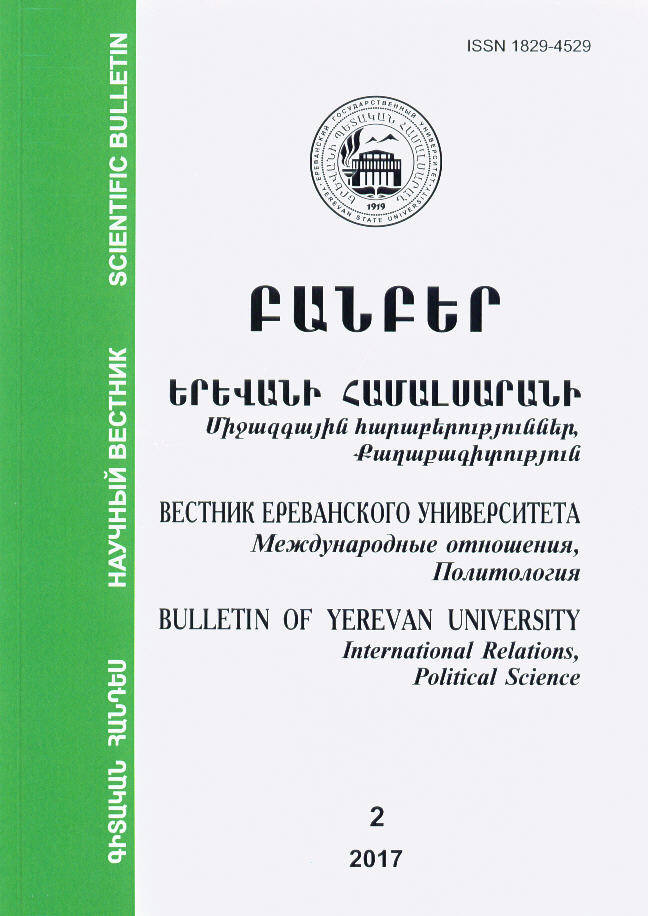
“Bulletin of Yerevan University. International Relations, Political Science” is a scientific journal devoted to the development processes of post-Soviet countries, the processes of European and Eurasian integration, and topical issues in international relations and diplomacy. The Bulletin publishes scientific articles and studies on the comparative study of contemporary political events, the democratization of political systems, the formation of civil society organizations, political ideology and culture, as well as public administration, geopolitics, civilizational interaction and humanitarian cooperation. The Bulletin is devoted to the study of a complex of problems of development and interaction of post-Soviet countries. The Bulletin accepts original articles and comprehensive studies not previously published.
The article deliberates on the Kurdish issue within so-called ethnic Kurdistan including relevant territories in Turkey, Iran, Iraq and Syria. It is emphasized that Kurds are currently the biggest ethnic group in the Middle and Central East lacking statehood. The idea is highlighted that the war now in progress in Syria has
brought fresh blood into the national Kurdish movement. The article analyzes the activities of Kurdish political parties and organizations; the perspectives of the Kurdish issue; as well as the policy of the USA and the European Union towards this complex and intricate question. It is noteworthy that Kurds are currently one of the key factors in the politics of the Middle and Central East.
The article analyzes the Turkey-GeorgiaAzerbaijan energy cooperation under the framework of the Baku-Tbilisi-Erzurum gas pipeline and its importance for each of the three states. In this regard, the research discusses the Trans-Caspian gas pipeline project, related problems and perspectives for the trilateral cooperation. It also assesses the influence of the EU and U.S. on the TurkeyGeorgia-Azerbaijan trilateral energy cooperation.
In the article, on the bases of analysis of the Armenian domestic political events, it is demonstrated that one of the main peculiarities of Armenian political life is believed to be tense, conflicting relations. It is expressed in the communication levels between authority and opposition and on the other hand, between authority and the society. Based on the analysis of the public relations’ modern two-sided symmetric dialogical concepts, the article suggests using political dialog as an effective tool for the improvement of the situation. Considering the political dialogue as an element of sustainable civic culture, the article argues that the use of dialogical practices can have a positive impact on the further democratization process of the Republic of Armenia.
The article is devoted to the conceptual transformation and subsequent expansion of the activities of the North Atlantic Treaty Organization after the end of the Cold War. A comparative analysis of the three Strategic Concepts of the North Atlantic Alliance of 1991, 1999 and 2010 is conducted.
The article explores the features of political culture in integration and democratization processes in post-Soviet countries using the comparative method of analysis. After the collapse of the Soviet Union, a new process of transformation has started. Recent research has shown that during this period several peculiarities have proved that post-Soviet transformation is exceptionally a complex and multi-vector process. All these countries declared democracy values as a top priority but actually, only a part of them was able to build more or less a democratic regime. Especially these countries are those which have chosen the way of European integration. Meanwhile, in other post-Soviet countries which have preferred Eurasian integration or stayed outside, there are still many challenges to democracy they need to overcome. In the framework of research, the article also explores the features of political culture and its impact on integration and democratization processes in post-Soviet countries. Finally, we conclude that consociational democracy model can be a useful tool to democratization for some post-Soviet countries with plural societies.
The study of the problem of party system formation and of the political parties’ role under the conditions of the development of parliamentarism in Armenia has significant meaning. Political parties, representing the interests of social groups and citizens, are the most important linkage in the political system of society. In
the article, the latest changes to the Electoral Code, regarding the electoral system and the composition of the National Assembly of the Republic of Armenia are presented. The author studies the aspects of political parties of Armenia through the correlation analysis. Based on the data of the elections to the National Assembly of Armenia in 2017, the differences and similarities of the party electorates are analyzed, and a comparative analysis is given.
The matter of the organization of communications during the elections provides with the solutions of several problems. It depends on how effectively political parties will organize their relations with electors. The main forms of communication which have been used by political parties in the process of federal elections since Armenia’s independence have been observed in the article. Special attention has been paid to the matter of Parliamentary elections of 2017 as they were a transition from a kind of a political system into another. The article observes the new forms of communications in the elections which were offered by the political parties in the elections of 2017.