
| E - ISSN | : | 3045-3100 |
| P - ISSN | : |

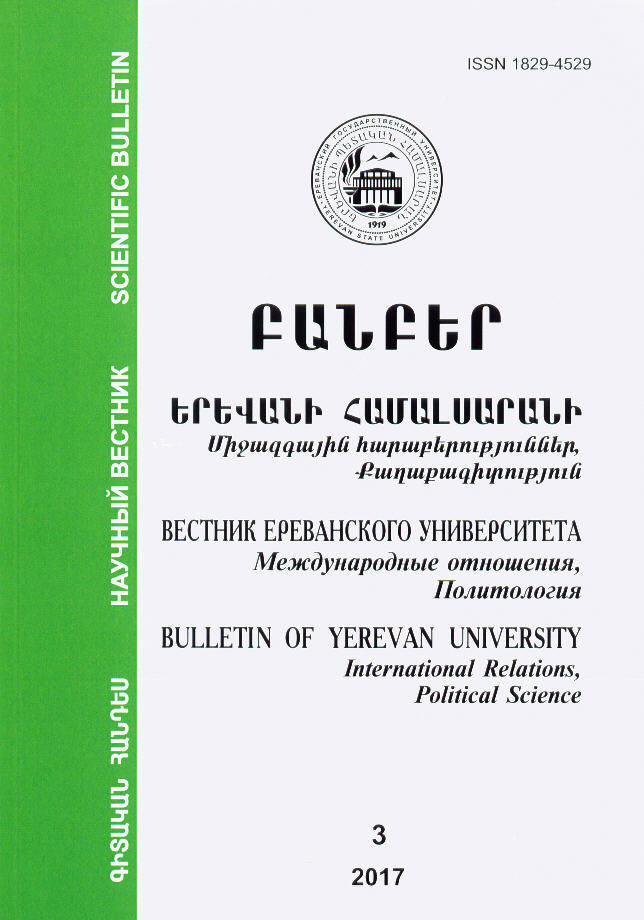
“Bulletin of Yerevan University. International Relations, Political Science” is a scientific journal devoted to the development processes of post-Soviet countries, the processes of European and Eurasian integration, and topical issues in international relations and diplomacy. The Bulletin publishes scientific articles and studies on the comparative study of contemporary political events, the democratization of political systems, the formation of civil society organizations, political ideology and culture, as well as public administration, geopolitics, civilizational interaction and humanitarian cooperation. The Bulletin is devoted to the study of a complex of problems of development and interaction of post-Soviet countries. The Bulletin accepts original articles and comprehensive studies not previously published.
The article deals with the issues of diplomatic negotiations in Batumi and the dismantling of the Transcaucasian state, as well as the creation of three independent republics. In Batumi, it became clear that the Turkish side abandoned its previous position on negotiating on the basis of the Treaty of Brest-Litovsk and put forward new, more serious territorial demands for the whole of the Caucasus and Armenia in particular. Through Transcaucasia, Turkey sought to pave the way for the Turkic-speaking regions of Central Asia. Such aspirations of Turkey contradicted the geopolitical and economic interests in the South Caucasus of its ally Germany. During the TurkishTranscaucasian diplomatic negotiations in Batumi, the delegations of Georgia and Germany initially prepared the ground for the final disintegration of the already disconnected independent Transcaucasian republic. Finally, at noon on May 26, the Transcaucasian Seim decided to disband it. In the evening of the same day, the head of the Turkish delegation Khalil-bey presented an ultimatum, and four hours earlier Georgia proclaimed its independence. On May 28, the National Council of Muslims proclaimed independence at the request of tribal Turkey (the Caucasian Tatars appealed to the Turkish delegation with a request to facilitate their entry into Turkey, but the request was rejected ...). On May 30, the National (Central) Council of Armenians declared itself the supreme and sole authority in the Armenian provinces.
The current article studies the nature and the dynamics of relations between the European Union and three post-Soviet countries, Armenia, Georgia and Moldova, after the collapse of the Soviet Union and their involvement in the European Neighbourhood Policy. In the article, it is attempted to uncover the compliance of the ENP with domestic and foreign political needs of the countries under consideration. Moreover, the article discusses the main mechanisms of transformation, i.e. Europeanization, implemented by the EU.
The author presents the main resources of soft power in international relations - culture, political values and foreign policy, separately revealing each of them. He
emphasizes the importance of the difference between the potential and the real soft power, as well as the process of transformation of the potential soft power into the real one. The author outlines various strategies for the realization of the soft power of countries in international relations, taking into consideration the differences of the aims they pursue.
In the article it is highlighted the idea, that modern democratic regime types, especially electoral democracies with their representative institutes are facing serious problems in terms of legitimacy and public trust. From this point of view on the bases of analyses of Armenian domestic political processes, the article suggests considering the public policy as an effective tool of civic culture in the relations of public and policy makers. Consequently, the article argues, that deliberative democracy and discursive politics are believed to be robust instruments insuring deliberative civic engagement in the process of decision making in the Republic of Armenia.
In the middle of the 20th century, in the context of increasing role and volume of information, as well as the development of information technology, the threats to information security became much more complicated. As a result, the perception of information security has changed. If previously, the concept of "information
security" was used in the context of the development of information and communication technologies to identify problems that arise through computer networks, now it has become more comprehensive, referring not only to the scope of technology.
The article analyzes one of the most important problems of the public administration of the Republic of Armenia (RA). The research subject is the public personnel policy as one of the main mechanisms of formation and recruitment of political elite. Specifically, the problem involves the study of the public service system,
its functionality. The study is an attempt to justify the necessity of introducing a unified public personnel policy in the public service system, which, in turn, will help to announce the principles of political elite formation and recruitment processes in the Republic of Armenia. The article highlights the role of the political elite as a group of politicians and high-ranking officials managing, controlling and leading the sociopolitical processes in Armenian society.
In the contemporary situation of market economy, the modernity of monitoring of Armenia’s migration policy is due to the direct influence of migration processes on public life and infrastructures. The comparative studies of the negative consequences of migration allow assessment of efficient management trends. In this regard, the development and actualization of efficient migration policy are vital for Armenian society.