
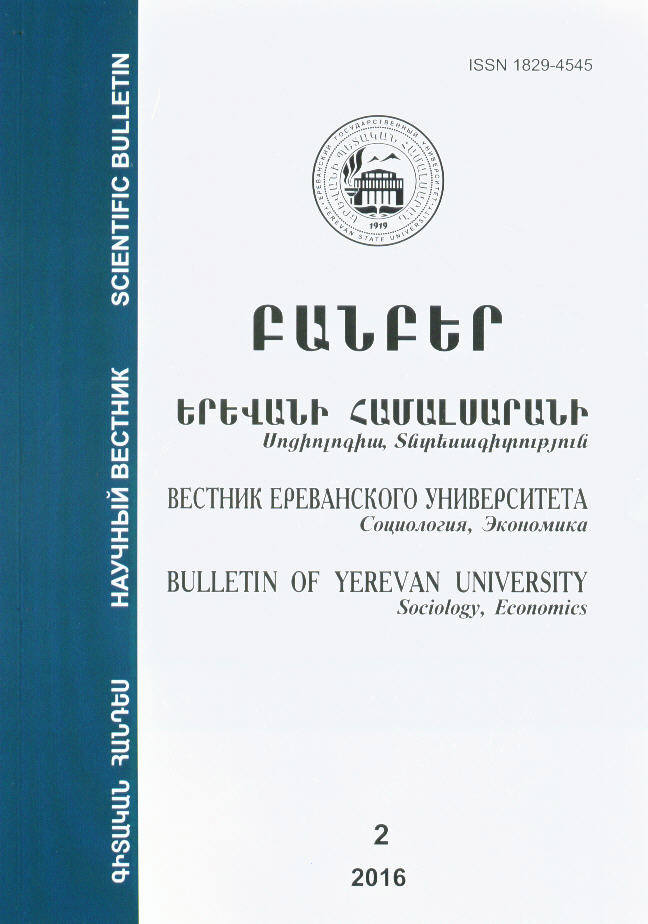
Banber Erevani hamalsarani. Sots'iologia.
| E - ISSN | : | 2738-263X |
| P - ISSN | : | 2579-2938 |

Since 2011 large-scale reforms have been initiated in public administration sphere of Armenia. They are directed towards the total changes in territorial division system of the country and assume merging communities. Though the reforms are highly demanded from the point of supporting the long-term development of local government system in Armenia they also can bring to very negative consequences. This article aims to study the possible negative effects of community expansion reforms in Armenia and discusses the ways of overcoming them.
Syrian Armenians had a passive role in the political life of Syria, as they were an important part of Armenian Diaspora and had responsibilities related to special functions, priorities, ethnic preservation, participation in social and economic life. Moving to Armenia and appearing in other social and political environment, they are standing in front of the adaptation of that environment, otherwise, the lack of political interest and their intention not to participate in the socio-political processes deprived them of being and feeling Armenian citizens.
In parallel with the civilizational development of the society, the true origins of the social construction gradually enfeeble. The deformation of the social ties and relations threaten to turn into a "social entropy", the social converts into a blank sign, devoid of any objective content. The erosion of the sustainable patterns in groups that represent the social identification, "a new atomization" and its reverse side - "massivization" - is the modern manifestation of the "demise of the social ', its appeal to the" simulacrum ". Does "social death" mean sociocultural retribution for civilization progress? As a result of the comparative-typological analysis of traditional, industrial and postindustrial societies, the author concludes that in the cultural and anthropological sense those countries progress most apart from technical and technological realities of the postmodern society who skillfully combine panhuman socio-cultural universals, traditional and modern values.
Some terms related to “social protection” are discussed in the article the clear and precise definition of which is very important for defining the content of the term “social protection”. Besides, the author presents the definition of the term “social protection” in the article
The transformation of traditional social networks to migration networks can be viewed as an undermining of traditional social cohesion between local community representatives. That is the modification of functional connections between community representatives or a disruption of traditional social ties and creation of new ties outside the community-formation of family networks on the principle of “transnationality”. By their nature these social processes do not only transform the existing social ties and relations in rural communities, making them transnational, but they also demonstrate the urgency of the problems inside the society, such as the weakening and distortion of social ties and relations, distortion of trust between the members of society, the loss of traditional identity of Armenian peasants, the attempt of community representatives to solve their economic problems through migration networks, by establishment of relations abroad.