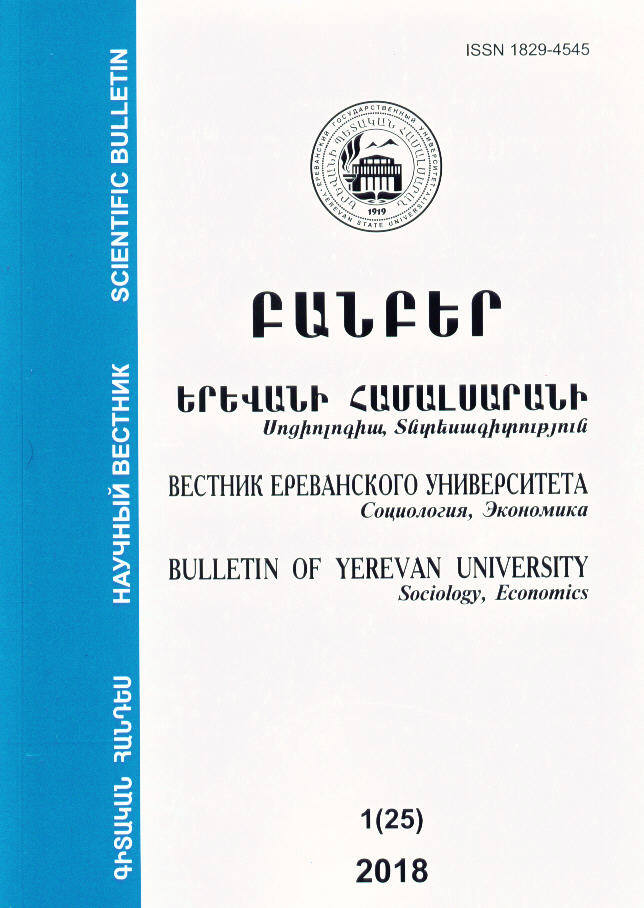
Banber Erevani hamalsarani. Sots'iologia.
| E - ISSN | : | 2738-263X |
| P - ISSN | : | 2579-2938 |

The article deals with the problem of correction of criminals in prisons. Based on the analysis of information, it is concluded that the imprisonment of offenders does not contribute to their correction, moreover, it does not create the prerequisites for their reintegration into the society. On the one hand, crime is growing all over the
world, on the other hand, an imprisonment is still a prevalent form of punishment in all societies. The societies spend huge financial resources on the maintenance of prisoners, but without serious success in their correction. Social workers will be able to radically change the situation in the penitentiary system of Armenia if there are adequate conditions for their rehabilitative activities.
Based on the sociological surveys of the residents of Yekaterinburg (Russia) and the migrant workers from Central Asian countries on the territory of Russia, the authors characterize the relationship between these two communities. The results show that the main reason for a negative attitude is primarily a cultural rejection and misunderstanding the cultural features of the other community. Shared social identity and the cultural identity in its core is analyzed within the framework of Samuel Huntington’s approach on the factors of identity formation. These studies demonstrate that the most important element in the relationship of Russians and migrants from the countries of Central Asia is culture or rather cultural differences. That is why the authors insist on a separate examination of the definition "cultural identity", the correction of which can result in a significant reduction of mutual hostility.
Transformation processes occurring in the socio-economic life of modern society, have a direct impact in people's minds, their sentiments, perceptions, estimates and, consequently, in behavior. An important area of research today is the use of the instruments for the study of socio-economic processes, which take into account subjective perceptions, evaluations, intentions, expectations and their impact on macroeconomic phenomena. One of these tools is the consumer confidence index (CCI) which is a multi-component indicator that is calculated on the basis of sociological information. This article examines trends in consumer sentiment of the Vologda oblast residents, examines the features of private components of the IPN study of consumer attitudes in terms of various socio-demographic and income groups of the population. The use of an index for macroeconomic research provides a rare opportunity to incorporate psychological factors when modeling and forecasting the economy. Preparation of forecasts of the socio-economic situation gives an opportunity to capture trends that are often difficult to detect using traditional econometric methods, and, on this basis, to make adjustments in the management of economic processes.
The problem of identity has become relevant at present. Being formed in a social environment, identity gives one a sense of the significance of its existence, becomes a means of unification, and provides the solidarization at the macro and micro levels of society. As a
multifaceted phenomenon, identity is studied in various fields of science. In sociology, the attention of identity is given to various concepts, among which the structural constructivism
by P. Bourdieu can be distinguished. Identity is based on the classification of entities each other’s interaction, on the identification of identical practices. At the base of the identical practices are similar principles of their creation. The concept of habitus provides an analytical model for studying and identifying the principles on the basis of which the interaction practices are created. In our case, as a habit, we consider the trust and the structures in which it is formed. Family structures and friendly networks act as such. To assess the formation of the habitus of trust in family structures, we believe it is possible on the basis of studying the opinion of respondents regarding the degree of interpersonal trust. The data indicate a high prevalence of this principle. A number of practices confirm this. Among them, the friendship and trust of friends, and seeking help in difficult situations.
In recent years on the background of Syrian civil war, an increasing flow of refugees to European countries was observed. The intensity of these migration processes raises the complexity of problems related to refugee’s safe mobility and integration processes accompanied by strict and enclosed migration policy in many European countries. In the crater of these developments, the role of civil society gets more significance. Particularly fictionalization of CS institutions defined with instrumental and discursive meanings, on the one hand, manifests itself by humanitarian-supportive, voluntary missions of CS subjects, on the other hand with articulated critical discourse and different forms of its implication (New social movements, for instance) in the sphere of CS. Thus, this paper based on the analysis of iconographic elements of CS discourse explores the hegemonic role of liberal democratic orientations and normative value systems, as well as discursive implementations of transnational paradigm.
Global migration processes are becoming an important factor in forming modern cultural landscape and an object of social networks and media close attention. Proceeding from the Copenhagen school securitization concept, it is the positioning of a problem as a threat that forms our attitude to it from the point of view of security. Mass migration is becoming one of such problems in the modern world. Modern Russian migration flows can be conditionally divided into internal and external. External flows are mainly represented by labour migrants from former Soviet republics, who used to be “own” but turned into “alien” due to the circumstances. Internal migrants predominantly constitute the mass flows of displaced migrants from former hot spots, largely from the Caucasus. They do not have a migrant status; they are Russian citizens, a part of “own” category. The regions of the Southern Federal District have become main host regions. The article analyses situation of the internal migrants and academic mobility subjects, “educational migrants” from Dagestan in the Astrakhan Oblast’, and the way the locals perceive them. The analysis of the forums and social networks has shown that the shift of internal migrant image from directory own/different to the “alien” directory is taking place. In separate cases, the process of demonization can be observed. It disturbs the ethnic and confessional balance that has existed in the region for centuries.