
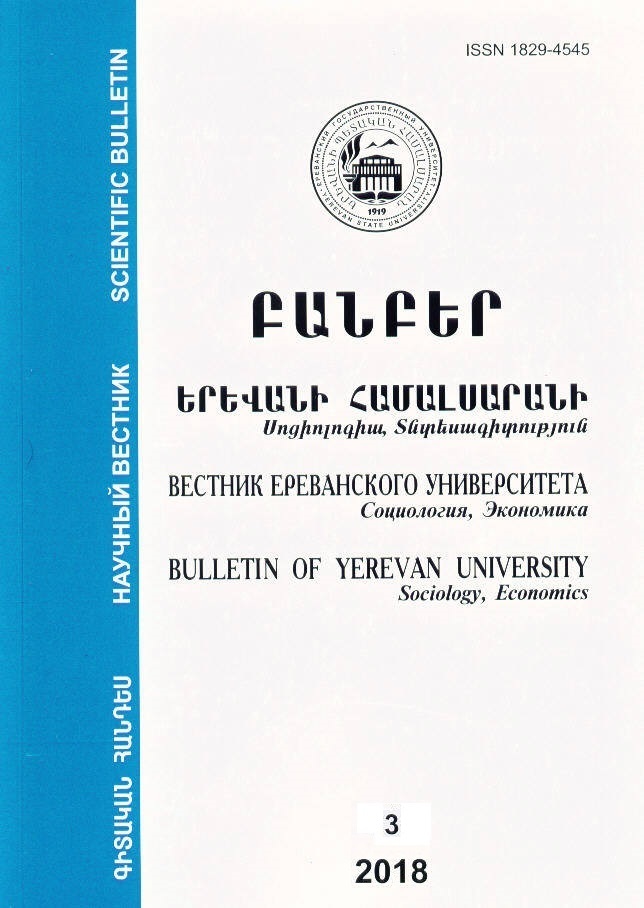
Banber Erevani hamalsarani. Sots'iologia.
| E - ISSN | : | 2738-263X |
| P - ISSN | : | 2579-2938 |

There are many approaches in scientific literature for interpreting the concept “social protection of the population”. They all suggest many varieties of how to explain it. Some suggest defining the social protection as a complex of procedures directed towards promoting stable profit of the different groups of the population. Other approaches consider social protection as a system of social risks’ regulation. There is no cumulative opinion also on how the social protection of the population connects with relevant notions like social state, a welfare state, social security, and social policy. The article discusses those issues. Particularly, it has an aim to generalize the main scientific descriptions and explanations of that concept and to interpret its connections with the notions mentioned above. The article also describes the opportunities for analyzing social protection by applying system analysis methodologies adopted by sociology.
The cultural, social, economic and political transformations that took place in public life in the 21st century led to serious changes in the context of the processes of interaction. As a result, the forms and purposes of communication have also been changed. Today one of the most important goals of communication is the demonstration of own social status and self-presentation. In this situation arises the problem of visualization of public life through visual communication. The main goals of social networks’ users are self-presentation, socialization, and integration. This article focuses on the detection of trends of visualization in public life. As the best platforms for the implementation of visual communication, we have observed the social networks Facebook and Instagram. The changes, which may arise in connection with the increase of the visual component in social networks, as well as the growing number of users of social networks, indicate that the social life today is largely based on visual communication.
Existing studies of social capital traditionally view children as objects and passive actors of the capital formation process. Acknowledging the child as an independent entity (subject) is a relatively new approach based on viewing them as subjects of rights. Here the child is an active participant of the social interaction process, who initiates in and develops their own social network. This article attempts to conducta comparative analysis of the two approaches mentioned above.