Vol. 30 No. 2 (41) (2026)
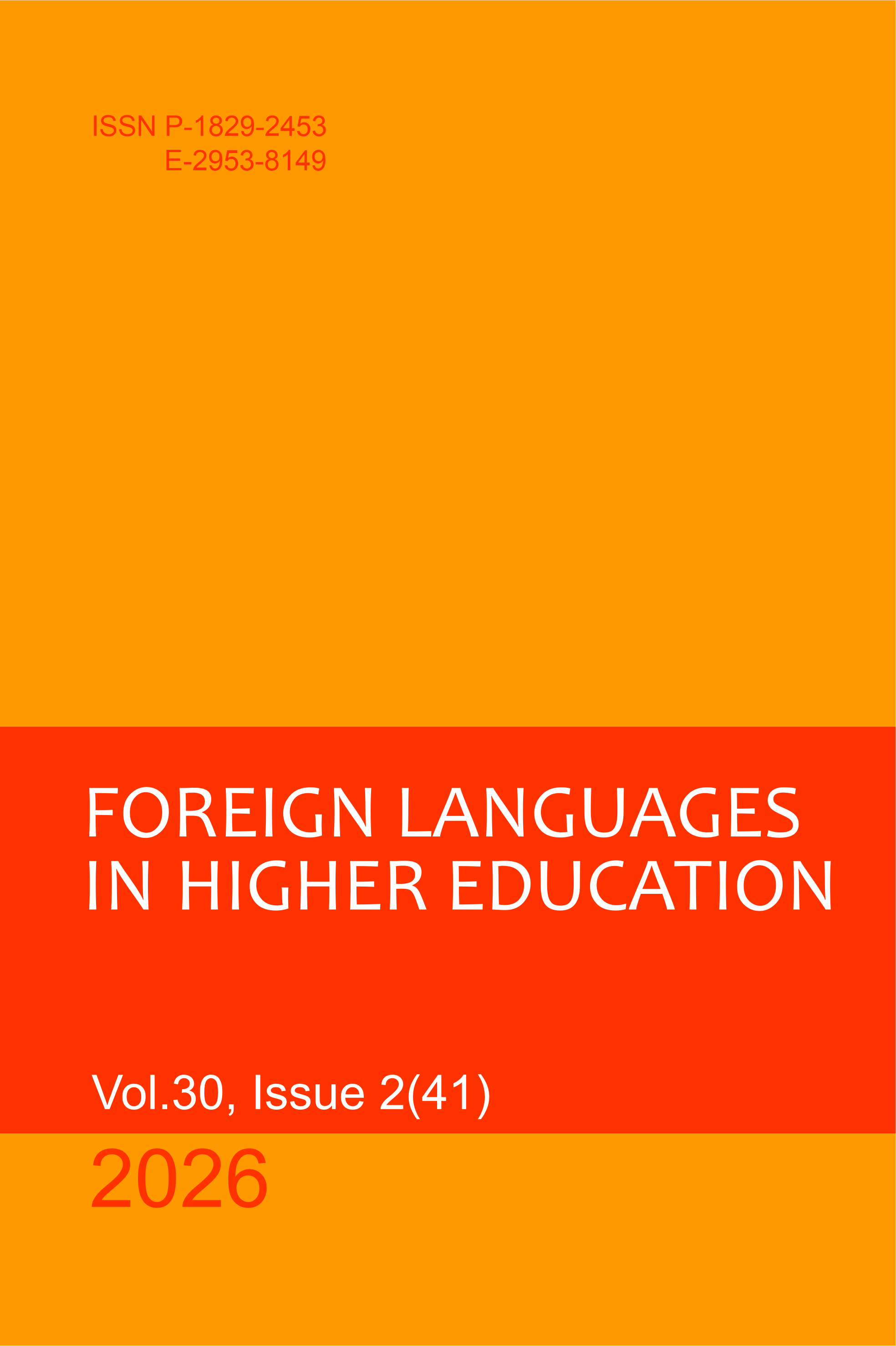
Full Issue
Linguistics
-
Linguistics
FABULOUS TOPONYMS IN BRITISH AND ARMENIAN LITERATURE: A STUDY OF REFERENCE
AbstractToponyms have long been a central focus of scholarly inquiry. Toponymy, the study of place names, is an interdisciplinary academic field. Several disciplines - including Linguistics, History, Geography, Ethnology, and Archaeology - examine these lexical units, each with its own specific interests. This study explores the linguistic mechanisms of reference employed in British and Armenian fabulous toponyms, namely the invented place names that populate the mythic or fantasy landscapes depicted in British and Armenian literature. By analysing examples such as Hogwarts, Narnia, Neverland, and Camelot, the article investigates how these fictional toponyms derive meaning through multiple referential layers. Three primary dimensions of reference are identified: intra-textual, pertaining to the internal structure of the fictional universe; inter-textual, relating to resonance with antecedent literary traditions and the real world; and real-world, involving references to geographical, cultural, and linguistic realities beyond the textual domain. The fundamental question remains: "How do we refer to something that does not exist in reality?"
References -
Linguistics
PRONOMINAL INNOVATIONS ON SOCIAL MEDIA: USAGE PATTERNS, DEVELOPMENT, AND FUTURE PROSPECTS ON X
AbstractThis research paper discusses the formation and development of linguistic innovations on social media platforms. Communication on social media platforms has unquestionably become an essential component of modern communication. As a result of social media communication, many grammatical structures and lexical items have emerged during the previous years, hence linguists need to identify these innovations, study the causes of their formation, and integrate them into the standard language. As new technologies have been developed, new language anomalies have appeared on social media sites. The English language has experienced significant modifications and alterations due to its widespread use in social media and increasing frequency on the Internet. Variations in language have a propensity to turn into standard forms over time. Hence, this research paper makes an attempt to study the most commonly used linguistic innovations on social media platforms, and their integration to language norms. The study focuses on pronominal invariants and includes a questionnaire to gather data on the causes and users of linguistic deviations. Time series analysis is used to predict the probability of linguistic innovations becoming language norms.
References -
Linguistics
HEDGING IN GENDERED DISCOURSE: A QUALITATIVE PRAGMATIC ANALYSIS OF FEMALE-FEMALE AND MALE-MALE DIALOGUES
AbstractThe current paper analyzes the gendered use of hedges in female-female and male-male interactions. The study uses a qualitative discourse-analytic approach based on the selected dialogues in One of Us Is Back by Karen M. McManus, The Goldfinch by Donna Tartt, and Inferno by Dan Brown, drawing on pragmatic, contextual, and gender-oriented perspectives. The results show that the interactions between females often include instances of hedging to facilitate negotiation, to reduce disagreement, to manage potential sensitive evaluations or to achieve interpersonal alignment. Female characters also employ unhedged contradiction, sarcasm and categorical statements, especially when familiarity allows for directness. A particular feature of the selected male–male interactions is the presence of hedging and related mitigation resources in situations where the speaker faces incomplete knowledge, accountability, moral or social vulnerability, dependence on the other speaker, or need to diminish the force of directives. Hedging can then be used by a male to serve protective, evidential and cooperative rather than only ambiguous functions. These findings reflect a contextual interpretation of gendered language that the role of hedging in women's and men's negotiations of intimacy, knowledge, authority, vulnerability, and communicative goal is different.
References -
Linguistics
THE ECOLOGICAL FOOTPRINT OF ARTIFICIAL INTELLIGENCE: AN ECOLINGUISTIC ANALYSIS OF MEDIA MULTIMODALITY AND POLITICAL RHETORIC
AbstractRapid technological advancement, particularly the rapid proliferation of Artificial Intelligence (AI) infrastructure, creates a profound paradox: while offering advanced monitoring tools for planetary conservation, its massive energy and water demands exacerbate systemic ecological crises. This study examines how eco-discourse and multimodal media shape public risk perception and political governance surrounding AI’s environmental footprint. Utilizing an ecolinguistic framework, we analyze media representations, investigative journalism, corporate messaging, and recent political rhetoric—focusing on executive policy shifts toward technological acceleration versus environmental regulation. The analysis demonstrates how language and visual semiotics either illuminate tangible ecological costs (such as data center resource depletion and ambient noise pollution) or obscure them through strategic euphemisms and greenwashing. Ultimately, the paper highlights the critical role of transparent public discourse in translating complex, abstract environmental data into urgent, actionable civic awareness and sustainable AI governance.
References -
Linguistics
THE ROLE AND SIGNIFICANCE OF DEIXIS IN MEDIA TEXT
AbstractDeictic expressions constitute an integral part of media communication, where they acquire special significance. The uniqueness of these linguistic units consists in their meaning, pragmatically charged and situationally anchored. This is particularly important in media texts, as the events, processes, and phenomena described must be localised in space and time to have the desired effect on recipients in terms of relevance, timeliness, dynamism, engagement, and appeal. The paper presents an approach to analysing media discourse, which is based on recognising the leading role of the human factor in communication. It reveals the significance of deixis in constructing and interpreting the content and structure of media texts and analyses the interaction between the addresser and the addressee, realised through the category of pronominal deicticity, particularly through the pragmasemantic potential of the pronoun 'we'.
References
Methodology
-
Methodology
PHRASEOLOGIZED SYNTACTIC STRUCTURES AS A COMPONENT OF NON-NATIVE SPEAKERS’ COMMUNICATIVE COMPETENCE
AbstractPhraseologized syntactic structures (PSS) convey speaker attitudes and subjective modality in colloquial Russian, yet their implicit meanings and limited cross-linguistic equivalence can make them difficult for non-native speakers to interpret. This study examines their role in communicative competence in Russian as a foreign language (RFL) and their relevance to instruction at the B2-C1 levels. The analysis reviews classifications considering the structural and semantic idiomaticity of PSS and their functions in different communicative contexts. It relates these features to the development of pragmatic awareness, discourse competence, and sociocultural competence. The discussion identifies the limited coverage of PSS in contemporary RFL textbooks as a gap in advanced language instruction and proposes exercises for recognizing these structures, interpreting their meanings in context, and using them appropriately in communication. The study argues for the systematic inclusion of syntactic phraseology in advanced RFL teaching, with attention to the relationship between linguistic form, speaker stance, and communicative context.
References -
Methodology
THE IMPLEMENTATION OF PROJECT-BASED LEARNING METHODOLOGY IN SOCIAL SCIENCE EDUCATION AT V. BRUSOV STATE UNIVERSITY
AbstractHigher education has stopped being about the transmission of theories and abstract knowledge in Social Sciences for a couple of decades. It has become about the development of professional, social, and real-life skills that are applicable after graduation. In this regard, project-based learning (PBL) methodology is one of the most efficient methodologies to achieve these outcomes. For that purpose, the current paper examines how project-based learning methodology is implemented and adopted in the context of teaching English as a Foreign Language for professional purposes to Armenian students at the “Public Communication and Service” faculty at Brusov State University. The aim of the article is to represent how the methodology was implemented and what outcomes were acquired while teaching English for professional purposes to 83 students from the PR, Service, and Tourism departments. The methodology applied in the current study relies on a data-driven, evidence-based descriptive approach. In other words, the research paper details the results that were recorded in each phase of the methodology application. As an outcome, the students developed their professional knowledge, soft skills, and language proficiency. Moreover, the methodology application contributed to the growth of social responsibility and emotional features.
References