
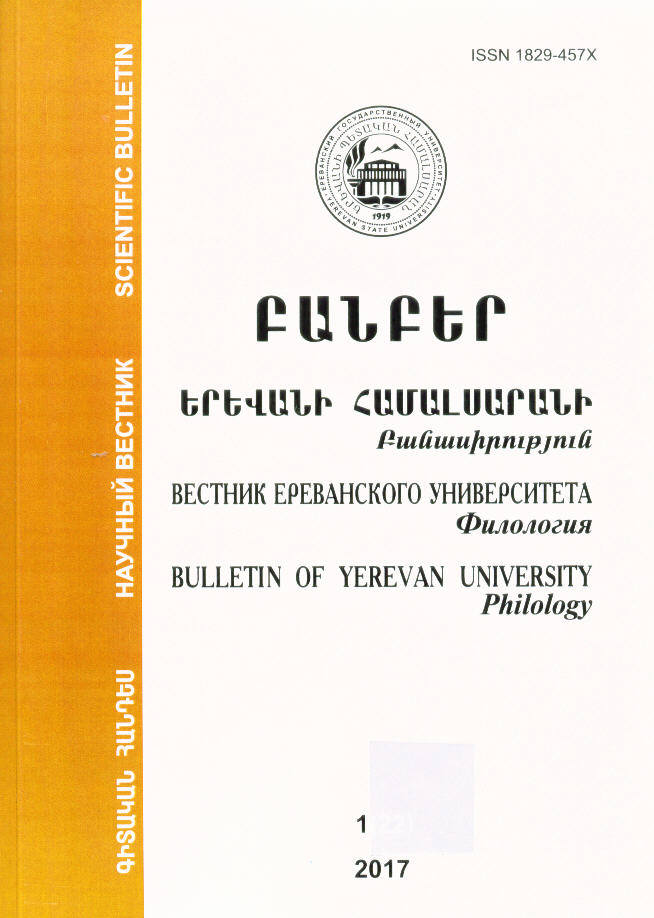
Banber Erevani hamalsarani. Banasirut'yun.
| E - ISSN | : | 2738-2575 |
| P - ISSN | : | 1829-457X |

In Modern Eastern Armenian, the punctuation of some grammatical tags raises confusion. Over time, some contradictions appear in the rules and structural usage of punctuation. There is a part of a quotation or parallel punctuation threads, which is contrary to the punctuation rules. This article will detail the rules and threads of such contradictions and obstacles to the realization of the textbooks and instructional materials in Modern Eastern Armenian. Guided by this modern punctuation dilemma, as well as inter-linguistically attempt tojustify and correct punctuation structures freely.
In the VII-VIII centuries Armenian Holy Hymn Canon (Sharakan) History initializes a new stage: authors working during this period (Komitas Aghdzetsi, Sahak Dzoraporetsi, Hovhan Odznetsi, Stepanos Syunetsi, Sahakadukht) create Sharakans rich in scriptural, Christian and national Holy Hymn topics, Canon is included in chronicles. Through linguistic investigation of Sharakans, it is possible to make an idea about the linguistic patterns of this genre. This article investigates morphological realities of Sharakans, considering which we especially tried to find out if Sharakans have deviations from Grabar (old Armenian) or not. Investigating some noticeable linguistic characteristics of such parts of speech as nouns, adjectives, numerals, pronouns, verbs, etc., it is found out that there is little difference between the morphological system of Sharakans and classic Armenian. The differences have semantic and syntactic character.
In 1894-1923 on the territory of the Ottoman Empire occurred not only the Armenian Genocide programmed by state but also
linguicide still ongoing on different manifestations. Thousands of Armenian educational and religious institutions, theaters, cultural centers, mass media, publishing and printing houses, libraries, medieval manuscripts were destroyed, writers, poets, teachers of Armenian were arrested and killed, many Armenian folklore works disappeared, Armenian toponyms in Western Armenia were constantly being replaced by Turkish ones, most of the western dialects of Armenian had been wiped out at once or gradually. The Western Armenian had lost homeland. A fruitful and effective Armenian environment was gone, of which only scraps and pieces stayed in the Diaspora. Western Armenian in each colony is influenced by the dominant language of the country. In the past two decades, he began to be influenced also by the Eastern Armenian language. He even forced out of family consumption due to more and more spreading of mixed marriages. Western Armenian now is an endangered language around the world. The Turkish Republic with its foreign policy and by dint of international terrorist organizations is trying to weaken and destroy the Armenian colonies in the Middl e East.
The purpose of our article is the consideration of the ways of expressing satire in Arandzar's short stories, which demonstrate Western Armenian reality during the end of XIX – the beginning of XX centuries. The unity of oppositions of comedy and tragedy, sorrow and laughter is the most characteristic line of Arandzar's satire. This is an ideological phenomenon and turns into a systematized way of thinking. The target of Arandzar's satire is different aspects of Western Armenian literary, social and political life of his time, which distorts the mentality and psychology of the Armenians who live under the Turkish yoke. In his short stories, sharp satire is directed against the Turkish arbitrariness, the legal system, the impunity of the rulers on the one hand, on the other hand, the writer with no less acutesatire criticizes the cowardice of rich Armenians, their indifference to their own people.
One of the basic concepts of narratology is the point of view. In the 1980s the term focalization, which was brought in use by G. Genette, became widely popular. It implied the restriction of the scope as compared to omniscience. Focalization has three degrees; zero, internal and external. These three can be presented simultaneously in some works, thus providing rhythmic and informational variation. A remarkable example of the simultaneous implementation of the three
focalisation degrees in modern Armenian literature is the novella “Hangover” by Hrant
Matevosyan, where the narrator conveys various information
A. Martine’s Book “The Principle of Economy in the Phonetic Changes” is one of the fundamental works of diachronic phonemics. According to “The Principle of Economy in the Phonetic Changes” the phonetic/phonemic changes occurring in the language are conditioned by the communication momentum in the process of speaking and the resistance of human anatomy organs to them. This is a phenomenon, which J. Tsipf had formulated as a law of “minimal effort”. Although in A. Martine’s
concept the main functives (series, row, correlation) refer to the paradigm (system), but their function becomes a reality in the flow of speech (syntagm). Accordingly, it is not correct to claim that A. Martine’s “theory of economy” is constructed exceptionally with the counting of systematic data. Although he has treated the notions of “phonetic laws” and linguistic similarities with stipulation and tried to build an open theoretical system which will take into consideration not only the famous facts, but also will leave room for observations, his system is also not devoid of the trend of universality which should be considered quite natural. Being very well-structured “The Theory of Economy” is, however, not devoid of some contemplation of mind.
Proper names like common nouns have their general lexical characteristics. The anthroponymic vocabulary of the language consists of two major layers: a) active names or basic anthroponymic vocabulary and b) passive names. The second layer in its turn has 2 subgroups: 1) obsolete names and 2) new names, neologisms, which are not rooted in the active anthroponymic vocabulary. These names can easily be transferred in the course of time into the active layer or become occasionally In the musoedde rwno ardn tuhnroitpso. nymic vocabulary of the Armenian literary language, we would note the following main tendencies are noted in the selection and use of personal names: a) complex or composite anthroponyms are replaced with shorter ones, compound names lose their suffixes or other root particles thus becoming short monosyllabic names, for example, Արեգնազ (Aregnaz) > Արեգ (Areg), Ոսկեհատ (Voskehat)> Ոսկի (Voski), Նաիրուհի (Nairuhi) > Նաիրի (Nairi), Արևիկ (Arevik) > Արեւ(Arev), Աստղիկ (Astghik) > Աստղ (Astgh), b) the increasing use of so-called universal, common names, which are both female and male anthroponyms: Արեգ (Areg), Տաթև (Tatev), Նաիրի (Nairi), Վան (Van), Շուշի (Shushi), c) the most popular foreign names, mainly European and biblical, national names are used less, names of this type are losing their function of national identification – Էլեն (Elen), Միլենա (Milena), Ալան (Alan), էրիկ (Erik), Էդուարդ (Eduard), Ալեքս (Alex), Մարիա (Maria), Մերի(Meri), Մարի (Mari), Էմանուել (Emanuel), Սառա (Sara), Եվա (Eva) etc. The latest tendency is quite alarming.