
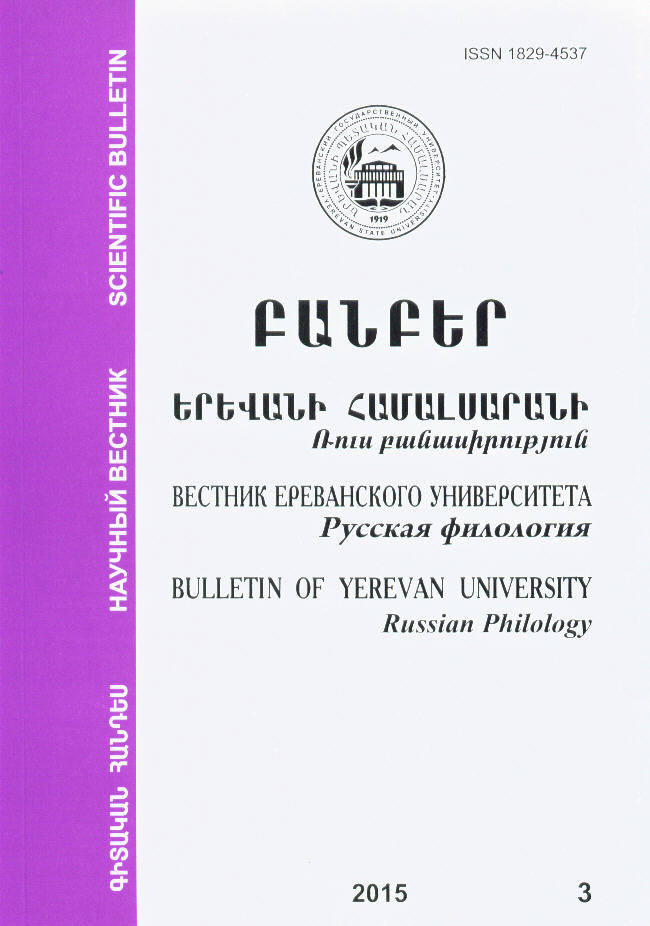
Banber Erevani hamalsarani. Ŗus banasirut'yun.
| E - ISSN | : | 2738-2583 |
| P - ISSN | : | 1829-4537 |

The article examines the literary connections between Paruyr Sevak’s poetry and Marina Tsvetaeva’s works. It is shown that Sevak knew Tsvetaeva’s poetry perfectly, highly appreciated it and had been influenced by poetess’s figurative thinking and way of constructing poetic language. The propinquity of Armenian and Russian poet's love lyrics is a matter of special attention. The author concludes that Tsvetaeva’s deep and original art had a indubitable impact on the motivs, philosophy and poetics of Sevak’s works.
Inna Lisnyanskaya (1928–2014) is a highly visible figure in Russian poetry of the last decades. Under the Soviets many of her poems could not be issued due to the censorship restrictions, and during 1979-1987 she was not published in the USSR at all. After 1988 Lisnyanskaya got her recognition, critical acclaim and some prestigious awards (RF State Prize, Solzjenicin Prize, the prize “Poet”). Born and raised in Baku (her mother was an Armenian), Lisnyanskaya repeatedly addressed herself to Armenian themes (massacres in Shushi in 1918 and in Baku in 1990, the destruction of “her dearest” Stepanakert in 1992). “Armenian verses" аге not exceptional, but more than natural in the trend of Lisnyanskaya's poetry. It is shown in the paper, that they reflect characteristic features of her work .
Undertaking the translation and publication of Armenian medieval poetry, especially “Book of Lamentations” by Grigor Narekatsi had a special place within the scope of academician Levon Mkrtchyan’s activity. Since 1960-s Levon Mkrtchyan initiated the realization of a number of activities involving Naum Grebnev – a well-known expert in the art of translation. The published letters are evidence of the efforts owing to which the works of Armenian medieval poets, especially Kuchak, Narekatsi, were published in Russian and highly appreciated.
Modus and subtext are different categories. The value implied by speaker does not always correspond to the objective meaning of the utterance. “The value implied by speaker”, or hidden meaning, is realized through the intonation. Teachers should be aware of the difference between pragmatic and projective methods of communication for adequate delivering it to students. Projective text cannot be correctly interpreted without a good knowledge of the relevant culture.
