

Vol. 19 (2021)
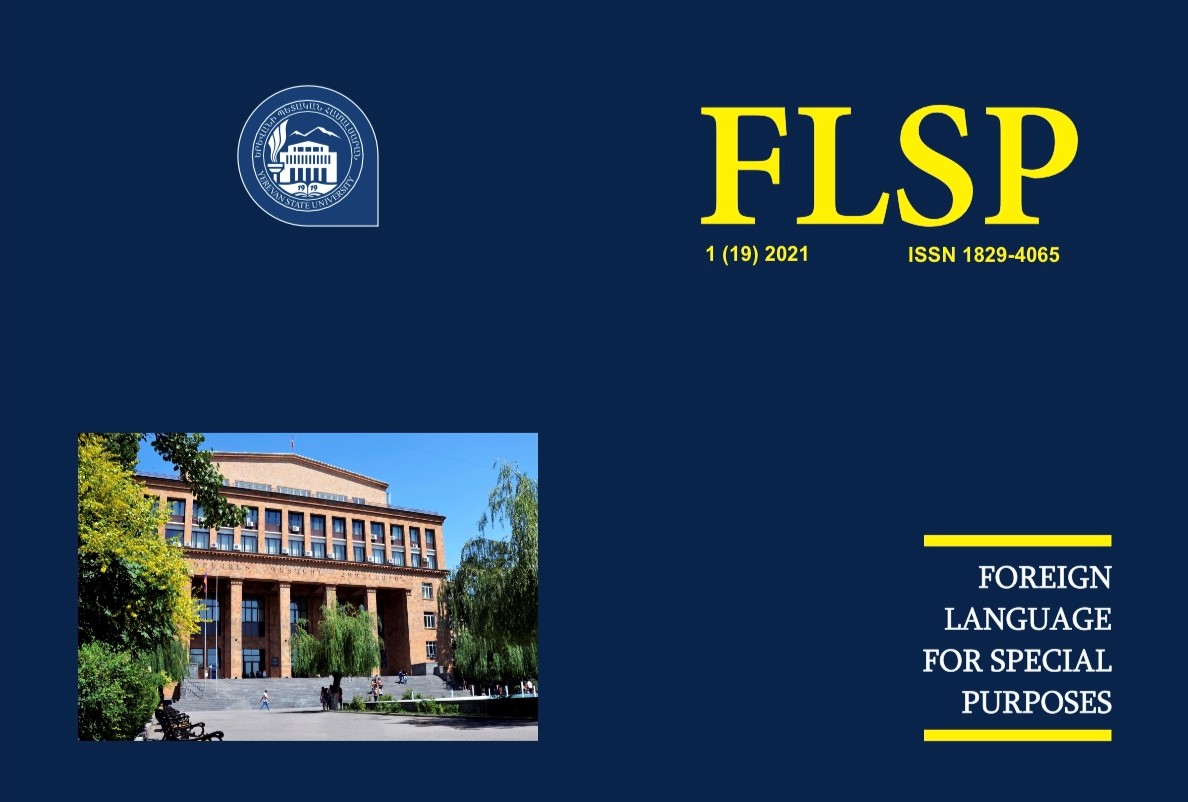
Full Issue
Articles
-
Articles
THE BASIC PRINCIPLES AND MEANS OF "EXPRESSIVE SYNTAX" IN ENGLISH
AbstractThe present article highlights the basic principles and means of "expressive
syntax" in English.
As is known, expressiveness covers all areas of the language: its arsenal of
expressive means is not limited. Paying proper attention to the problems of
expressiveness particularly to concepts of "expressive syntax" and "stylistic
syntax" some of the scհolars adhere to the point that the subjects of their study
are somewhat different. "Expressive syntax" explores linguistic sources of speech
expressiveness, whereas "stylistic syntax" studies the structure of speech with
regard to it stylistic features.ReferencesАлександрова О.В. (1984), Проблемы экспрессивного синтаксиса. М.:
Высш. школа. – 211 с.
Арнольд И.В. (1990), Стилистика современного английского языка: (Стилистика декодирования) Текст: учеб. пособие для студентов пед. ин-тов по
спец. «Инос. яз.». / И. В. Арнольд. 3-е изд. – М.: Просвещение – 300 с.
Бархударов Л.С. (1975), Язык и перевод (Вопросы общей и частной
теории перевода), М. – «Междунар. отношения».
Ванников Ю.В. (1965), Явление парцелляции в современном русском
языке Текст. / Ю. В. Ванников. М., – 189 с.
Валгина Н.С., Синтаксис современного русского языка. М., 1980 - 416 с.
Виноградов В.В., (1954), Некоторые задачи изучения синтаксиса простого
предложения. // Вопросы языкознания.
Виноградов В.В., (1981), Проблемы русской стилистики. Москва,– 319 с.
Гак В. Г., (1981), Теоретическая грамматика французского языка. Синтаксис, М., – 832 с.
Иванчикова Т.В. (2010), Формирование речевой компетентности студентов
экономических специальностей вуза: ситуационный подход Текст. / Т.В.
Иванчикова //Дис. . д-ра пед. наук. -М.,.
Розенталь Д. Э. (1977), Практическая стилистика русского языка Текст. :
учебник для вузов / Д. Э. Розенталь. М.: Изд. 4-е. испр — М.: Высш.
школа,.-316 с.
-
Articles
FEATURES OF INTERCULTURAL COMMUNICATION IN SOCIAL MEDIA
AbstractAs a result of the scientific analysis of the peculiarities of intercultural
communication in social media, the article theoretically proves that the presence
of certain personal qualities of media consumers is not enough for the formation
and development of communication skills in social media, since here the
communication process is inextricably linked with speech. Language literacy
implies language proficiency and the practical application of all forms and
methods of correct speech construction. And speech competence is the skill of
creating methods for formulating thoughts and their appropriate application in the
process of perceiving and transmitting information. The conviction is expressed
according to which correctly constructed media cultural communication is a
meaningful substantiation of language connections, mastery of the transmission
mechanisms of words, phrases and sentences, the acceptance of language
thinking, ethnic and socio-cultural stereotypes of the communicating parties, in
compliance with the accepted norms of communication in social media.ReferencesБиблер В. С. (1989), Культура. Диалог культур. Вопросы философии, № 6.
- С. 31-42.
Гальскова, Н. Д. (2004), Теория обучения иностранным языкам: Лингводидактика и методика: Учеб. пособие для студ. лингв, ун-тов и фак. ин. яз.
высш. пед. учеб. заведений Текст. / Н. Д. Гальскова, Н. И. Гез. М.:
Издательский центр «Академия», с. 336.
Головлева Е. Л. (2008), Массавые коммуникации и медиапланирование
//Феникс, Ростов на Дону, с. 200.
Грушевицкая Т., Попков В., Саохин А. (2002), Основы межкультурной
коммуникации // Учебник для вузов, с. 277.
Гумбольт В. (1985), Язык и философия культуры, М.: с. 452.
Манукян А.М. (2019), Социально-психологические механизмы гипнотического манипулирования сознанием масс в медийном пространстве на
примере социальных сетей (Vk, Facebook, instagram) Азимут научных
исследований : Педагогика и психология. Москва, Т 8. N 3(28) с. 345-347.
Муратов А. Ю. (2005), Использование проектного метода для формирования межкультурной компетенции //Интернет-журнал «Эйдос»,
//http://www.eidos.ru/joumal/2005/0523.htm.
Сафонова В. В. (1996), Изучение языков международного общения в
контексте диалога культур и цивилизаций. Истоки. Воронеж., с. 237.
Сепир. Э. (1993), Избранные труды по языкознанию и культурологии. М.,
с. 656.
Пикулева Ю. Б. (2002), Культурный фон современной телевизионной
рекламы // Известия Уральского государственного университета. – Екатеринбург, № 24. с. 268-276.
Чибисова О. В. (2011), Взаимодействие молодежных субкультур как тип
межкультурной коммуникации.- LAP LAMBERT Academic Publishing ISBN, с.
Berry J. W., Poortinga Y. H., Segall M. H and Dasen (2002), Cross-Cultural
Psychology: Research and Applications, (2nd edition). Cambridge: Cambridge
University Press, 588p.
Brooks N. (1986), Culture in the classroom. In JM Valdes (Еd.) Culture bund.
Cambridge: Cambridge University Press, pp. 123-129.
Deardorff D. K. (2008), What is Intercultural Competence? //Kellner-verlag.
Germany, p. 10.
Fitzgerald H. (2003), How different are we? Spoken discourse in intercultural
communication. Clevedon: Multilingual Matters.
Hall E. T. (1990), Understanding Cultural Differences //Intercultural Press, p.
Samovar, L. A., Porter, R. E., & McDaniel, E. R. (2010).Communication
between cultures (7th ed.). Boston, MA: Wadsworth Cengage Learning.
Samovar, L. A., & Porter, R. E. (1997) (Eds.). Intercultural communication: A
reader (eighth ed.). Belmont, Ca: Wadsworth Publishing Company, p. 244.
-
Articles
ON CURRENT APPROACHES TO THE CONCEPT OF POLITENESS
AbstractIn recent decades abundant linguistic and interdisciplinary research has
focused on the study of conditions for communicative success and effectiveness.
In the light of these studies the concept of politeness has gained special
importance. It is viewed as a special communicative-pragmatic category
regulating speech behavior This article aims at studying and analysing the current
theories and approaches to the concept of politeness, focusing specifically on the
analysis of politeness principles, maxims and postulates advanced by Grice,
Leech, Goffman, Lakoff, Brown and Levinson.ReferencesBrown P., Levinson S. (1978), Universals in Language Usage: Politeness
Phenomena // Questions and Politeness: Strategies in Social Interactions. Ed.
by Goody E.N., Cambridge, Cambridge University Press.
Brown P., Levinson S. (1987), Politeness: Some Universals in Language
Usage, Cambridge UP, 30-198.
Goffman E. (1967), On face-work: An analysis of ritual elements in social
interaction. In E. Goffman (Ed.), Interaction Ritual, Garden City, NY, Anchor
Books, p. 5-46.
Goffman E. (1981), Forms of Talk. – Philadelphia, p. 335.
Grice H.P. (1975), Logic and Conversation. – In: “Syntax and Semantics”, v. 3,
ed. by P. Cole and J.L. Morgan, N.Y., Academic Press, p. 45-134.
Lakoff R. (1973), The logic of politeness: or, Minding your p’s and q’s //
Papers from the Ninth Regional Meeting: Chicago Linguistic Society. - #9,
Chicago, University of Chicago, p. 292-305.
Leech G.N. (1983), Principles of Pragmatics. London – N.Y., Longman, pp. 3-
Zhang Q. (1998), Fuzziness – vagueness – generality – ambiguity // Journal of
pragmatics, vol. 29, #1, p. 31.
Аллен Дж.Ф., Перро Р. (1986), Выявление коммуникативного намерения,
содержащегося в высказывании. // Новое в зарубежной лингвистике, Вып.
, М., Прогресс, с. 322-363.
Винокур Т.Г. (1993), Говорящий и слушающий. Варианты речевого
поведения. М., Наука, с. 60, 172.
Демьянников В.З. (1982), Конвенции, правила и стратегии общения
(интерпретирующий подход к аргументации). Известия АН СССР, Серия
лит-ры и языка. #4, с. 327-337.
Ермакова О.Н., Земская Е.А. (1993), К построению типологии коммуникативных неудач (на материале естественного русского диалога) // Русский
язык в его функционировании. Коммуникативно - прагматический аспект.
М., с. 20, 65.
Земская Е.А. (1994), Категория вежливости в контексте речевых действий
// Логический анализ языка: Язык речевых действий. М., Наука.
Карасик В.И. (1992), Язык социального статуса. М., Институт языкознания
РАН, Волгогр. гос. пед. институт.
Русский язык в его функционировании: коммуникативно-прагматический
аспект. √ М., 1993, с. 35, 221.
Формановская Н.И. (1982), Употребление русского речевого этикета. М.,
с.4, 201.
-
Articles
TENDENCIES OF THE STRUCTURAL IMPLEMENTATION OF SENTENCES IN MODERN GERMAN
AbstractThe article examines several trends of the structural implementation of
sentences in modern German. As a result of the study it has become clear that
there is a tendency towards the expansion of the substantive group and the
reduction of the frequency of the use of subordinate sentences in case of the
usage of the substantive group and subordinate sentences. As for the “frame
structures” in German, in this case there is a clear tendency towards
“framelessness”. The analysis of the “passive field” in German has shown that
alongside with the paradigm of the latter there are such verb structures which can
be considered synonymous to the passive structures.ReferencesԳաբրիելյան Յու. (2006), Գերմաներեն լեզվի տիպաբանություն, Երևան,
Երևանի համալս. հրատ.:
Braun P. (1979), Internationalismen-Gleiche Wortschätze in europäischen
Sprachen //Muttersprache, Wiesbaden, Gesellschaft für Deutsche Sprache, N
Duden. (1983), Deutsches Universalwörterbuch. Die authentische Darstellung
des Wortschatzes der deutschen Sprache, Mannheim, Bibliographisches
Institut.
Eggers H. (1983), Wandlungen im deutschen Satzbau. Vorzüge und Gefahren
// Muttersprache, Wiesbaden, Gesellschaft für deutsche Sprache, N 93.
Eichler W. (1976), Bünting K. Deutsche Grammatik. Form, Leistung und
Gebrauch der deutschen Gegenwartssprache, Kronberg im Taunus, Scriptor.
Erben J. (1968), Deutsche Grammatik. Ein Leitfaden, Frankfurt am Main,
Fischer-Taschenbuch.
Gabrieljan Ju. (2008), Deutsche Grammatik in Theorie und Praxis, Jerewan,
Verlag der Universität Jerewan.
Korn K. (1962), Sprache in der verwalteten Welt, München, dtv Deutscher
Taschenbuch Verlag.
Polenz von P. (1984), Entwicklungstendenzen des deutschen Satzbaus,
Göttingen, Vanderhoeck und Ruprecht.
Rath R. (1965), Trennbare Verben und Ausklammerung // Wirkendes Wort,
Schwann-Pagel, N 15.
-
Articles
ON SOME MICRO- AND MACROLINGUISTIC FEATURES OF ENGLISH FOOTBALL COMMENTARY
AbstractThe article deals with the language of football sportcasting, a genre with
increasing discursive importance. Football commentary is relevant, since its
linguistic features have been studied to a certain extent. Football and sportcasting
in general is a highly distinctive English genre with heavy reliance on
extralinguistic components of the communicative situation, in particular, the phase
of the play, channel of transmission, characteristics of the announcer and his/ her
erudition. Commentator's talk mainly describes the actual happenings,
simultaneously fulfilling the foregrounding and entertaining functions. This brings
into play macro-discursive and microlinguistic or subtextual features to sustain the
viewers' attention and the rapport between the announcer and the unseen
audience.ReferencesChovanec, J., 2009, Review on Football, Language and Linguistics, Time-Critical Utterances in Unplanned Spoken Language, Their Structures and Their
Relation to Non-Linguistic Situations and Event, Journal of Pragmatics, 390 p.
Crystal, D. and Davy D., 1969, Investigating English Style, London: Longman,
p.
Crystal, D., 1999, The Cambridge Encyclopedia of the English Language,
Cambridge: CUP, 491 p.
Delin, J. 2000, The Language of Everyday Life, London: Sage, 208 p.
Ferguson, C. 1983, Sports Announcer Talk: Syntactic Aspects of Register
Variation. Language in Society, 153-172 p.
Freeborn, D. 1986, Varieties of English, London: Macmillan, 282 p.
Goffman, Е. 2011, Face-Work and Interaction Rituals, Oxford: Oxford
University Press, 235-44p.
Lappin, R. 2000, Investigating the Lexical, Syntactic and Stylistic Features of
Television and Radio Football Commentaries, UK, East Yorkshire: South
Hunsley School, 175 p.
Lopez, C. Perez, 2018, A Comparative Study of War and Sport Metaphors in
Poltical News, Barcelon: Universitat Autonoma de Barcelon,,
https://ddd.uab.cat/pub/tfg/2018/196074/Perez_Carla_TFG.pdf
Müller, T. 2007, Football, Language and Linguistics. Time-Critical Utterances
in Unplanned Spoken Language, Their Structures and Their Relation to Non-Linguistic Situations and Events, Language in Performance, Tübingen: Gunter
Narr, 269-282p.
-
Articles
STRATEGIES OF TRANSLATING ANTHROPONYMS IN J. R. TOLKIEN’S THE LORD OF THE RINGS (comparison of English and Armenian versions of the epic)
AbstractThe article considers the strategies employed in the translation of
anthroponyms in J. Tolkiens The Lord of the Rings into Armenian. Anthroponyms
here are used with the dominant quasi-anthroponyms to create the mythical and
magic atmosphere of the Middle Earth. They relate to the class of realia or
culture-bound words, which have increasingly been in the centre of attention of
translators and are relevant. Culture-bound proper names of The Lord of the
Rings demand consideration to preserve the intention of the source text, resulting
in different proportion of adequate and equivalent analogues.ReferencesBaker M. (1992), In Other Words. London and New York: Routledge, 317p.
Catford J. (1965), A Linguistic Theory of Translation: An Essay in Applied
Linguistics. London: Oxford University Press, London: Unwin Books, 214p.
Davies E. (2003), A Goblin or a Dirty Nose? The Translator: Studies In
Intercultural Communication 9(1). Manchester: St. Jerome Publishing, 330p.
Harvey, M. (2003). A Beginner's Course in Legal Translation: the Case of
Culture-Bound Terms, 357-369pp.
Kriegs H. (1986) Translation Problems and Translation Sstrategies of
Advanced German Learners of French, Interlingual and Intercultural
Communication, Tubigen, 263-275p.
Levitskaya T. and Fiterman A.M. (1973) Textbook about Translation from
English into Russian, 477p.
Newmark P. (1988), A Textbook of Translation. Hertfordshire: Prentice Hall,
p.
Newmark P. (1991), About Translation. Great Britain: Cromwell Press, 207p.
Nida E. (1964), Towards the Science of Translating. Netherlands: Leiden, 321p.
Nadelcheva S. (2017), Translation Strategies in the Lord of the Rings, the
Twelfth International Scientific Conference, 1213-1220pp.
Magarh'an E'., Madanineri Diragaly, (1989), https://lib.mskh.am/-
images/books/Matanineri-tirakaly_J.R.R.Tolkien.pdf, 995p.
Paghtasarh'an S., Kh'o'wrch'ah'anc S. (2018), Hah'ereni antznano'wnneri dar'atartzman xntri sho'wrch', Panper, EBLH, Er&an, e'ch' 161-174
Бреус Е. (2000), Основы теории и практики перевода с русского языка на
английский, 101с.
Гудий К. (2012), Типология приемов передачи культурно-специфических
слов, Вестник Воронежского государственного университета. Серия:
Лингвистика и межкультурная коммуникация, с. 180-184
Казакова Т. (2001), Практические основы перевода, Издательство Союз, С.
Петербург, 164 с.
Латышев Л. (2005), Технология перевода: Учеб. пособие для студ. лингв,
вузов и фак., Издательский центр «Академия», 159 с.
-
Articles
THE EXPRESSION OF THE WRITER’S INTENTION THROUGH METAPHORIC SIMILES
AbstractThe subject matter of the present article is the study of metaphoric simile as
an embodiment of the writer’s intention in verbal art. The study of verbal art in
very general lines brings us closer to the central question of the paper. The
problem of simile as a figure of speech is discussed and the attention is focused
on its realization in verbal art. "Metaphoric similes" are closely connected with the
global purport of the work and the intention of the writer. The study of the material
confirms that the category of literary simile as a stylistic figure very widely used in
verbal art is constituted by two categorial forms: "metaphoric simile" and
"metonymic simile" which are opposed to each otherReferencesВиноградов В.В. (1959), О языке художественной литературы.
Гаспарян С.К. (2000), Фигура Сравнения в Функциональном Освещении.
Ереван,
Хоффнан Р., Кассирер Э., Якобсон Р., Ричарде А., Блэк М., Лакофф
Дж., Ортониидр А.(1990),- Теория Метафоры. - Москва. Прогресс.
Black M. (1962), Models and Metaphors: Studies in Language and Philosophy.
- N.Y.: Ithaca.
Croft W. (1997), The role of domains in die interpretation of metaphors and
metonymies. Cognitive Linguistics.
Dirven R. (1996), Conversion as a Conceptual Metonymy of Basic Event
Schemata.Fass, Dan. Processing Metonymy and Metaphor.
Earl R. (1985), MacCormac. A Cognitive Theory of Metaphor. MIT Press,
Cambridge (Mass.)-London,
Eliot T.S. (1971), The Three Voices of Poetry, London
Frank M. (2004), Exploring Literature 2nd.ed. by Pearson Education, Inc.
Galperin I.R. (1977), Stylistics. -2nd. - M., 1977
Gasparyan S.K. (2004), The Linguostylistic and Linguopoetic Analysis in
Action. // Գիտելիք Երեվան-Էջ 38-45
Gibbs, R. (1994), The Poetics of Mind: Figurative Thought, Language, and
Understanding. New York: Cambridge University Press.
Glucksberg, S., and Keysar B. (1990), Understanding Metaphorical
Comparisons: Beyond Similarity. Psychological Review
Glucksberg, S. (2001), Understanding Figurative Language. Oxford and New
York: Oxford University Press.
John Searle. (1979), "Metaphor", in A. Ortony ed. Metaphor &Thought.
Lakoff, G. (1980), Johnson M. Metaphors We Live by. - Chicago, London,
Lakor T, G. (1993), The Contemporary Theory of Metaphor, ed. A. Ortony,
Lawrence D. (1961), "Mountolive" New York
Miller, G. (1979), Images and models, similes and metaphors, ed. A. Ortony,
Richards I.A. (1936), Metaphor. - hi: I.A. Richards. The philosophy of retoric.
London, Oxford Univ. Press,
Ricoeur P. (1978), The Rule of Metaphor. - London - Henley,
Stanford W.B. (1936), Greek Metaphor. - Oxford,
Tirrell L. (1991), Reductive and nonreductive simile theories of Metaphor. The
Journal of Philosophy.
Sources
(en.wikipedia.org/wiki/Literature)
(web.bu.edu/../AestRoefJitm)
(en.wikipedia.org/wiki/Metaphor)
(1ефсоппес1.ипн1^и/~18гае1/18гае1&...)
(en.wikipedia.org/wiki/Simile)
(en.wikipedia.org/wiki/Lawrence _Durrell).
(en.wikipedia.org/wiki/Mountolive)
(en.wikipedia.org/wiki/Authorial int...)
-
Articles
THE ARMENIZATION AND TEACHING OF FOREIGN WORDS AT HIGHER EDUCATIONAL INSTITUTIONS
AbstractInterlingual communication is one of the most important factors to enrich
language vocabulary. As far as Armenian is concerned, interactions with foreign
languages are inevitable as they have entered almost every area of our lives.
They are widely used in science, medicine, business, education, mass media,
international relations, Internet and computer technology, and other areas of life,
and thus have a great influence on Armenian vocabulary.
The article aims to study and introduce the influence of foreign languages on
Armenian vocabulary by bringing examples of foreign words, many of which have
Armenian equivalents, while others are simply borrowed. The author introduces
the main ways of word-formation in Armenian and the means of creating
equivalents of foreign words, and also gives the semantic classification of foreign
words, how they enter our language, etc. Besides, the article mentions effective
methods of teaching words at higher educational institutions.ReferencesBauer L., Rochelle L., Plag I. (2013), The Oxford Reference Guide to English
Morphology, Oxford, Օxford University Press.
Harmer J., (2015), The Practice of English Language Teaching, 5th ed.,
England, Pearson Education Limited.
Mattiello E. (2017), Analogy in Word-Formation: A Study of English Neologisms
and Occasionalisms, Berlin, Mouton De Gruyter.
Kriko'rh'an X., Kriko'rh'an Z. (2011), No'r ankleren-hah'eren par'aran,
Er&an, «Angh'o'wnaqar»:
E'lo'h'an S. (2002), Arti hah'ereni no'rapano'wt'h'o'wnneri par'aran,
Er&an, «Nairi» hrad.:
Garabedh'an S. (2021), «T'avshh'a» heghap'o'xo'wt'h'an par'abasharah'in
ar'antznahadgo'wt'h'o'wnnery, Er&an, Hah'akidagan hantes:
Hah'rabedh'an A. (2011), Odar par'eri par'aran, ergro'rt lramshagvadz hrad., Er&an, heghinagah'in hrad.:
Mardiro'sh'an A. (2007), Arti hah'ereni no'rapano'wt'h'o'wnneri par'a-
gazmagan gaghabarnery, Er&an, «E'tit' Brind» hrad.,:
Nazarh'an A. (1993), Lezvapanagan derminneri franseren-r'o'wseren-hah'eren o'wso'wmnagan par'aran, Er&an, «Abo'lo'n» hrad.:
Bo'wro'go'wro'w V. (2006), Hamako'rdzagcah'in o'wso'wco'wm (verabadrasdo'ghi o'wgheco'wh'c), Er&an, «Andares» hrad.:
Ch'aho'wgh'an K., Aghah'an E'., Ar'aqelh'an V., Qo'sh'an V. (1980), Hah'o'c
lezo'w, I mas, A brag (Neradzo'wt'h'o'wn, hnchh'o'wnapano'wt'h'o'wn, par'akido'wt'h'o'wn, tartzvadzapano'wt'h'o'wn), Er&an, «Lo'wh's» hrad.:
Saqabedo'h'an R'. (2014), No'r & no'ragazm par'er hah'ereno'wm, Er&an,
EBH hrad.:
Qamalh'an A. (2015), P'o'xar'o'wt'h'o'wn, odarapano'wt'h'o'wn & e'gzo'dizm,
Panper Er&ani hamalsarani, Panasiro'wt'h'o'wn, Er&an, № 2 (17), e'ch'.
-80.
Лексикология английского языка. Пособие для учителей средней школы
(1955) / под ред. Н. Амосовой/, Ленинград, изд.-во ''Учпедзиг''.
https://www.langcom.am/Language Committee
-
Articles
DEVELOPING CULTURAL AWARENESS IN TEACHING ENGLISH: COMPLAINING IN ENGLISH AND ARMENIAN CULTURAL CONTEXTS
AbstractThe present paper promotes to optimize ways of developing the cultural
awareness of the Armenian students of English. Proceeding from the assumption
that the cultural element should be implemented in the English language
classroom, the paper seeks to show that the Armenian students' culturallyinduced behaviour can be enhanced by teaching them how to communicate
effectively in cross-cultural settings. For the purpose of the cross-cultural
pragmatic analysis, one speech act, complaint, has been picked out. The choice
of this expressive speech act can be explained by the fact that it is often used in
everyday face-to-face communication and displays a high degree of cultural
sensitivity. The main result of the research is the postulation that the linguistic
expression of the illocutionary force is culture specific. The paper also indicates
that the teacher can contribute to the growth of cultural sensitivity of the Armenian
students of English by teaching them how to transfer the pragmatic competence
appropriately in cross-cultural communicative settings.ReferencesAng, S., Van Dyne, L., Tan, M.L. (2011) Cultural Intelligence. In: The
Cambridge Handbook of Intelligence. Ed. by Robert J. Sternberg and Scott B.
Kaufman. New York: CUP, pp. 582–602.
Beebe, L., Takahashi, T., & Uliss-Weltz, R. (1990) Pragmatic Transfer in
ESL Refusals. In: Pragmatic Transfer with Speech Act of Refusal. Ed. by R. C.
Scarcella, E. S. Andersen, & S. D. Krashen. http://old.staff.neu.edu.tr/~cise.cavusoglu/Documents/ELT%20516/Sample%20proposal%202.pdf (Accessed:
09.2021)
Betáková L. (2008) Structure of Classroom Discourse. In: English Projects in
Teaching and Research in Central Europe. Ed. by J. Schmied and Ch. Haase.
Proceedings of Freiburg Conference , May 04.06.2007, pp. 147-155
Blum-Kulka, S., House, J., & Kasper, G. (Eds.) (1989). Cross-cultural
Pragmatics: Requests and Apologies. Norwood, NJ: Ablex.
Cohen, A. D. (2005) Strategies for Learning and Performing L2 Speech Acts.
Intercultural Pragmatics. 2(3), pp. 275-301.
Cohen, A. D. (2011) Learner Strategies for Performing Intercultural
Pragmatics. MinneWITESOL Journal. 28, pp. 13-24.
Davis, K. A., & Henze, R. C. (1998). Applying Ethnographic Perspectives to
Issue in Crosscultural Pragmatics. Journal of Pragmatics. 30, pp. 399-419.
Davitishvili, N. (2017) Cross-Cultural Awareness and Teaching English as a
Second Language in the Context of Globalization. Sino-US English Teaching
(9) DOI: 10.17265/1539-8072/2017.09.003
Enochs, K., & Yoshitake-Strain, S. (1999) Evaluating Six Measure of EFL
Learners’ Pragmatic Competence. JALT Journal, 21, 29-50. https://jaltpublications.org/files/pdf-article/jj-21.1-art2.pdf
Eslami-Rasekh, Z. (2005) Raising the Pragmatic Awareness of Language
Learners. ELT Journal. 59, pp. 199-208. doi:10.1093/elt/cci039
https://citeseerx.ist.psu.edu/viewdoc/download?doi=10.1.1.135.5791&rep=rep1&
type=pdf (Accessed: 17.09.2021)
García, C. (1989) Apologizing in English: Politeness Strategies Used by Native
and Non-native Speakers. Multilingua. 8, pp. 3-20. file:///C:/Users/User/Downloads/Apology_and_Linguistic_Politeness_Strategies_in_En.pdf
Gay, G. (2010) Culturally Responsive Teaching: Theory, Research and
Practice. New York, NY: Teachers College Press.
Hampden-Turner, Ch., Trompenaars, F. (2000) Building Cross-Cultural
Competence. New Haven, CT. Yale University Press
Holliday, A., Hyde M., Kullman, J. (2010) Intercultural Cpommunication: An
Advanced Resource Book for Students. Ed. by Ch. N. Candlin and R. Carter.
London and New York, Routledge.
Ishihara, N. & Cohen, A. D. (2010) Teaching and Learning Pragmatics:
Where Language and Culture Meet. Harlow, Essex, England: Longman/Pearson
Education Ltd.
Johnson G., Rinvolucri, M. (2010) Culture in our Classrooms: Teaching
Language through Cultural Content. Delta Publishing. Halstan & Co.,
Amsterham, Bucks, England.
Judd, E. (1999) Some Issues in the Teaching of Pragmatic Competence. In:
Culture in Second Language Teaching and Learning. Ed. by E. Hinkel.
Cambridge: Cambridge University Press, pp. 152-166.
Kasper, G., & Blum-Kulka, S. (Eds.) (1993) Interlanguage Pragmatics. New
York: Oxford University Press.
Kohls, L.R, Knight, J. M. (1994) Developing Intercultural Awareness: A CrossCultural Training Handbook. Boston, London, Intercultural Press.
Levinson, S. C. (1983) Pragmatics. Cambridge, UK: Cambridge University
Press.
Lingenfelter, J.E, Lingenfelter, Sh. G. (2003) Teaching Cross-Culturally. An
Incarnational Model for Learning and Teaching. Grand Rapids, Michigan.
Baker Academic Press.
Mehan, H. (1985). The Structure of Classroom Discourse. In: Handbook of
Discourse Analysis: Discourse and Dialogue. Ed. by T. van Dijk. Vol. 3.
London, UK: Academic Press, pp. 119-131.
Paronyan, Sh. (2012) Pragmatics. Yerevan, Yerevan University Press.
Peterson, B. (2004) Cultural Intelligence. Boston, London, Intercultural
Press.
Rose, K. R., Kasper, G. (2001) Pragmatics in Language Teaching. In:
Pragmatics in Language Teaching. Ed. by K. R. Rose, G. Kasper. Cambridge,
Cambridge University Press, pp. 1-11.
Scarcella, R. C., Anderson, E. S., Krashen, S. D. (Eds.) (1990) Developing
Communicative Competence in a Second Language. New York: Newbury
House Publishers.
Searle, J. (1969) Speech Acts: An Essay in the Philosophy of Language.
Cambridge, UK: Cambridge University Press.
Takahashi, S. (1996) Pragmatic Transferability. Studies in Second Language
Acquisition. 18(2), pp. 189-223. doi:10.1017/S0272263100014881 https://conservancy.umn.edu/bitstream/handle/11299/162595/3-Cohen.pdf?sequence=-
&isAllowed=y (Accessed 17.09.2021)
Tomalin, B., Stempleski, S. (1993) Cultural Awareness. Oxford University
Press.
Utley, D. (2012) Intercultural Resource Pack: Intercultural Resources for
Language Teachers. Cambridge, Oxford University Press.
Walsh, S. (2006) Investigating Classroom Discourse. London, Routledge.
Yamagashira Hisako (2001) file:///C:/Users/User/Downloads/kiyo_31_15%-
(1).pdf (Accessed July 20, 2021)
OALD – Oxford Advanced Learner's Dictionary. 7th Edition. Oxford University
Press. 2006
-
Articles
METHODS TO INCREASE STUDENT MOTIVATION WHEN TEACHING ENGLISH
AbstractThe problems of teaching foreign languages are now more urgent than ever
due to the emergence of so-called alternative teaching methods and techniques.
The urgency of the use of new information technologies is dictated by the realities
of today's education, in particular, the need to speak an appropriate level of a
foreign language, creative thinking and the ability to work in a team. However, the
acquisition of foreign language communication skills is seen as problematic
without the motivational component. Motivation is a generator of students' interest
in learning a foreign language. This article discusses the full range of motivational
learning tools available for teaching English, which allows you to develop
communication skills that are motivated not by external motives but by an
individual with a strong, conscious desire to learn a foreign language. It helps to
improve the language and put into practice the knowledge gained in the
classroom. The purpose of the study is conditioned by the need for parallel use of
foreign language and Internet technologies in the conditions of modern reality.
The methods used by the authors in the study of motivational trends in the study
of English and language skills include modern accessible questionnaires based
on Internet resources and social networks, as well as analysis of the results
obtained.
The rapid development of different ways of teaching foreign languages, the
changes in the socio-cultural context of public life imply a change in the demands
of modern society towards education in general and language education in
particular. Discovery of English teaching methods is therefore a very topical issue
in the context of learner motivational disclosure.
The purpose of this article is to explore the main ways and means of
increasing your motivation to learn English. In order to achieve this goal, we
consider it necessary to consider what the English teaching system should be
like, which contributes to the challenge that hinders the learner, to increase the
motivation to learn.
The article presents several types of assignments based on audio-visual
material for teaching English and fiction.
Recent studies and analysis of publications are the main directions that
addressed the aspects of this issue, on the basis of which the author
substantiates, highlighting the previously unresolved parts of the overall problem.
Before discussing the research on motivational methodology of English teaching,
it is necessary to consider the essence of the concept of "motivation" in the
context of this study.ReferencesАртамонова Г.В. (2013) Чтение как важнейшее звено при изучении
иностранных языков // Балтийский гуманитарный журнал.. № 4. С. 7-12.
Божович Л. И. (1995) Избранные психологические труды: Проблемы
формирования личности / Под. ред. Д. И. Фельдштейна. — М.: Междунар.
пед. акад.,. 209 с.
Зимняя И.А. (2004) Педагогическая психология: учебник по педагогической психологии. М.: Логос, с. 130.
Кошелева И.Н., (2016) На пути к педагогическому мастерству или как
поддержать мотивацию студентов к изучению английского языка в вузе,
Московский государственный институт международных отношений,
https://mgimo.ru/upload/iblock/94f/kosheleva.pdf, 27.03.2022
Леонтьев А.Н. (1995) О некоторых психологических вопросах сознательности учения // Хрестоматия по педагогической психологии / Сост. А.И.
Красило, А.П. Новгородцева. М., С. 5–23.
Кулюткин Ю.Н. (1985) Психология обучения взрослых. М.: Просвещение,
с. 305
Маклаков А.Г. (2001) Общая психология. СПб.: Питер, с. 519.
Минеева О.А., (2016) Борщевская Ю.М., Клопова Ю.В. Использование
технологии «учебная фирма» при обучении иностранному языку для специальных целей в неязыковом вузе // Проблемы современного педагогического образования. № 52-3, с. 167-168.
Минеева О.А., Даричева М.В. (2015) Использование системы Moodle в
процессе обучения иностранному языку студентов неязыковых специальностей // Вектор науки ТГУ. Серия: Педагогика, психология. №4 (23), с.
Оладышкина А.А., Минеева О.А. (2017) Проектноориентированный метод
обучения иностранному языку (на примере веб-квестов) // Известия
Балтийской государственной академии рыбопромыслового флота:
психолого-педагогические науки (теория и методика профессионального
образования). № 4 (42). С. 131- 134.
Перетятько Г.И. (2014) Теоретические аспекты личност-но-ориентированного обучения // Евразийский союз ученых. № 8-4, с. 35-36.
Педагогический энциклопедический словарь. / Гл. ред. Б.М. Бим-Бад. – М.:
Больш. рос. энциклопедия, 2002, с. 94.
Рогова Г.В. (1991) Методика обучения иностранным языкам в средней
школе: теоретико-практическое мето- дическое пособие. / Г.В. Рогова,
Ф.М. Рабинович, Т.Е. Сахарова. М.: Просвещение, 1991, с. 10-11.
Рубинштейн С.Л. (1989) Основы общей психологии: В 2 т. / С.Л.
Рубинштейн – М.: Педагогика, Т. 2,с. 118.
Рябцева О.М. (2012) Пути повышения мотивации в изучении иностранного
языка // Известия ЮФУ. Технические науки. № 10 (135), с. 128.
Сивухин А.А. (2016) Роль интегративного подхода в обучении иностранному языку для специальных целей будущих бакалавров в вузе // Азимут
научных исследо- ваний: педагогика и психология. Т. 5. № 1 (14), с. 107.
Сергеева Н.Н., (2012) Угрюмова С.В. Классификация мо- тивов к
изучению иностранного языка // Педагогическое образование в России.
№3. С. 114-119.
Смирнова Е.В. (2017) Аспекты личностно-ориентированного обучения при
использовании средств ИКТ в образовательном процессе по иностранному
языку // Карельский научный журнал. Т. 6. № 1 (18). С. 33-37.
Цветкова С.Е., (2017) Малинина И.А. Систематизация содержания
иноязычной подготовки будущих инженеров в области самолёто- и вертолётостроения // Инженерное образование. № 21, с. 187.
Mineeva O. A., (2018) The ways of increasing students’ motivation in learning
the english language, Azimuth of Scientific Research: Pedagogy and
Psychology. Т. 7. № 1(22):
-
Articles
MONITORING AND EVALUATION IN LANGUAGE EDUCATION
AbstractPedagogical supervision has a leading role in the learning and teaching
process. It should take place in accordance with a learner-centered approach as
a means for gaining information about the qualitative state and increasing
efficiency of the educational process. The modern approach to the problem
requires from learners to participate in their own assessment procedure of
learning, thus demonstrating the level of language proficiency.ReferencesАствацатрян М.Г. (2004), Тесты как способ измерения уровня владения
иноязычной продуктивной речью. Непрерывное обучение иностранным
языкам: Опыты, перспективы (II), Минск, 200 c.
Брейгина М.Е., Климентенко А.Д. (1979), Контроль в обучении иностранным языкам учащихся средних профтехучилищ. Высшая школа., М.,
с.
Гохлернер М.М., Ейгер Г.В. (1985), Формирование контрольных действий в учебной деятельности по овладению иностранным языком //
Fremdsprachenunterricht. – N3., 87 с.
Колкер Я.М., Устинова Е.С. и др. (2011), Практическая методика
обучения иностранному языку.-Артикль.-Рязань, 332 с.
Настольная книга учителя иностранного языка. (2004), Астрель, М.,
с.
Подласый И.П. (2002), Педагогика: Новый курс Кн. 1: Общие основы.
Процесс обучения, М., ВЛАДОС, 576 с.
Фридман Л.М., Волков К.Н. (1985), Психологическая наука – учителю,
Просвещение, М., 225 с.
Alderson J.C., Clapham C. and Wall D. (1995), Language Test Construction
and Evaluation, CUP., Cambridge, 318 p.
Common European Framework of Reference for Languages: Learning,
Teaching, Assessment. (2001), Modern Languages Division., Strasbourg,
Cambridge University Press, 260 p.
Relating Language Examenations to the Common European Framework of
Reference for Languages: Learning, Teaching, Assessment (CEF). (2003),
Manual. Preliminary Pilot Version, Language Policy Divisiuon, Strasbourg, 132 p.
