| E - ISSN | : | 3045-3100 |
| P - ISSN | : |

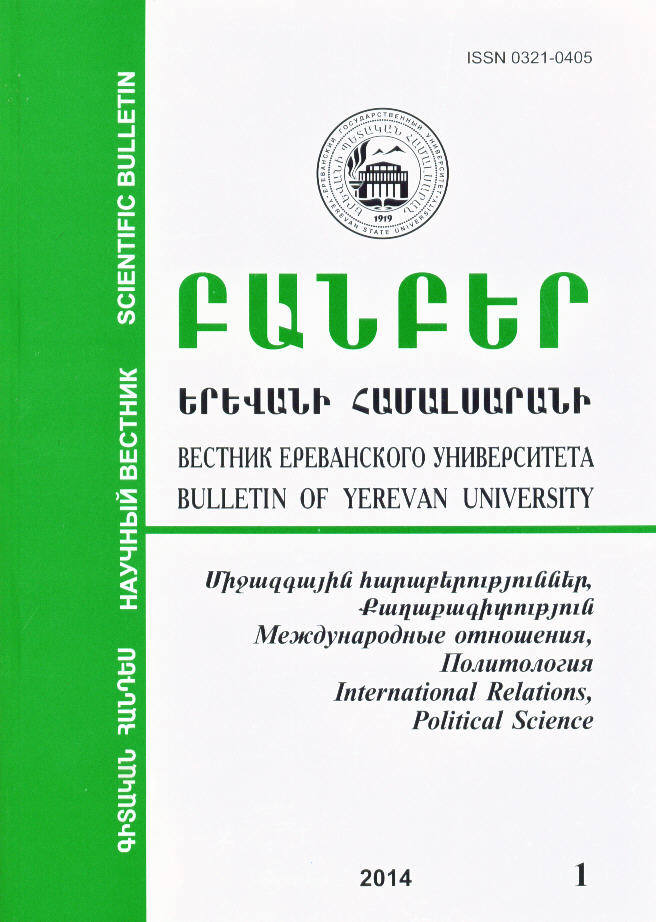
“Bulletin of Yerevan University. International Relations, Political Science” is a scientific journal devoted to the development processes of post-Soviet countries, the processes of European and Eurasian integration, and topical issues in international relations and diplomacy. The Bulletin publishes scientific articles and studies on the comparative study of contemporary political events, the democratization of political systems, the formation of civil society organizations, political ideology and culture, as well as public administration, geopolitics, civilizational interaction and humanitarian cooperation. The Bulletin is devoted to the study of a complex of problems of development and interaction of post-Soviet countries. The Bulletin accepts original articles and comprehensive studies not previously published.
This article examines the issues related to the
Armenia’s participation in international peace operations. In particular, Armenia’s engagement in international peace operations is derived from Armenia’s national security
interests, as well as is in line with her international commitments and the concept of
cooperative security. Besides, it is aimed at raising her international reputation and level
of involvement of the country in global processes, as well as developing her own peacekeeping capabilities. In the mean time, Armenia with its’ peacekeeping experience and
capabilities could also contribute in the development of the CSTO peacekeeping capabilities. A comprehensive study of the subject brings to the conclusion that the perception of Armenia’s security concept is being transformed, as a result of which Armenia is
capable not only to provide her own security, but also as a security contributing state to
participate in the international collective efforts aimed at strengthening international
peace and security
This paper analyzes the legal basis, main directions and
existing obstacles, as well as possible perspectives of bilateral cooperation between the
Republic of Armenia and the French Republic in the sphere of science. Being a weak
link in the Armenian-French cultural, educational and scientific relations, scientific
cooperation between Armenia and France has developed rather slowly. However, since
2008 the cooperation in this sphere has fixed a positive shift, which was determined by
new agreements and increased attention to the issue by Armenia and France.
The article presents the relationship between Turkey and Arab Maghreb countries in the
Arab Spring. Particular emphasis was placed on the Turkish model and the Arab
Maghreb countries’ positions towards it. There are also introduced parties desire to
imitate the Turkish mode which came to power in Maghreb. Also attention was paid to
the Turkish policy towards the Maghreb countries during the Arab Spring. That policy
aimed to protect and strengthen its position in the region which has a significant importance for Turkey. Submitting these and other developments, the article concludes that
during the Arab Spring Turkey's policy was successful to a large extent.
After proclaiming of independence in 1991 the
Republic of Armenia undertook the process of establishing diplomatic relationships.
Syria was one of the first countries with which there were established such relationships.
There were signed three agreements between the Republic of Armenia and Arab Republic of Syria in Yerevan, on 30 March, 1992. One of them was the agreement on commercial-economic cooperation. There were organized a number of visits during which
there were signed various agreements. There was created a significantly flexible legal
base for cooperation in the sphere of commercial-economic relationships. There was
also created an interstate committee that held several meetings both in Armenia and
Syria. There were organized both exhibitions and business forums and a many highranking officials from both countries brought their participation in them. There were
granted discounts for carrying out business projects. But independent on the efforts
spent on the commercial-economic sphere in the period of 1991-2011 the desirable
result was not achieved.
Nowadays modeling has significant meaning in policy analysis and is one of the most effective methods to analyze political situations and to solve complicated problems. In the article, the author presents the model for assessing political system stability, based on the method of index construction as just this approach gives an opportunity to analyze the stability of the given country in its different periods (in-country analysis) as well as to compare different countries by stability level(cross-country analysis), using integrated numerical factor of stability (index).
The interdisciplinary research implemented by the author and presented in the article is devoted to the development and comparative analysis of the political stability index of the South Caucasus, the EurAsEC and the EU. The author also makes a comparative analysis of mentioned 35 countries (countries of the South Caucasus, the EurAsEC and the EU member states) by political, social and economic aspects as aggregated factors as well as by separate variables included in the model.
In the context of geopolitical processes, occurring in the South Caucasus after the collapse of the USSR, Turkey's aspiration to penetrate the region of geopolitical and geostrategic importance for her, gaining control over the regional processes, promotion of its own scripts and projects, and positioning itself as a regional superpower is worth mentioning. Developing the tactics of its geopolitical influence expansion in the South Caucasus official Ankara at this stage continues to implement a consistent policy of strengthening its positions in Azerbaijan and Georgia by effective usage of military - political and economic as well as foreign policy levers (thus seeking to declare itself not only a regional but also a global power, able to influence the political processes of the South Caucasus and the Caspian - Central Asian region as well). Based on the abovementioned, the possible formation of strategic alliance of Turkey, Azerbaijan and Georgia, which will deepen the dividing lines of the South Caucasus, thus finally displacing Armenia out of the regional processes is alarming.
The article deals with the topical problem of formation of ethnic identity and its manifestation in the communities of Diaspora. The issue of correlation
of identity and social consciousness is explained. Distinctive features explaining ethnic identity in the process of social-political problem solving in Diaspora are disclosed by using the propositions of different paradigms.
The article discusses several problems concerning the knowledge of the Armenian language as an obligatory condition for occupying vacant positions of the municipal service. Studying normative legislative acts controlling above-mentioned relations it has been concluded that there are problems which impede the implementation of the equal rights of citizens to occupy the vacant position of municipal service. The article attempts to find their political and legal solutions.