| E - ISSN | : | 2738-2826 |
| P - ISSN | : | 2738-2699 |
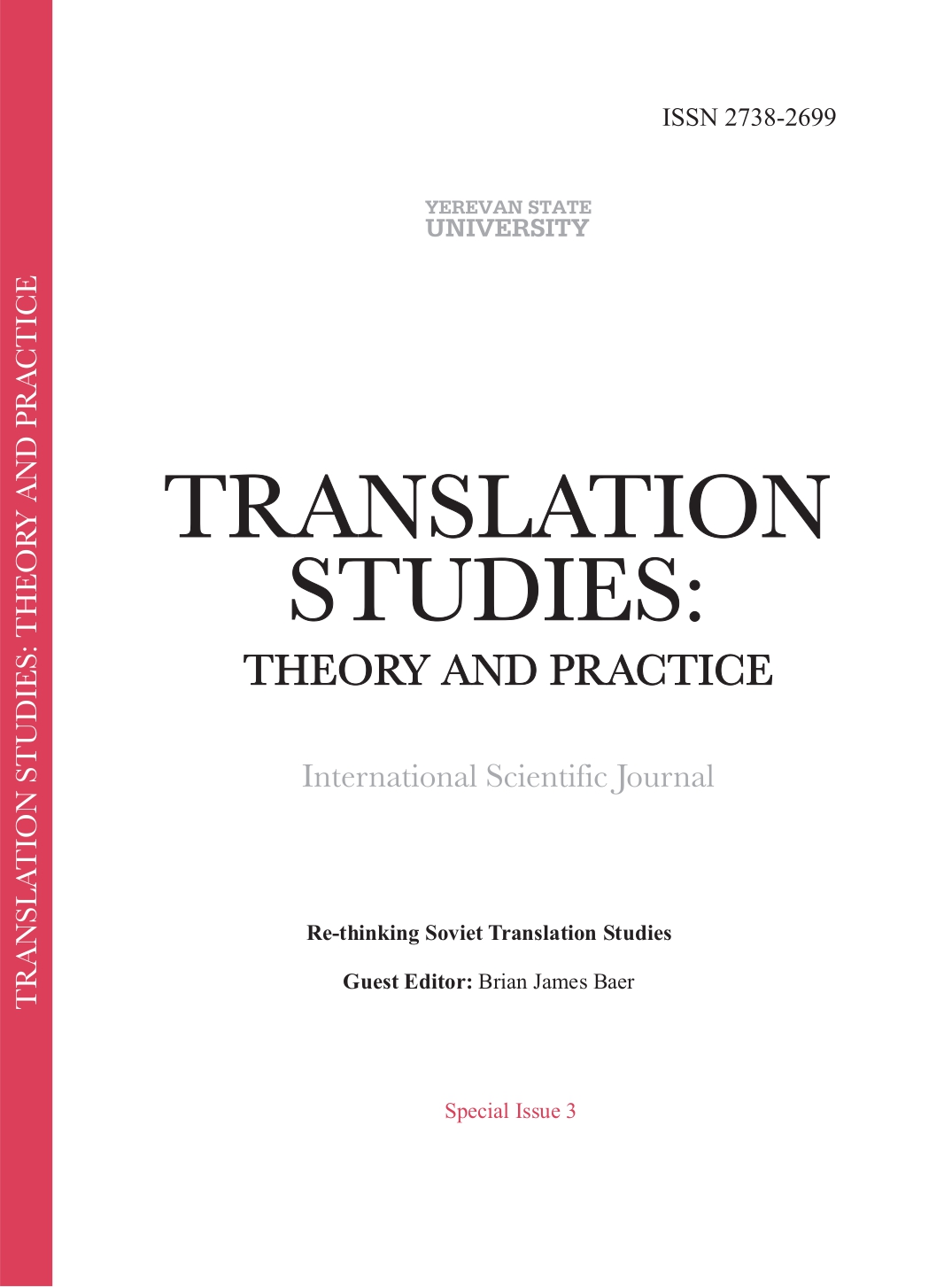
Vol. SI-3 (2026) / Re-thinking Soviet Translation Studies
Full Issue
Introduction
-
Introduction
On Translation and Peripheries
AbstractIntroduction to Re-thinking Soviet Translation Studies
ReferencesOhanyan, Hermine, and Artur Ishkhanyan. 2026. “Rethinking Internationalism and Peace in Transcaucasia following Renewed Conflict.” Social Sciences & Humanities Open 13: online.
Tihanov, Galin. 2017. “The Location of World Literature.” Canadian Review of Comparative Literature / Revue Canadienne de Littérature Comparée. 44(3) : 468-481.
Part I: Re-thinking Translation History from the Periphery
-
Part I: Re-thinking Translation History from the Periphery
Translation and Soviet Nationalities Policy: The View from the Periphery
AbstractThe literature on translation in the Soviet Union has largely focused on the “center” — i.e., on state-sponsored policies and translation into Russian. This article seeks to address that imbalance by turning scholarly attention to how Soviet translation policy was experienced in the periphery, that is, in the various Soviet republics, a complex story long suppressed beneath the propagandistic veneer of druzhba narodov, or “friendship of Soviet peoples.” At the same time, this article aims to address the rather desultory treatment of translation in the now vast literature on Soviet nationalities policy and, more broadly, on Soviet coloniality, by examining the role of translation in both a practical sense, as a techne of communist internationalism, and in a metaphorical sense as symbolizing the Soviet state’s commitment to fostering greater mutual understanding and respect among its constituent peoples. These dual aims are then explored through the life of Armenian writer, editor, and translator Karen Mikaelian.
ReferencesPrimary Sources
Museum of Literature and Art of Armenia named for Yegishe Charents (MLA), Karen Mikaelian Papers.
Secondary Sources
Aiagan, Burkitbai. 2005. Kazakhstan. Natsional’naia entsiklopediia [Kazakhstan: National Encyclopedia]. Edited by B. Aiagan. Vol. 2, G–I, 450–51. Almaty: Kazak Entsiklopediiasy.
Baer, Brian James, ed. 2011. Contexts, Subtexts and Pretexts: Literary Translation in Russia and Eastern Europe. Amsterdam and Philadelphia: John Benjamins.
______. 2022. “Censorship, Permitted Dissent, and Translation Theory in the USSR: The Case of Kornei Chukovskii.” In Translation under Communism, edited by Christopher Rundle, Daniele Monticelli, and Anna Lange, 73–110. London and New York: Palgrave Macmillan.
______. 2023. “Transfiction in Late Soviet Society: The Imaginary East in Semen Lipkin’s Dekada.” In Transfiction and Bordering Approaches to Theorizing Translation: Essays in Dialogue with the Work of Rosemary Arrojo, edited by D. M. Spitzer and Paulo Oliveira, 94–110. London and New York: Routledge.
Baer, Brian James, and Philipp Hofeneder. 2025. “A Tale of Two Skopos Theories: (Re-)Siting Translation Theory.” Target 37(3): 309–32.
Baer, Brian James, and Susanna Witt, eds. 2018. Translation in Russian Contexts: Culture, Politics, Identity. London and New York: Routledge.
Bagdasarian, Robert. 1984. “Iz pisem russkikh pisatelei i perevodchikov Karenu Mikaelianu” [From Letters of Russian Writers and Translators to Karen Mikaelian]. VON 11: 81–86.
______. 1987. “Neopublikovannaia stat’ia Nikolaia Tikhonova k ‘Antologii armianskoi poezii’” [Nikolai Tikhonov’s Unpublished Article for the Anthology of Armenian Poetry]. VON 4: 82–85.
______. 2010. Karen Mikaelian: Tvorchestvo i vklad v russko-armianskie literaturno-kul’turnye vsaimosviazi [Karen Mikaelian: Creative Work and Contribution to Russian-Armenian Literary and Cultural Relations]. Yerevan: Lingva.
Burnett, Leon, and Emily Lygo, eds. 2013. The Art of Accommodation: Literary Translation in Russia. Oxford: Peter Lang.
Chernovatyi, Leonid, and Vyacheslav Karaban. 2007. Oleksandr Finkel – Zabutyi Teoretyk Ukrainskoho Perekladoznavstva [Oleksandr Finkel: The Forgotten Theorist of Ukrainian Translation Studies]. Vinnytsia: Nova Knyha.
Chukovskii, Kornei. 1936. Iskusstvo perevoda [The Art of Translation]. Moscow and Leningrad: Academia.
______. 1941. Vysokoe iskusstvo [The High Art]. Moscow: Khudozhestvennaia Literatura.
Chukovsky, Nikolai. 2013 [1961]. “The Tenth Muse.” In Russian Writers on Translation: An Anthology, edited by Brian James Baer and Natalia Olshanskaya, 115–17. Manchester: St. Jerome.
Clark, Katerina. 2021. Eurasia without Borders: The Dream of a Leftist Literary Commons, 1919–1943. Cambridge, MA: Harvard University Press.
Clark, Katerina, and Evgeny Dobrenko, with Andrei Artizov and Oleg Naumov, eds. 2007. Soviet Culture and Power: A History in Documents, 1917–1953. New Haven and London: Yale University Press.
Derzhavyn, Volodymyr. 1930. “Russkie perevodnye antologii ukrainskoi literatury (za 1929–1930 god)” [Russian Translation Anthologies of Ukrainian Literature (for 1929–1930)]. Krasnoe Slovo [The Red Word] 12: 143–56.
Editorial Board. 1955. Introduction. Inostrannaia Literatura [Foreign Literature] 1: 3–4.
Fadeev, Aleksandr. 1960. “Torzhestvo razuma i spravedlivosti” [The Triumph of Reason and Justice]. September 23, 1947. In Sobranie sochinenii v 5-i tomakh. Tom chetvertyi. Stat’i i rechi [Collected Works in Five Volumes. Volume Four: Articles and Speeches], edited by F. Knipovich, V. M. Ozerov, and K. A. Fedin, 442–47. Moscow: Khudozhestvennaia Literatura.
Fedorov, Andrei V. 1930. “Priemy i zadachi khudozhestvennogo perevoda” [Methods and Tasks of Literary Translation]. In Iskusstvo perevoda [The Art of Translation], by Kornei Chukovskii and Andrei Fedorov, 89–235. Moscow and Leningrad: Academia.
Finkel’, Aleksandr. 1928. “Ukrainskie pisateli v russkikh perevodakh” [Ukrainian Writers in Russian Translations]. Krasnoe Slovo [The Red Word] 1–2: 116–35.
Frank, Susanne. 2023. “Armenian Literature as World Literature: Phases of Shaping It in the Pre-Soviet and Stalinist Contexts.” In World Literature in the Soviet Union, edited by Galin Tihanov, Anne Lounsberry, and Rossen Djagalov, 35–66. Boston: Academic Studies Press.
Friedberg, Maurice. 1997. Literary Translation in Russia: A Cultural History. University Park, PA: Penn State Press.
Gor’kii, Maksim. 2013. Polnoe sobranie sochinenii. Pis’ma v dvadtsati chetyrekh tomakh [Complete Works. Letters in Twenty-Four Volumes]. Vol. 16, Pis’ma. Mart 1926–iul’ 1927 [Letters: March 1926–July 1927]. Moscow: Nauka.
Kalnychenko, Oleksandr, and Lada Kolomiyets. 2022. “Translation in Ukraine during the Stalinist Period: Literary Translation Policies and Practices.” In Translation under Communism, edited by Christopher Rundle, Anna Lange, and Daniele Monticelli, 141–72. Cham: Palgrave Macmillan.
Kalnychenko, Oleksandr, and Yuliana Poliakova. 2011. Ukraiins’ka perekladoznavcha dumka 1920-kh–pochatku 1930-kh rokiv: Khrestomatiia [Ukrainian Translation Thinking of the 1920s–Early 1930s: Anthology]. Vinnytsia: Nova Knyha.
______, eds. 2015. Volodymyr Mykolayovych Derzhavyn. Pro mystetstvo perekladu: Statti ta retsenzii 1927–1931 rokiv [Volodymyr Mykolayovych Derzhavyn: On the Art of Translation: Articles and Reviews, 1927–1931]. Vinnytsia: Nova Knyha.
Kamovnikova, Natalia. 2019. Made Under Pressure: Literary Translation in the Soviet Union, 1960–1991. Amherst and Boston: University of Massachusetts Press.
______. 2026. The Fearful Steelpen: Russian Translations of “Ulysses,” 1920–1930s. Amherst and Boston: University of Massachusetts Press.
Kaplan, Isabel R. 2020. “Comrades in Arts: The Soviet Dekada or National Art and the Friendship of Peoples.” RUDN Journal of Russian History 19(1): 78–94.
Khotimsky, Maria. 2011. A Remedy for Solitude: Russian Poet-Translators in the Soviet and Post-Soviet Eras. Doctoral diss., Harvard University.
Kolomiyets, Lada. 2015. Ukraiins’kyi khudozhniy pereklad ta perekladachi 1920–30-kh rokiv: Materialy do kursu ‘Istoriia perekladu’ [Ukrainian Literary Translation and Translators of the 1920s–1930s: Materials for the Course “History of Translation”]. Vinnytsia: Nova Knyha.
Kostiuk, Hryhory. 1960. Stalinist Rule in the Ukraine: A Study in the Decade of Mass Terror (1929–1939). New York: Frederick A. Praeger.
Leighton, Lauren G. 1991. Two Worlds, One Art: Literary Translation in Russia and America. DeKalb, IL: Northern Illinois University Press.
Lipkin, Semen. 1990. Dekada [The Decade]. Moscow: Knizhnaia palata.
Mace, James E. 1983. Communism and the Dilemmas of National Liberation: National Communism in Soviet Ukraine, 1918–1933. Cambridge, MA: Harvard Ukrainian Research Institute.
Maguire, Muireann, and Cathy McAteer. 2024. Translating Russian Literature in the Global Context. Cambridge, UK: Open Book Publishers.
Martin, Terry. 1998. “The Origins of Soviet Ethnic Cleansing.” The Journal of Modern History 70: 813–61.
______. 2001. “An Affirmative Action Empire: The Soviet Union as the Highest Form of Imperialism.” In A State of Nations: Empire and Nation-Making in the Age of Lenin and Stalin, edited by Ronald Grigor Suny and Terry Martin, 67–90. Oxford and New York: Oxford University Press.
Maskaliūnienė, Nijole, and Ingrida Tatolytė. 2024. Vertimas ir cenzūra sovietinės ideologijos sąlygomis. Lietuva, 1940–1990 [Translation and Censorship under Soviet Ideology: Lithuania, 1940–1990]. Vilnius: Vilniaus universiteto leidykla.
Ohanyan, Hermine, and Artur Ishkhanyan. 2026. “Rethinking Internationalism and Peace in Transcaucasia following Renewed Conflict.” Social Sciences & Humanities Open 13. DOI 10.1016/j.ssaho.2026.102756.
Pervyi Soiuznyi S”ezd Sovetskikh Pisatelei [First All-Union Congress of Soviet Writers]. 1934. Stenograficheskii otchet [Stenographic Report]. Moscow: Goslitizdat.
Plokhy, Serhii. 2006. The Origins of the Slavic Nations: Premodern Identities in Russia, Ukraine, and Belarus. New York: Cambridge University Press.
Rundle, Christopher, Anna Lange, and Daniele Monticelli, eds. 2022. Translation under Communism. London and New York: Palgrave Macmillan.
Savchenko, Iurii A. 1927. “Pochin” [The Beginning]. Pluzhanin 9/10 (13/14): 63–71.
Schippel, Larisa, and Cornelia Zwischenberger, eds. 2016. Going East: Discovering New and Alternative Traditions in Translation Studies. Berlin: Frank & Timme.
Sherry, Samantha. 2015. Discourses of Regulation and Resistance: Censoring Translation in the Stalin and Khrushchev Era Soviet Union. Edinburgh: University of Edinburgh Press.
Slezkine, Yuri. 2000. “The USSR as a Communal Apartment, or How a Socialist State Promoted Ethnic Particularism.” In Stalinism: New Directions, edited by Sheila Fitzpatrick, 313–47. London and New York: Routledge.
Starynkevych, Yelyzaveta. 2011 [1930]. “Problemy i dostizheniia v iskusstve perevoda: (K itogam ukrainskoi perevodnoi literatury za 1929–1930 g.g.)” [Problems and Achievements in the Art of Translation: On the Results of Ukrainian Translated Literature for 1929–1930]. In Ukraïns′ka perekladoznavcha dumka 1920-kh–pochatku 1930-kh rokiv: Khrestomatiia vybranykh prats′ z perekladoznavstva do kursu “Istoriia perekladu” [Ukrainian Translation Thought of the 1920s–Early 1930s: A Reader of Selected Works on Translation Studies for the Course “History of Translation”], edited by O. A. Kalnychenko and Iu. Iu. Poliakova, 442–51. Vinnytsia: Nova Knyha.
Šteinbergs, Ivars. 2022. “Translating Poetry to Resist Soviet Coloniality: Tracing the Legacy of Uldis Bērziņš.” Letonica 45: 141–61.
Strikha, Maksym. 2006. Ukrains’kyi khudozhnii pereklad: Mizh literaturoiu i natsiietvorenniam [Ukrainian Literary Translation: Between Literature and Nation-Building]. Kyiv: Fakt; Nash Chas.
Surovtsev, Iurii. 1981. “Znachenie khudozhestvennogo perevoda v esteticheskom vzaimoobogashchenii literatur narodov SSSR i v internatsional’nom vospitanii sovetskikh liudei” [The Significance of Literary Translation in the Aesthetic Mutual Enrichment of the Literatures of the Peoples of the USSR and in the Internationalist Education of Soviet People]. Voprosy Literatury [Questions of Literature] 10: 3–44.
Tarlovskii, Mark. 1940. “Khudozhestvennyi perevod i ego portfel’” [Literary Translation and Its Portfolio]. Druzhba narodov [Friendship of Peoples] 4: 233–84.
Tihanov, Galin, Anne Lounsberry, and Rossen Djagalov, eds. 2023. World Literature in the Soviet Union. Boston: Academic Studies Press.
Usov, Dmitrii. 1934a. “Iz nabliudenii nad tekhnikoi perevoda” [Observations on Translation Technique]. In Sbornik tekstov dlia perevoda s nemetskogo iazyka [Collection of Texts for Translation from German], edited by D. Usov, Z. Til’ts, and A. Tuntser, 5–26. Moscow: Gosudarstvennoe uchebno-pedagogicheskoe izdatel’stvo.
______. 1934b. Osnovnye printsipy perevodcheskoi raboty [Basic Principles of Translation Work]. Moscow: Gosudarstvennoe uchebno-pedagogicheskoe izdatel'stvo.
Vasserman, Elizaveta. 2026. Andrei Fedorov in the History of Translation Studies. London and New York: Routledge.
Witt, Susanna. 2011. “Between the Lines: Totalitarianism and Translation in the USSR.” In Contexts, Subtexts, and Pretexts: Literary Translation in Eastern Europe and Russia, edited by Brian James Baer, 149–70. Amsterdam and Philadelphia: John Benjamins.
______. 2013. “The Shorthand of Empire: Podstrochnik Practices and the Making of Soviet Literature.” Ab Imperio 3: 155–90.
Zhangyru, Rukhani. 2021. “V pamiati blagorodnykh potomkov” [In Memory of Noble Descendants]. Kyzylordinskie Novosti [Kyzylorda News], October 21, 7.
-
Part I: Re-thinking Translation History from the Periphery
Soviet Language Policy: Historical Development and Impact on Ethnic Groups and Languages
AbstractThis article examines Soviet language policy from 1917 to 1991. The analysis identifies a transition from the early promotion of national languages under korenizatsiya to a later system in which Russian assumed broader functions in interethnic communication, education, administration, science, and professional mobility. The study finds that this process generally increased Russian-language competence while producing diverse outcomes for titular and minority languages. Ukraine illustrates changing institutional conditions for Ukrainian, including the expansion of Ukrainian-language schooling and publishing during the 1920s, subsequent orthographic revision, and the growth of Russian-medium education in later decades. The Caucasian cases demonstrate the importance of local conditions: Armenian and Georgian retained extensive institutional functions, whereas Azerbaijani experienced repeated script changes and smaller languages had more limited support. The findings suggest that Soviet language policy generated patterns of bilingualism and language maintenance or shift that varied according to institutional, demographic, and cultural factors.
ReferencesAlpatov, Vladimir M. 2000. 150 iazykov i politika: 1917–2000. Sotsiolingvisticheskie problemy SSSR i postsovetskogo prostranstva [150 Languages and Politics: 1917–2000. Sociolinguistic Problems of the USSR and the Post-Soviet Space]. Moscow: Kraft+/Institut vostokovedeniia RAN.
______. 2017. “Scripts and Politics in the USSR.” Studi Slavistici 14(1): 9–19. https://doi.org/10.13128/Studi_Slavis-21936
Bilaniuk, Laada. 2005. Contested Tongues: Language Politics and Cultural Correction in Ukraine. Ithaca, NY: Cornell University Press.
Blitstein, Peter A. 2001. “Nation-Building or Russification? Obligatory Russian Instruction in the Soviet Non-Russian School, 1938–1953.” In A State of Nations: Empire and Nation-Making in the Age of Lenin and Stalin, edited by Ronald G. Suny and Terry Martin, 253–74. Oxford: Oxford University Press.
Bruchis, Michael. 1984. “The Effect of the USSR Language Policy on the National Languages of Its Turkic Population.” In The USSR and the Muslim World: Issues in Domestic and Foreign Policy, edited by Y. Ro’i, 129–48. London: George Allen & Unwin.
Crisp, Simon. 1990. “Soviet Language Planning 1917–53.” In Language Planning in the Soviet Union, edited by Michael Kirkwood, 23–45. London: Palgrave Macmillan. https://doi.org/10.1007/978-1-349-20301-7_2
Danylenko, Andrii, and Halyna Naienko. 2019. “Linguistic Russification in Russian Ukraine: Languages, Imperial Models, and Policies.” Russian Linguistics 43(1): 19–39. https://doi.org/10.1007/s11185-018-09201-7
Dickens, Mark. 1988. Soviet Language Policy in Central Asia. Accessed September 20, 2026.
https://www.academia.edu/398257/Soviet_Language_Policy_In_Central_Asia.
Dietrich, Ayşe Pamir. 2006. “Language Policy and the Status of Russian in the Soviet Union and the Successor States outside the Russian Federation.” Australian Slavonic and East European Studies 19(1–2): 1–27.
Druviete, Ina, and Dace Strelevica-Osina. 2008. “Some Aspects of the Sociolinguistic Situation in Latvia: Causes and Effects.” Suvremena Lingvistika 34(65): 89–114.
Dziuba, Ivan. 1998 [1966]. Internatsionalizm chy rusyfikatsiia? [Internationalism or Russification?]. Kyiv: KM Academia.
Gabunia, Kakha, and Ketevan Gochitashvili. 2020. “The Russian Language in Georgia.” In The Soft Power of the Russian Language: Pluricentricity, Politics and Policies, edited by Arto Mustajoki, Ekaterina Protassova, and Maria Yelenevskaya, 37–45. London: Routledge.
Garibova, Jala. 2020. “The Russian Language in Azerbaijan: Changing Practices and Emerging Paradigms.” In The Soft Power of the Russian Language: Pluricentricity, Politics and Policies, edited by Arto Mustajoki, Ekaterina Protassova, and Maria Yelenevskaya, 55–70. London: Routledge.
Goskomstat SSSR. 1991. Itogi Vsesoiuznoi perepisi naseleniia 1989 goda [Results of the 1989 All-Union Population Census]. Moscow: Finansy i statistika.
Green, Sonia Bychkov. 1997. “Language of Lullabies: The Russification and De-Russification of the Baltic States.” Michigan Journal of International Law 19(1): 219–75. https://doi.org/10.2139/SSRN.1261425
Grenoble, Lenore. 2003. Language Policy in the Soviet Union. Dordrecht: Kluwer Academic Publishers.
Guadagnolo, Gary, and Trey Guinn. 2014. “The ABCs of Tatar: Multilingual Accommodation and Soviet Language Politics.” Russian Journal of Communication 6(2): 127–42. https://doi.org/10.1080/19409419.2014.906319
Gurbanova, Nubar, and Rungthum Rangsikul. 2018. “Language in Politics Features of the Soviet Language Policy in 1920s–1930s.” International Conference on Language Phenomena in Multimodal Communication (KLUA 2018) 228: 418–22. https://doi.org/10.2991/klua-18.2018.64
Haarmann, Harald. 1995. “Multilingualism and Ideology: The Historical Experiment of Soviet Language Politics.” European Journal of Intercultural Studies 5: 6–17. https://doi.org/10.1080/0952391950050302
Hewitt, Brian George. 1990. “Aspects of Language Planning in Georgia (Georgian and Abkhaz).” In Language Planning in the Soviet Union, edited by Michael Kirkwood, 123–44. London: Palgrave Macmillan. https://doi.org/10.1007/978-1-349-20301-7_7
Isaev, Magomet I. 1979. Iazykovoe stroitel’stvo v SSSR [Language Construction in the USSR]. Moscow: Nauka.
Kirkwood, Michael. 1990. “Language Planning: Some Methodological Preliminaries.” In Language Planning in the Soviet Union, edited by Michael Kirkwood, 1–22. London: Palgrave Macmillan. https://doi.org/10.1007/978-1-349-20301-7_1
Kreindler, Isabelle T. 1990. “Soviet Language Planning since 1953.” In Language Planning in the Soviet Union, edited by Michael Kirkwood, 46–63. London: Palgrave Macmillan. https://doi.org/10.1007/978-1-349-20301-7_3
Kubaichuk, Viktor. 2020. Khronolohiia movnykh podii v Ukraini: Zovnishnia istoriia ukrainskoi movy [Chronology of Language Events in Ukraine: An External History of the Ukrainian Language]. Kyiv: K.I.S.
Lane, Pia, James Costa, and Haley De Korne, eds. 2017. Standardizing Minority Languages: Competing Ideologies of Authority and Authenticity in the Global Periphery. 1st ed. Routledge. https://doi.org/10.4324/9781315647722
Liber, George O. 1992. Soviet Nationality Policy, Urban Growth and Identity Change in the Ukrainian SSR 1923–1934. Cambridge: Cambridge University Press.
Liddicoat, Anthony. 2019. “Language-in-Education Policy in the Central Asian Republics of Kyrgyzstan, Tajikistan, Turkmenistan, and Uzbekistan.” In The Routledge International Handbook of Language Education Policy in Asia, edited by Andy Kirkpatrick and Anthony J. Liddicoat, 452–70. Routledge. https://doi.org/10.4324/9781315666235-32
Loader, Michael. 2017. “Restricting Russians: Language and Immigration Laws in Soviet Latvia, 1956–1959.” Nationalities Papers 45 (6): 1082–99. https://doi.org/10.1080/00905992.2017.1287690
Malykhin, Oleksandr, Nataliia Aristova, Nataliia Dichek, and Maryna Zahorulko. 2023. “Language Policy and School Education as Main Factors of Ukraine State Creation.” Sabiedrība, integrācija, izglītība [Society, Integration, Education] 1: 516–27. https://doi.org/10.17770/sie2023vol1.7082
Martin, Terry. 2001. The Affirmative Action Empire: Nations and Nationalism in the Soviet Union, 1923–1939. Ithaca, NY: Cornell University Press.
Masenko, Larysa, Viktor Kubaichuk, and Orysia Demska-Kulchytska, eds. 2005. Ukrainska mova u XX storichchi: Istoriia linhvotsydu. Dokumenty i materialy [The Ukrainian Language in the Twentieth Century: A History of Linguicide. Documents and Materials]. Kyiv: Kyievo-Mohylianska akademiia.
Mikhalchenko, Vida Iu., and Solntsev, Vadim M., eds. 1994. Iazyk v kontekste obshchestvennogo razvitiia [Language in the Context of Social Development]. Moscow: Institut iazykoznaniia RAN.
Nimchuk, Vasyl. 2002. “Perednie slovo” [Foreword]. In Ukrainskyi pravopys (proekt naibilsh poshyrenoi redaktsii 1928 r.) [Ukrainian Orthography (Draft of the Most Widely Circulated 1928 Edition)]. Kyiv: Naukova dumka.
Ornstein, Jacob. 1959. “Soviet Language Policy: Theory and Practice.” The Slavic and East European Journal 3(1): 1–24. https://doi.org/10.2307/305536
Pool, Jonathan. 1992. “Soviet Language Planning: Goals, Results, Options.” In The Soviet Nationality Reader. Routledge.
Rogers, Rosemarie. 1987. “Language Policy and Language Power: The Case of Soviet Publishing.” Language Problems and Language Planning 11(1): 82–103. https://doi.org/10.1075/LPLP.11.1.07ROG
Rozhankivsky, Roman. 2003. “Zasady terminotvorennia ta terminovzhyvannia” [Principles of Term Formation and Terminological Usage]. In Problemy ukrainskoi terminolohii [Problems of Ukrainian Terminology], 3–8. Lviv: Lvivska politekhnika.
Seiden, Jonathan. 2022. “‘To Retain’ or ‘Reject’ Russian? A Comparative Study of Bilingual Education in Soviet Central Asia.” International Journal of Russian Studies 11(1): 33–50.
Shelestyuk, Elena. 2019. “National in Form, Socialist in Content: USSR National and Language Policies in the Early Period.” The International Scientific and Practical Conference ‘Current Issues of Linguistics and Didactics: The Interdisciplinary Approach in Humanities and Social Sciences’ (CILDIAH-2019) 69: 00104. https://doi.org/10.1051/shsconf/20196900104
Shevelov, George Y. 1989. The Ukrainian Language in the First Half of the Twentieth Century (1900–1941): Its State and Status. Cambridge, MA: Harvard Ukrainian Research Institute.
Shorish, Mobin M. 1984. “Planning by Decree: The Soviet Language Policy in Central Asia.” Language Problems and Language Planning 8(1): 35–49. https://doi.org/10.1075/LPLP.8.1.03SHO
Sichkarenko, Halyna. 2023. “Features of Language Policy in Soviet Ukraine: Socio-Communicational Aspect (1960s–1980s).” Library Science. Record Studies. Informology 1: 35–40. https://doi.org/10.32461/2409-9805.1.2023.276762
Smith, Jeremy. 2018. “Nationalism and Regionalism in the Soviet Union, 1953–1965.” Slavic Review 76(4): 983–1002. https://doi.org/10.1017/slr.2017.253
Tabatadze, Shalva. 2025. “Language Policy in Georgia: Historical Legacies and Contemporary Challenges.” Journal of Multilingual and Multicultural Development 1: 84–93. https://doi.org/10.1080/01434632.2024.2441723
Zolyan, Suren, and Lilit Hakobyan. 2020. “The Russian Language in Armenia.” In The Soft Power of the Russian Language: Pluricentricity, Politics and Policies, edited by Arto Mustajoki, Ekaterina Protassova, and Maria Yelenevskaya, 46–54. London: Routledge.
-
Part I: Re-thinking Translation History from the Periphery
Soviet Language Engineering: Intra‑ and Inter‑Republican Translation in Early Soviet Ukraine
AbstractThis article examines the complex landscape of Soviet language engineering through translation policies in Ukraine during the 1920s and 1930s. Under the early Bolshevik policy of Korenizatsiia (indigenization), Ukraine served as a multi-ethnic testing ground where translation functioned as a tool to bolster the symbolic capital of the Ukrainian language. The study proffers a detailed historiography and explores intra-republican translation, including the reclamation of Russian-language works by Ukrainian authors and the vibrant bidirectional exchange between Yiddish and Ukrainian literatures. It also details inter-republican efforts that integrated Belarusian, Caucasian, and Central Asian literatures into the Ukrainian sphere through direct translation. However, the article highlights a pivotal shift in the 1930s toward linguistic Russification and state repression. During this period, direct interethnic cultural ties were curtailed in favor of Russian-mediated translation, which aimed to impose a centralized Soviet identity. Ultimately, the article demonstrates how translation served a dual role: while it initially enriched the Ukrainian literary tradition and fostered cultural autonomy, it was eventually co-opted as an instrument of ideological assimilation and Soviet control.
ReferencesAnnus, Epp. 2017. Soviet Postcolonial Studies: A View from the Western Borderlands. Abingdon, Oxon: Routledge. https://doi.org/10.4324/9781315226583
Baer, Brian James. 2025. “Birth of a Discipline? Soviet Translation Studies in the 1920s.” Stridon: Journal of Studies in Translation and Interpreting 4(2): 5–28.
Baskina (Malikova), Maria. 2021. “Filologicheski tochnyi perevod 1920–1930-kh godov: liudi i institutsii” [Philologically Accurate Translation of the 1920s–1930s: People and Institutions]. In Khudozhestvenno-filologicheskiy perevod 1920–1930-kh godov [Artistic and Philological Translation of the 1920s–1930s], compiled by M. E. Baskina, edited by M. E. Baskina and V. V. Filichev, 5–82. St. Petersburg: Nestor-Istoriia.
Bilaniuk, Laada. 2005. Contested Tongues: Language Politics and Cultural Correction in Ukraine. Ithaca, NY, and London: Cornell University Press.
Brandenberger, David. 2002. National Bolshevism: Stalinist Mass Culture and the Formation of Modern Russian National Identity. Cambridge, MA: Harvard University Press.
Chebotayev, Mykola. 2019. “‘Hrets’ka operatsiia’ NKVS 1937–1938 r.: do i pislia” [The “Greek Operation” of the NKVD, 1937–1938: Before and After]. Den’, 152–53. Accessed September 20, 2026. https://day.kyiv.ua/article/ukrayintsi-chytayte/hretska-operatsiya-nkvs-1937-1938-r-do-i-pislya
Chernetsky, Vitalii. 2011. “Nation and Translation: Literary Translation and the Shaping of Modern Ukrainian Culture.” In Contexts, Subtexts, Pretexts: Literary Translation in Eastern Europe and Russia, edited by Brian James Baer, 33–53. Amsterdam and Philadelphia: John Benjamins.
Dollerup, Cay. 2000. “Relay and Support Translations.” In Translation in Context, edited by Andrew Chesterman, Natividad Gallardo San Salvador, and Yves Gambier, 17–26. Amsterdam: John Benjamins.
Dziuba, Ivan Mykhailovych. 1995. “Kurylov Semen Mykolayovych.” In Kup–Kiu. Ukrains’ka Literaturna Entsyklopediia. Tom 3 [Kup–Kiu: Ukrainian Literary Encyclopedia. Vol. 3], edited by I. O. Dzeverin et al. Kyiv: “Ukrainian Encyclopedia” named after M. P. Bazhan. Accessed September 20, 2026. http://izbornyk.org.ua/ulencycl/ule80.htm
Flier, Michael S., and Andrea Graziosi, eds. 2017. The Battle for Ukrainian: A Comparative Perspective. Cambridge, MA: Harvard Ukrainian Research Institute.
Glaser, Amelia. 2017. “Jewish Alienation through a Ukrainian Looking Glass: Dovid Hofshteyn’s Translations of Taras Shevchenko.” Prooftexts 36(1–2): 83–110. https://doi.org/10.2979/prooftexts.36.1-2.04
Hofstein, David. 2012. О білий світе мій... Вибрані поезії [“O Light World of Mine…” Selected Poems]. Kyiv: Dukh i Litera.
Hohol’, Mykola. 1929. Tvory. Tom 1. Vechory na khutorі pіd Dykankoiu: Povisti vіd pasіchnyka Rudoho Panka vydani [Works. Vol. 1. Evenings on a Farm near Dykan’ka: Stories Published by the Beekeeper Rudyi Panko]. General editors I. Lakyza and P. Fylypovych; stylistic editor A. Nikovskyi. Kharkiv: Knyhospilka.
______. 1930. Tvory. Tom 2. Myrhorod [Works. Vol. 2. Myrhorod]. General editor I. Lakyza; stylistic editors M. Zerov and A. Kharchenko. Kyiv: Knyhospilka.
Istoriia vydavnytstv Ukrainy. Derzhavni vydavnytstva Ukrainy. 1917–2007 roky. Elektronnyi resurs [History of Publishing Houses of Ukraine: State Publishing Houses of Ukraine, 1917–2007. Electronic Resource]. 2009. Kyiv: Derzhavna naukova ustanova “Knyzhkova palata Ukrainy imeni Ivana Fedorova.” Archived February 13, 2021. Accessed April 30, 2026. http://www.ukrbook.net/elektr_publ/istor_vydav.pdf.
Kalnychenko, Oleksandr. 2016. “History of Ukrainian Thinking on Translation (from the 1920s to the 1950s).” In Going East: Discovering New and Alternative Traditions in Translation Studies, edited by Larisa Schippel and Cornelia Zwischenberger, 309–338. Berlin: Frank & Timme.
Kalnychenko, Oleksandr, and Lada Kolomiyets. 2022. “Translation in Ukraine during the Stalinist Period: Literary Translation Policies and Practices.” In Translation under Communism, edited by Christopher Rundle, Anne Lange, and Daniele Monticelli, 141–72. Basingstoke: Palgrave Macmillan.
Khvylia, Andrii. 1933. Znyshchyty korinnia ukrains’koho natsionalizmu na movnomu fronti [Destroy the Roots of Ukrainian Nationalism on the Linguistic Front]. Kharkiv: Radians’ka shkola.
Kolomiyets, Lada. 2015. Ukrains’kyi khudozhnii pereklad ta perekladachi 1920–30-kh rokiv. Materialy do kursu “Istoriia perekladu” [Ukrainian Literary Translation and Translators in the 1920s–30s: Materials for the Course “History of Translation”]. 2nd ed., rev. and expanded. Vinnytsia: Nova Knyha. Originally published 2013 by TSNU Press, Kyiv.
______. 2020. “Translation as an Instrument of Russification in Soviet Ukraine.” In Translation and Power, edited by Lucyna Harmon and Dorota Osuchowska, 29–43. Berlin: Peter Lang.
______. 2025. “The Yiddish Renaissance in Ukraine and Its Reflection in the Ukrainian Poets’ Early Commemoration of the Victims in Babyn Yar.” Kulturolohichna dumka [The Culturology Ideas] 28(2): 99–112. https://doi.org/10.37627/2311-9489-28-2025-2.99-112
Kolomiyets, Lada, and Oleksandr Kalnychenko. 2024. “Translating Russian Literature in Soviet and Post-Soviet Ukraine.” In Translating Russian Literature in the Global Context, edited by Muireann Maguire and Catherine McAteer, 295–320. Cambridge: Open Book Publishers. https://doi.org/10.11647/OBP.0340
MAPA Digital Atlas of Ukraine. n.d. “Ethnic Groups in Ukraine, Ukrainians, 1926 Census.” Harvard Ukrainian Research Institute. Accessed September 20, 2026. https://www.gis.huri.harvard.edu/resource/12-ethnic-groups-ukraine-ukrainians-1926-census
Martin, Terry Dean. 2001. The Affirmative Action Empire: Nations and Nationalism in the Soviet Union, 1923–1939. Ithaca, NY: Cornell University Press.
Masenko, Larysa, ed. 2005. Ukrains’ka mova u XX storichchi: istoriia linhvitsydu. Dokumenty i materialy [The Ukrainian Language in the Twentieth Century: A History of Linguicide. Documents and Materials]. Compiled by L. Masenko, V. Kubaychuk, and O. Demska-Kulchytska. Kyiv: Publishing House “Kyiv-Mohyla Academy.”
Monticelli, Daniele. 2011. “‘Totalitarian Translation’ as a Means of Forced Cultural Change: The Case of Postwar Soviet Estonia.” In Between Cultures and Texts: Itineraries in Translation History, edited by Antoine Chalvin et al., 187–200. Bern: Peter Lang.
Rundle, Christopher, Anne Lange, and Daniele Monticelli, eds. 2022. Translation under Communism. Basingstoke: Palgrave Macmillan.
Sherry, Samantha. 2015. Discourses of Regulation and Resistance: Censoring Translation in the Stalin and Khrushchev Soviet Era. Edinburgh: Edinburgh University Press.
Shevchenko, Taras. 2018. Kobzar: Selected Works. Bilingual ed. Translated into Yiddish by David Hofstein. Kyiv: Dukh i Litera Publishers.
Shevelov, George Y. 1989. The Ukrainian Language in the First Half of the Twentieth Century (1900–1941): Its State and Status. Cambridge, MA: Harvard University Press.
Strikha, Maksym. 2020. Ukrains’kyi pereklad i perekladachi: mizh literaturoiu i natsiietvorenniam [Ukrainian Translation and Translators: Between Literature and Nation-Building]. Kyiv: Dukh i Litera.
Titkov, Aleksandr. 2015. “Teki Odulok – zachinatel nesushchestvuyushchey literatury” [Tekki Odulok: The Founder of a Non-Existent Literature]. Literaturnaya Rossiya, February 23, 2015. https://litrossia.ru/item/898-oldarchive/.
Tymoczko, Maria, and Edwin Gentzler, eds. 2002. Translation and Power. Amherst and Boston: University of Massachusetts Press.
Witt, Susanna. 2017. “Institutionalized Intermediates: Conceptualizing Soviet Practices of Indirect Translation.” Translation Studies 10 (2): 166–82. https://doi.org/10.1080/14781700.2017.1286254
Witt, Susanna, and Brian James Baer, eds. 2018. Translation in Russian Contexts: Culture, Politics, Identity. New York and London: Routledge.
-
Part I: Re-thinking Translation History from the Periphery
An Outline History of Ukrainian Interpreting and Interpreting Studies Through the Prism of Pseudocoloniality
AbstractThis paper examines the history of interpreting in Soviet Ukraine through the analytical lens of pseudocoloniality, focusing on the invisibility of Ukrainian interpreters and the subordination of Ukrainian as a working language. The research employs historiographic sources, memoirs, archival materials, and original interviews with former practitioners to reconstruct interpreting practices across a wide range of institutional and social contexts, including diplomacy, courts, military service, tourism, cinema, community settings, and sites of repression. Attention is also paid to the ways in which interpreting functioned not only as linguistic mediation but also as an instrument of ideological control, surveillance, and assimilation. The analysis demonstrates that interpreting in the Ukrainian SSR was rarely recognized as an autonomous profession; instead, it was frequently embedded in other roles and governed by centralized language policy that privileged Russian. The article addresses a significant gap in interpreting historiography and argues for the necessity of integrating postcolonial and pseudocolonial perspectives into the study of interpreting in imperial and post-imperial contexts.
References“A War Crime in Any Language.” n.d. Beaches of Normandy Tours. Accessed September 7, 2026.
https://www.beachesofnormandy.com/articles/A_war_crime_in_any_language/?id=c55092bb3d
Baigorri-Jalón, Jesús. 2010. “Wars, Languages and the Role(s) of Interpreters.” In Les liaisons dangereuses: langues, traduction, interprétation, 173-204. Beirut.
______. 2015. “History.” In Routledge Encyclopedia of Interpreting Studies, edited by Franz Pöchhacker. London/New York: Routledge.
Berezhkov, Valentin. 1968. Tegeran 1943 [Tehran 1943]. Moscow: AP Novosti.
Catalina, Iliescu Gheorghiu. 2020. “A Taxonomic Analysis Proposal for Research in Diplomatic Interpreting.” Across Languages and Cultures 21(1): 23-41. https://doi.org/10.15561084.2020.00002
Cherednychenko, Oleksandr, 2026. Written interview by Taras Shmiher and Oleksandra Litvinyak. January. Unpublished.
Chernov, Gelij V. 2002. “Conference Interpreting in the USSR: History, Theory, New Frontiers.” Meta: Journal des traducteurs 37(1): 149-62. https://doi.org/10.7202/002227ar
Chernov, Sergei. 2016. “At the Dawn of Simultaneous Interpreting in the USSR: Filling Some Gaps in History.” In New Insights in the History of Interpreting, 135-66. Amsterdam: John Benjamins Publishing Company.
Chernovaty, Leonid, Iryna Lypko, and Svitlana Romaniuk. 2021. “Dvadtsiat rokiv doslidzhen navchannia haluzevoho perekladu: zdobutky i perspektyvy” [Twenty Years of Research of Teaching Specialised Translation and Interpreting: Achievements and Prospects]. Research Bulletin. Philological Sciences 1(193): 68-77. DOI: 10.36550/2522-4077-2021-1-193-68-77
Cronin, Michael. 2002. “The Empire Talks Back: Orality, Heteronomy and the Cultural Turn in Interpreting Studies.” In Translation and Power, edited by Maria Tymoczko and Edwin Gentzler, 45–62. Amherst: University of Massachusetts Press.
Davis, Thomas O. 2011. “Our National Language.” In An Outline History of Irish Literature in Texts, edited by L. Sikorska, J. Jarząb, and D. Krzyżaniak, 160-62. Poznań: Wydawnictwo Poznańskie.
Footitt, Hilary. 2021. “Methodological Issues Related to the History of Interpreting.” In The Routledge Handbook of Translation History, 23-37. London: Routledge.
Gaiba, Francesca. 1998. The Origins of Simultaneous Interpretation: The Nuremberg Trial. Ottawa: University of Ottawa Press.
Gile, Daniel. 2009. “Interpreting Studies: A Critical View from Within.” MonTI: Monografías de Traducción e Interpretación 1(6): 135-155.
Halchak, Serhii. 2004. “Skhidni robitnyky” z Podillia u Tretiomu Reikhu: deportatsiya, natsystska katorha, opir ponevoliuvacham [“Eastern Workers” from Podillia in the Third Reich: Deportation, Nazi Forced Labor, Resistance to the Enslavers]. Vinnytsia: Knyha-Veha.
Kadrić, Mira, Sylvi Rennert, and Christina Schäffner. 2021. Diplomatic and Political Interpreting Explained. London: Taylor & Francis.
Kaindl, Klaus. 2025. “The Translator’s Nested Identities: Translator Studies and the Auto/Biographical Turn.” Perspectives 33(2): 326–340. https://doi.org/10.1080/0907676X.2024.2421772
Kitsyla, Lidia, 2026. Written interview by Taras Shmiher and Oleksandra Litvinyak. January. Unpublished.
Kolomiyets, Lada. 2020. “Translation as an Instrument of Russification in Soviet Ukraine.” In Translation and Power, 29-43, edited by Lucyna Harmon and Dorota Osuchowska. Berlin: Peter Lang GmbH.
Konstytutsiya (Osnovnyi Zakon) Ukrayinskoyi Radianskoyi Sotsialistychnoyi Respubliky [Constitution (Basic Law) of the Ukrainian Soviet Socialist Republic]. 1937. January 30. Accessed September 7, 2026. https://static.rada.gov.ua/site/const/istoriya/1937.html
Konstytutsiya (Osnovnyi Zakon) Ukrayinskoyi Radianskoyi Sotsialistychnoyi Respubliky [Constitution (Basic Law) of the Ukrainian Soviet Socialist Republic]. 1978. April 20. Accessed September 7, 2026. https://zakon.rada.gov.ua/laws/show/888-09#Text
Konstytutsiya (osnovnyi zakon) Ukrayinskoyi Sotsiyalistychnoyi Radianskoyi Respubliky [Constitution (Basic Law) of the Ukrainian Socialist Soviet Republic]. 1929. May 15. Accessed September 7, 2026. https://zakon.rada.gov.ua/laws/show/n0001316-29/ed19290515#Text
Konstytutsiya Ukrayinskoyi Narodnoyi Respubliky (Statut pro derzhavnyi ustrii, prava i vilnosti UNR) [Constitution of the Ukrainian People’s Republic (Statute on the State System, Rights, and Freedoms of the UPR)]. 1918. April 29. Accessed September 7, 2026. https://zakon.rada.gov.ua/laws/show/n0002300-18#Text
Konstytutsiya Ukrayinskoyi Sotsiyalistychnoyi Radianskoyi Respubliky [Constitution of the Ukrainian Socialist Soviet Republic]. 1919. March 10. Accessed September 7, 2026. https://zakon.rada.gov.ua/laws/show/n0001316-19#Text
Kulbida, Svitlana. 2004. “Use and State of Sign Language in Ukraine: History of Research.” In Modern Trends of Special Education Development (Canada-Ukraine Experience), 173–81.
Kumiko, Torikai. 2014. “Oral History as a Research Method to Study Interpreters’ Habitus.” In Remapping Habitus in Translation Studies, 133-147. https://doi.org/10.1163/9789401210867_010
Kushnirenko, Volodymyr, 2026. Written interview by Taras Shmiher and Oleksandra Litvinyak. January. Unpublished.
Masenko, Larysa. 2005. Ukrayinska move u XX storichchi: istoriya linhvotsydu: dokumenty i materialy [The Ukrainian Language in the Twentieth Century: A History of Linguicide: Documents and Materials]. Kyiv: Kyiv-Mohyla Academy Publishing House.
Matiash, Iryna. 2019. Foreign Representations in Ukraine (1917–1919): State Mission and Everyday Life [Inozemni predstavnytstva v Ukrayini (1917–1919 rr.): derzhavna misiya ta povsiakdennist]. Kyiv: Institute of History of Ukraine, National Academy of Sciences of Ukraine.
Miram, Gennadii. 2001. Translation of Cartoons. Profession: Translator [Perevodnye kartinki. Professiya: perevodchik]. Kyiv: Elha; Nika-Tsentr.
“Nuremberg Trials.” n.d. Sources.com. Accessed January 14, 2026. https://www.sources.com/SSR/Docs/SSRW-Nuremberg_Trials.htm
Odrekhivska, Iryna. 2025. “Colonial Routes: How Soviet Linguistic Imperialism Framed Ukrainian Literature in Translation.” National University of Kyiv-Mohyla Academy Language: Classic – Modern – Postmodern 11: 171–185. https://doi.org/10.18523/lcmp2522-9281.2025.11.171-185
Palazhchenko, Pavlo. 2020. “Perekladach Horbachova Palazhchenko: Thatcher roziyshlasia: “Nu shcho vony nakoyily? Yaki zh vony pislia tsioho lidery?” [Gorbachev’s Interpreter Palazhchenko: Thatcher Exploded: “What Have They Done?! What Kind of Leaders Are They after This?”]. Accessed September 7, 2026. https://gordonua.com/ukr/publications/perekladach-gorbachova-palazhchenko-tetcher-rozbushuvalasya-nu-shcho-voni-nakoli-yak-zh-voni-pslya-cogo-lderi-1480741.html
Palko, Olena. 2020. Making Ukraine Soviet: Literature and Cultural Politics under Lenin and Stalin. London: Bloomsbury Publishing.
Pöchhacker, Franz. 2004. Introducing Interpreting Studies. London: Routledge.
Poluzhyn, Mykola M. 2004. Lecture Notes on the Historiography of Linguistics. Vinnytsia: Foliant.
Roland, Ruth A. 1999. Interpreters as Diplomats: A Diplomatic History of the Role of Interpreters in World Politics. Ottawa: University of Ottawa Press.
Saprykin, Serhii Serhiiovych, and Andrei P. Chuzhakin. 2011. Svit usnoho perekladu: navchalnyi posibnyk [The World of Oral Interpreting: A Study Guide]. Vinnytsia: Nova Knyha.
Snihur, Serhiy, 2026. Written interview by Taras Shmiher and Oleksandra Litvinyak. January. Unpublished.
Surovtsova, Natalia. 1996. Spohady [Memoirs]. Kyiv: Olena Teliha Publishing House.
Synhayivskyi, Serhiy, 2026. Written interview by Taras Shmiher and Oleksandra Litvinyak. January. Unpublished.
Tryuk, Malgorzata. 2016. “Interpreting and Translating in Nazi Concentration Camps during World War II.” Linguistica Antverpiensia, New Series: Themes in Translation Studies 15: 121–41.
Zayachkivska. Nadiya, 2026. Written interview by Taras Shmiher and Oleksandra Litvinyak. January. Unpublished.
-
Part I: Re-thinking Translation History from the Periphery
Against Mythistory: Oleksandr Finkel’s Theory and Practice of Translation (1929) and a Non‑Linear History of Translation Studies
AbstractThis article reassesses Oleksandr Finkel’s Theory and Practice of Translation (1929) as a foundational yet marginalized contribution to Translation Studies. It challenges narratives that locate the discipline’s emergence in the 1970s by showing that Finkel developed a systematic, theoretically ambitious model decades earlier in the Ukrainian and early Soviet context. Through close textual analysis and historiographic reconstruction, the study demonstrates how Finkel integrated linguo‑stylistic analysis, genre differentiation, and cultural‑historical reflection across non‑literary prose, literary prose, and verse. The article argues that his later neglect stemmed from Soviet Russocentrism and Cold War epistemic barriers, and contends that recovering Finkel enriches contemporary Translation Studies and supports a plural, non‑linear historiography attentive to marginalized traditions.
ReferencesAizenshtok, Ieremiia. 1970. “A. M. Finkel – Teoretik khudozhestvennogo perevoda” [A. M. Finkel as a Theoretician of Literary Translation]. In Masterstvo perevoda: Sbornik sed’moy, 1970 [The Craft of Translation: Issue Seven, 1970], edited by Kornei Chukovsky et al., vol. 7, 91–120. Moscow: Sovetskii pisatel’.
Baer, Brian James. 2020. “On Origins: The Mythistory of Translation Studies and the Geopolitics of Knowledge.” The Translator 26(3): 221–40. https://doi.org/10.1080/13556509.2020.1843755
______. 2024. “Birth of a Discipline? Soviet Translation Studies in the 1920s.” Stridon: Journal of Studies in Translation and Interpreting 4(2): 5–28. https://doi.org/10.4312/stridon.4.2.5-28
Baer, Brian James, and Philipp Hofeneder. 2025. “A Tale of Two Skopos Theories: (Re-)Siting Translation Theory.” Target 37(3): 309–32. https://doi.org/10.1075/target.23140.hof
Bally, Charles. 1909. Traité de stylistique française [Treatise on French Stylistics]. Vol. 1. Heidelberg: Carl Winter.
Bassnett, Susan, and André Lefevere, eds. 1990. Translation, History and Culture. London: Pinter Publishers.
Batchelor, Kathryn, and Iryna Odrekhivska. 2026. “When Is Translation Studies Not Translation Studies?” In Translation Studies before ‘Translation Studies’: Nothing Happened?, edited by Kathryn Batchelor and Iryna Odrekhivska, 1–22. London: UCL Press. Accessed September 20, 2026. http://www.jstor.org/stable/jj.31131070.6
Bryska, Oryslava. 2017. Mykola Zerov yak krytyk ta teoretyk perekladu [Mykola Zerov as a Translation Critic and Theorist]. Doctoral diss., Ivan Franko National University of Lviv.
Chernovatyi, Leonid, Vyacheslav Karaban, Valeriy Podminohin, Oleksandr Kalnychenko, and Vitaliy Radchuk, eds. 2007. Oleksandr Finkel – zabutyi teoretyk ukrainskoho perekladoznavstva: Zbirka vybranykh prats [Oleksandr Finkel: The Forgotten Theorist of Ukrainian Translation Studies: A Collection of Selected Works]. Vinnytsia: Nova Knyha.
Dzhuhastrianska, Yuliia, and Maksym Strikha. 2015. “Vazhlyva pamyatka z istorii ukrainskoho perekladoznavstva” [An Important Document from the History of Ukrainian Translation Studies]. In Novyi Protey [New Proteus], edited by Oleksandr Kalnychenko, 133–35. Vinnytsia: Nova Knyha.
Finkel, Aleksandr. 1922. “O perevode” [On Translation]. Khudozhestvennaia mysl’ [Artistic Thought] 12: 21–22.
______. 1939a. “O nekotorykh voprosakh teorii perevoda” [On Some Issues of Translation Theory]. Naukovi zapysky Kharkivskoho derzhavnoho pedahohichnoho instytutu inozemnykh mov [Scholarly Notes of the Kharkiv State Pedagogical Institute of Foreign Languages] 1: 59–82. Kharkiv.
______. 1962. “Ob avtoperevode” [On Autotranslation]. In Teoriia i kritika perevoda [Theory and Criticism of Translation], edited by Boris Larin, 104–25. Leningrad: Izdatel’stvo Leningradskogo universiteta.
Finkel, Aleksandr, and Mersedes Bullock. 2021. “On Autotranslation (Based on Material Relating to Hryhorii Kvitka-Osnovianenko’s Authorial Translations).” Translation & Interpreting Studies 16 (1): 156–83. https://doi.org/10.1075/tis.00050.fin
Finkel, Oleksandr H. 1939b. H. F. Kvitka-Osnov’ianenko yak perekladach vlasnykh tvoriv [H. F. Kvitka-Osnovianenko as a Translator of His Own Writings]. Candidate of Philological Sciences diss., Central State Archive-Museum of Literature and Art of Ukraine, fond 273, op. 1, od. zb. 17.
______. 1929a. “H. F. Kvitka – perekladach vlasnykh tvoriv” [H. F. Kvitka as a Translator of His Own Works]. In Kvitka-Osnov’ianenko: Zbirka na 150-richchia narodzhennia [Kvitka-Osnovianenko: Collection for the 150th Anniversary of His Birth], 107–32. Kharkiv: Ukrains’kyi. Reprinted 2007.
______. 1929b. Teoriya y praktyka perekladu [Theory and Practice of Translation]. Kharkiv: DVU.
Gile, Daniel. 2012. “Institutionalization of Translation Studies.” In Handbook of Translation Studies, vol. 3, edited by Yves Gambier and Luc van Doorslaer, 73–80. Amsterdam and Philadelphia: John Benjamins. https://doi.org/10.1075/hts.3.ins2
______. 2013. “Scienticity and Theory in Translation Studies.” In Handbook of Translation Studies, vol. 4, edited by Yves Gambier and Luc van Doorslaer, 148–55. Amsterdam and Philadelphia: John Benjamins.
Hermans, Theo. 1999. Translation in Systems. Manchester: St. Jerome.
Holmes, James S. 1988a. “The Name and Nature of Translation Studies.” In Translated! Papers on Literary Translation and Translation Studies, 66–80. Amsterdam: Rodopi. Originally presented 1972.
______. 1988b. “The Future of Translation Theory: A Handful of Theses.” In Translated! Papers on Literary Translation and Translation Studies, 99–102. Amsterdam: Rodopi. Originally published 1978.
Hostová, Ivana, Daniele Monticelli, Oleksandr Kalnychenko, and Martin Djovčoš. 2024. “Addressing Power Imbalances in Research and Translation Studies.” World Literature Studies 16 (3): 108–25. https://doi.org/10.31577/WLS.2024.16.3.8
Kalnychenko, Oleksandr. 2017. “History of Ukrainian Thinking on Translation (from the 1920s to the 1950s).” In Going East: Discovering New and Alternative Traditions in Translation Studies, edited by Larisa Schippel and Cornelia Zwischenberger, 309–38. Berlin: Frank & Timme.
Kalnychenko, Oleksandr, and Natalia Kamovnikova. 2019. “Oleksandr Finkel’ on the Problem of Self-Translation.” inTRAlinea: Online Translation Journal 21. Accessed September 20, 2026. http://www.intralinea.org/archive/article/2349
______. 2020. “Teaching Translation: Academic Courses in ‘Translation Theory and Practice’ of the Early 1930s.” Visnyk Kharkivskoho natsionalnoho universitetu imeni V. N. Karazina. Seriia: Metodyka vykladannia inozemnykh mov [The Journal of V. N. Karazin Kharkiv National University: Foreign Language Teaching Methods] 91: 147–55. https://doi.org/10.26565/2227-8877-2020-91-19
Kalnychenko, Oleksandr, and Yuliana Poliakova, eds. 2015. Volodymyr Derzhavyn. Pro mystetstvo perekladu: Statti ta retsenzii 1927–31 rokiv [Volodymyr Derzhavyn: On the Art of Translation: Articles and Reviews, 1927–31]. Vinnytsia: Nova Knyha.
Kalnychenko, Oleksandr. 2021. “Scholarly Introduction.” Translation & Interpreting Studies 16 (1): 149–53. https://doi.org/10.1075/tis.00048.kal
______. 2023. “Discovering Erased Discussion on Translation Method in Ukraine in 1927–1931.” In Translation Studies in Ukraine as an Integral Part of the European Context, edited by Martin Djovčoš et al., 36–62. Bratislava: VEDA.
______. 2025a. “Volodymyr Derzhavyn: An Erased Translation Scholar of the Late 1920s–Early 1930s.” In Positionalities of Translation Studies, edited by Garda Elsherif and Joanna Sobesto, 171–94. London and New York: Bloomsbury. https://doi.org/10.5040/9781350447905.0015 4)
______. 2025b. “Early Ideas on Translator and Interpreter Training in Ukraine: 1930s.” In Translator and Interpreter Training Methodology: The Ukrainian Dimension, edited by Leonid Chernovaty, 11–25. Banská Bystrica: Belianum. https://doi.org/10.24040/2025.9788055722580.
Kolomiyets, Lada. 2010. “O. M. Finkel yak teoretyk perekladoznavstva” [O. M. Finkel as a Theoretician of Translation Studies]. Visnyk Kharkivskoho natsionalnoho universytetu. Romano-hermanska filolohiia [The Journal of Kharkiv National University: Romance and Germanic Philology] 896: 150–56.
______. 2020. “A Psycholinguistic Analysis of the First Ukrainian Syllabi on Translation.” East European Journal of Psycholinguistics 7(2): 135–54. https://doi.org/10.29038/eejpl.2020.7.2.kol
Kolomiyets, Lada, Oleksandr Kalnychenko, Volodymyr Derzhavyn, and Mykola Zerov. 2026. “Ukraine, 1927–1932: Discussions of Translation Methods.” In Translation Studies before ‘Translation Studies’: Nothing Happened?, edited by Kathryn Batchelor and Iryna Odrekhivska, 217–52. London: UCL Press.
Mellinger, Christopher, and Brian Baer. 2021. “Research Ethics in Translation and Interpreting Studies.” In The Routledge Handbook of Translation and Ethics, edited by Kaisa Koskinen and Nike K. Pokorn, 365–380. London and New York: Routledge.
Potebnia, Aleksandr.1993. “Yazyk i narodnost’” [Language and Nationality]. In Aleksandr Potebnia: Mysl’ i yazyk [Aleksandr Potebnia: Thought and Language], 158–85. Kyiv: SYNTO.
Rysicz-Szafraniec, Ju. 2021. “Oleksandr Finkel v istoriyi ukrayinskoho perekladoznavstva” [Oleksandr Finkel in the History of Ukrainian Translation Studies]. Slavia Orientalis 70(2): 401–20.
Shmiher, Taras. 2004. “Oleksandr Finkel – teoretyk ukrainskoho perekladu” [Oleksandr Finkel as a Theorist of Ukrainian Translation]. In Hryhorii Kochur i ukrainskyi pereklad [Hryhorii Kochur and Ukrainian Translation], 272–78. Kyiv and Irpin: Perun.
______. 2009. Istoriia ukrainskoho perekladoznavstva XX storichchia [History of Ukrainian Translation Studies in the Twentieth Century]. Kyiv: Smoloskyp.
______. 2021. Istoriia ukrainskoho perekladoznavstva [History of Ukrainian Translation Studies]. Lviv: Ivan Franko National University of Lviv.
______. 2024. “Oleksandr Finkel and the Emergence of Translation Studies in Ukraine.” Inozemna filolohiia [Foreign Philology] 137: 204–18.
Vlakhov, Sergei, and Sider Florin. 1990. Neprevodimoto v prevoda [The Untranslatable in Translation]. Sofia: Nauka i izkustvo.
-
Part I: Re-thinking Translation History from the Periphery
Before Anton Popovič: Silenced Voices of Slovak Translation Studies
AbstractThis article examines the formative but largely overlooked contributions of Zora Jesenská and Jozef Felix to the emergence of Slovak Translation Studies prior to the work of Anton Popovič. Situating their ideas within the political and cultural constraints of twentieth-century Slovakia, the study demonstrates how their practice-based reflections on translation anticipated key concepts later systematized by Popovič. By contextualizing their work within the socialist period and its ideological interventions, the article highlights these silenced voices as crucial predecessors whose theoretical and practical insights significantly shaped the development of Slovak Translation Studies.
ReferencesBednárová, Katarína. 2014a. Dejiny umeleckého prekladu na Slovensku I. Od sakrálneho k profánnemu [History of Literary Translation in Slovakia I: From the Sacred to the Profane]. Bratislava: VEDA.
______. 2014b. “Jozef Felix a editorská prax” [Jozef Felix and Editorial Practice]. In Jozef Felix (1913–1977) a cesta k modernej slovenskej romanistike [Jozef Felix (1913–1977) and the Path to Modern Slovak Romance Studies], edited by Jana Truhlářová, 178–201. Bratislava: VEDA.
______. 2015. “Kontexty slovenského umeleckého prekladu 20. storočia” [Contexts of Slovak Literary Translation in the Twentieth Century]. In Slovník slovenských prekladateľov umeleckej literatúry. 20. storočie. A–K [Dictionary of Slovak Translators of Literary Works: Twentieth Century, A–K], edited by Oľga Kovačičová and Mária Kusá, 15–73. Bratislava: VEDA.
______. 2017. “Anton Popovič: Between Comparative Literature and Semiotics.” World Literature Studies 9(2): 21–37.
Biografický lexikón Slovenska. II. C–F [Biographical Lexicon of Slovakia. II. C–F]. 2004. Martin: Slovenská národná knižnica – Národný biografický ústav.
Djovčoš, Martin, and Matej Laš. 2022. “Translation as a Weapon: Literary Translation under the Slovak State (1939–1945).” inTRAlinea: Online Translation Journal 24: 1–10.
Drug, Štefan. 2001. “Premeny umeleckého života po roku 1948” [Transformations of Artistic Life after 1948]. In Umenie v službách totality 1948–1956 [Art in the Service of Totalitarianism, 1948–1956], edited by Milan Šútovec, René Bílik, Štefan Drug, Eva Jančíková, Eva Maliti Fraňová, and Vladimír Štefko, 7–35. Bratislava: Ústav slovenskej literatúry SAV.
Felix, Jozef. [1939] 1987. “Na margo slovenského prekladu Rostandovho Cyrana” [On the Slovak Translation of Rostand’s Cyrano]. In Na cestách k veľkým [On the Paths to the Greats], 297–309. Bratislava: Slovenský spisovateľ.
______. [1953] 1980. “Slovenský preklad Rablaisa” [The Slovak Translation of Rabelais]. Slovenské pohľady [Slovak Views] 96 (12): 101–5.
______. 1962a. “Hugov Satyr v slovenčine” [Hugo’s The Satyr in Slovak]. Slovenské pohľady [Slovak Views] 78 (6): 64–70.
______. 1962b. “Veľký Guillaume u nás. (Na margo nových prekladov z Apollinaira)” [The Great Guillaume in Slovakia: On the New Translations of Apollinaire]. Slovenské pohľady [Slovak Views] 78 (1): 70–79.
______. 1962c. “Veľký Guillaume u nás. (Na margo nových prekladov z Apollinaira)” [The Great Guillaume in Slovakia: On the New Translations of Apollinaire]. Slovenské pohľady [Slovak Views] 78 (2): 32–48.
______. [1964] 2005. “Komentár” [Commentary]. In Dante Alighieri, Božská komédia. Peklo [The Divine Comedy: Inferno], 289–405. Bratislava: SDA.
______. 1968. “Francúzsky preklad Sládkovičovej Maríny” [The French Translation of Sládkovič’s Marína]. Romboid 3 (2): 31–36.
______. 1972. “Naša prekladová literatúra. (K jubileu Tatranu)” [Our Translated Literature: On Tatran’s Anniversary]. Slovenské pohľady [Slovak Views] 88 (5): 116–23.
______. 1977. “Chuť smútku dvoch veľkých. (Úvahy nad novými prekladmi Baudelaira a Apollinaira)” [The Taste of Sorrow of Two Greats: Reflections on New Translations of Baudelaire and Apollinaire]. Slovenské pohľady [Slovak Views] 93 (5): 104–19.
______. 1986. “O preklade v národnej literatúre” [On Translation in National Literature]. In Domov a svet [Home and the World], 554–71. Bratislava: Slovenský spisovateľ.
______. 1987. “O štýle a prekladaní Dona Quijota” [On Style and the Translation of Don Quixote]. In Na cestách k veľkým [On the Paths to the Greats], 240–42. Bratislava: Slovenský spisovateľ.
Gromová, Edita. 2014. “Anton Popovič – osobnosť slovenskej translatológie” [Anton Popovič: A Leading Figure in Slovak Translation Studies]. In Myslenie o preklade na Slovensku [Thinking about Translation in Slovakia], by Libuša Vajdová et al., 55–71. Bratislava: Ústav svetovej literatúry SAV and Kalligram.
Jesenská, Zora. 1942. “Z prekladateľských problémov. (Na margo prekladu Bratov Karamazovcov)” [On Problems of Translation: On the Translation of The Brothers Karamazov]. Slovenská reč [Slovak Language] 10: 8–17.
______. [1950] 1963. “Ako som prekladala ‘Vojnu a mier’ a ‘Tichý Don’” [How I Translated War and Peace and And Quiet Flows the Don]. In Šarvátky a vyznania [Skirmishes and Confessions], 169–96. Bratislava: Slovenský spisovateľ.
______. [1956] 1963. “Stav a problémy v prekladateľskej oblasti” [The State of and Problems in the Field of Translation]. In Šarvátky a vyznania [Skirmishes and Confessions], 203–32. Bratislava: Slovenský spisovateľ.
______. 1961. “Uvedomiť si svoje miesto v prúdiacom vesmíre času” [To Become Aware of One’s Place in the Flowing Universe of Time]. In Šarvátky a vyznania [Skirmishes and Confessions], 240–64. Bratislava: Slovenský spisovateľ.
Jurovská, Michaela. 2014. “Jozef Felix ako vzor a inšpirácia” [Jozef Felix as a Model and Inspiration]. In Jozef Felix (1913–1977) a cesta k modernej slovenskej romanistike [Jozef Felix (1913–1977) and the Path to Modern Slovak Romance Studies], edited by Jana Truhlářová, 32–51. Bratislava: VEDA.
Maliti-Fraňová, Eva. 2007. Tabuizovaná prekladateľka Zora Jesenská [The Tabooed Translator Zora Jesenská]. Bratislava: VEDA.
Marčok, Viliam, et al. 2006. Dejiny slovenskej literatúry III [History of Slovak Literature III]. 2nd ed. Bratislava: Slovenské literárne centrum.
Palkovičová, Eva. 2014. “Pedagogický odkaz Jozefa Felixa” [The Pedagogical Legacy of Jozef Felix]. In Jozef Felix (1913–1977) a cesta k modernej slovenskej romanistike [Jozef Felix (1913–1977) and the Path to Modern Slovak Romance Studies], edited by Jana Truhlářová, 202–23. Bratislava: VEDA.
Pašteka, Július. 2014. “Spomínanie pri Felixovej storočnici” [Reminiscences on the Centenary of Felix’s Birth]. In Jozef Felix (1913–1977) a cesta k modernej slovenskej romanistike [Jozef Felix (1913–1977) and the Path to Modern Slovak Romance Studies], edited by Jana Truhlářová, 25–30. Bratislava: VEDA.
Pašteková, Soňa. 1998. “Transformácia obrazu ruskej literatúry (1945–1970)” [Transformation of the Image of Russian Literature (1945–1970)]. In Ruská literatúra v slovenskej kultúre v rokoch 1836–1996 [Russian Literature in Slovak Culture, 1836–1996], edited by Mária Kusá, 95–118. Bratislava: VEDA.
Popovič, Anton. 1968. Preklad a výraz [Translation and Expression]. Bratislava: VSAV.
______. 1970. “The Concept ‘Shift of Expression’ in Translation Analysis.” In The Nature of Translation, edited by James S. Holmes. Bratislava: Slovak Academy of Sciences.
______. 1971. Poetika umeleckého prekladu [The Poetics of Literary Translation]. Bratislava: Tatran.
______. 1975. Teória umeleckého prekladu [Theory of Literary Translation]. Bratislava: Tatran.
______. 1976. Dictionary for the Analysis of Literary Translation. Nitra: Department of Literary Communication, Pedagogical Faculty Nitra.
Šavelová, Monika. 2026. “The Beginnings of Translation Studies in Slovakia – The Case of Zora Jesenská.” In Translation Studies before ‘Translation Studies’: Nothing Happened?, edited by Kathryn Batchelor and Iryna Odrekhivska, 269–84. London: UCL Press.
Špirk, Jaroslav. 2009. “Anton Popovič’s Contribution to Translation Studies.” Target 21 (1): 3–29.
Truhlářová, Jana. 2014. “Jozef Felix a historická prekladateľská metóda” [Jozef Felix and the Historical Method of Translation]. In Myslenie o preklade na Slovensku [Thinking about Translation in Slovakia], by Libuša Vajdová et al., 32–54. Bratislava: Kalligram.
Valcerová, Anna. 2006. Hľadanie súvislostí v básnickom preklade [Searching for Connections in Poetry Translation]. Prešov: Prešovská univerzita v Prešove.
Valentová, Mária. 2017. “Anton Popovič a jeho nitrianska translatologická škola” [Anton Popovič and His Nitra School of Translation Studies]. World Literature Studies 9 (2): 49–61.
Valentová, Mária, and Lýdia Čechová. 2015. “Revitalizing Structuralism in Slovak Translation Theory – Potential and Limitations.” AUC Philologica 2015 (3): 141–47.
Vilikovský, Ján. 1984. Preklad ako tvorba [Translation as Creation]. Bratislava: Slovenský spisovateľ.
Zambor, Ján. 2000. Preklad ako umenie [Translation as Art]. Bratislava: Univerzita Komenského.
Part II: Re-thinking Soviet World Literature from the Periphery
-
Part II: Re-thinking Soviet World Literature from the Periphery
Gumilev, Gilgamesh and the Translator's Studio
AbstractThis article reconsiders Nikolai Gumilev’s 1919 translation of The Epic of Gilgamesh through Maxim Gorky’s Vsemirnaia literatura in the years immediately following the Revolution. Rather than treating Gilgamesh as an isolated literary experiment, it situates the translation within Gumilev’s wider theoretical, pedagogical, and institutional activity: his “nine commandments” of poetic translation, his teaching at the Translators’ Studio, his engagement with non-European literary traditions, and his collaboration with the Assyriologist Vladimir Shileiko. The article argues that the fragmentary nature of the ancient epic made it an especially revealing test of Gumilev’s theory of translation, requiring reconstruction rather than literal transfer. Gilgamesh consequently becomes a stress-test of this model: a text reconstructed from fragments, mediated through scholarship, and transformed into Russian poetic form.
ReferencesAkhmatova, Anna Andreevna. 1997. My Half Century: Selected Prose. Evanston, IL: Northwestern University Press.
Baer, Brian James. 2026. “The Pre-Revolutionary Roots of Soviet Translation Theory: Comparative Philology and the Translator’s Subconscious.” In Translation Studies before ‘Translation Studies, 201–14.
Baer, Brian James, and Sergey Tyulenev. 2024. “Social Aspects in Linguistic Theories of Translation.” In The Routledge Handbook of Translation and Sociology, 20–36.
Batiushkov, Fyodor D., Nikolai S. Gumilev, and Kornei I. Chukovsky. 1920. Printsipy khudozhestvennogo perevoda: Stat’i F. D. Batiushkova, N. Gumileva, K. I. Chukovskogo [Principles of Literary Translation: Articles by F. D. Batiushkov, N. Gumilev, and K. I. Chukovsky]. 2nd ed., supplemented. Gosudarstvennoe izdatel’stvo.
Blok, Alexander. 1931. “The Collapse of Humanism.” Translated by Isaiah Berlin. Oxford Outlook 11(55): 89–112.
Chechnev, Yakov Dmitrievich, and Marina Albinovna Arias-Vikhil. 2025. “Podkhody k izdaniiu khudozhestvennykh proizvedenii Vostoka vo ‘Vsemirnoi literature’ A. M. Gor’kogo” [Approaches to Publishing Artistic Works of the East in Maxim Gorky’s Vsemirnaya Literatura]. Tekst. Kniga. Knigoizdanie [Text. Book. Publishing] 38: 158–75. https://doi.org/10.17223/23062061/38/8
Chukovsky, Kornei I., and Nikolai S. Gumilev. 1919. Printsipy khudozhestvennogo perevoda [Principles of Literary Translation]. Vsemirnaia literatura.
Chukovsky, Kornei I. 1991. Dnevnik, 1901–1929 [Diary, 1901–1929]. Sovetskii pisatel’.
Dreyzis, Yulia. 2023. “Translating the Cryptic ‘East’: Perceptions of Chinese Classical Poetry in Twentieth Century Russia.” Journal of the European Association for Chinese Studies 4: 123–47.
Filicheva, V. V. 2018. “Perepiska F. Sologuba s izdatel’stvom ‘Vsemirnaya literatura’ (1918–1924)” [F. Sologub’s Correspondence with the Vsemirnaya Literatura Publishing House (1918–1924)]. Russkaia literatura [Russian Literature] 2: 222.
Grinevskaya, Isabella. 1919-1920. “Nikolai Gumilev. Ot marta 1919 do maya 1920 goda. Petrograd” [Nikolai Gumilev: From March 1919 to May 1920. Petrograd]. Nikolai Gumilev: Elektronnoe sobranie sochinenii [Nikolai Gumilev: Electronic Collected Works]. Accessed September 21, 2026. https://gumilev.ru/letters/240
Gumilev, Nikolai S. 1919a. Gilgamesh: Vavilonskii epos [Gilgamesh: A Babylonian Epic]. Introduction by V. K. Shileiko. St Petersburg: Z. I. Grzhebin.
______. 1919b. “Perevody stikhotvornye” [Verse Translations]. In Printsipy khudozhestvennogo perevoda [Principles of Literary Translation], 23–31. Vsemirnaia literatura.
______. 1991. “Programma kursa lektsii po istorii poezii” [Syllabus for a Course of Lectures on the History of Poetry]. In Sochineniia v trekh tomakh [Works in Three Volumes], vol. 3, 230–31. Sovetskii pisatel’.
Hickey, Martha Weitzel. 2009. The Writer in Petrograd and the House of Arts. Northwestern University Press.
Khotimsky, Maria. 2023. “‘The Treasure Trove of World Literature’: Shaping the Concept of World Literature in Post-Revolutionary Russia.” In World Literature in the Soviet Union, edited by Galin Tihanov, Anne Lounsberry, and Rossen Djagalov, 91–118. Academic Studies Press.
Lerner, Nikolai [N. L.]. 1919. “Printsipy khudozhestvennogo perevoda” [Principles of Literary Translation]. Zhizn’ iskusstva [Life of Art], March 8.
______. 1920. “Gilgamesh: Babylonian Epic. Translated by N. Gumilev. Introduction by V. Shileiko. Grzhebin Publishing House, St Petersburg, 1919.” Kniga i revoliutsiia [Book and Revolution] 2: 52–53.
Nayden, Michael M. 2018. Nikolai Gumilev’s Africa. Glagoslav Publications.
Page, Svetlana. 2018. “Maxim Gorky and World Literature: Challenging the Maxims.” In Translation and World Literature, 128–43. Routledge.
“Protokol zasedaniia kollegii Vostochnogo otdela izdatel’stva ‘Vsemirnaia literatura’, 5 iiunia 1919 g.” [Minutes of the Meeting of the Board of the Eastern Department of the Vsemirnaia Literatura Publishing House, June 5, 1919]. 1919. AG. F. A. N. Tikhonova. Op. 2. Ed. khr. 248.
-
Part II: Re-thinking Soviet World Literature from the Periphery
The Fate of Success: Anna Radlova's Shakespeare
AbstractToday, the discussion of Shakespeare translation in the early Soviet era typically centers on the giants Mikhail Lozinskii and Boris Pasternak, whose translations are often contrasted with Anna Radlova’s, and usually not in her favor. Indeed, Radlova experienced virtual oblivion in the Soviet postwar period and is rarely mentioned today. In the 1930s, however, Anna Radlova’s translations of Shakespeare dominated the Soviet cultural scene, and there was no more successful Shakespearean theater director than Sergei Radlov. This paper revisits the reception of Radlova’s translations and Radlov’s productions against the backdrop of the history of Shakespeare translation in the Soviet Union in the 1930s, the practice of stage translation, and the politics of translation at the height of Stalinism.
ReferencesAl’tman, Iogann. 1938. “Gamlet: novyi shekspirovskii spektakl’ pod rukovodstvom S. Radlova” [Hamlet: a New Shakespeare Production by S. Radlov]. Leningradskaia pravda, 2 June 1938, 4.
Aksenov, Ivan. 2020. “Ivan Aksenov and Soviet Shakespeare.” The Shakespearean International Yearbook 18: 21–42.
Anikst, Aleksandr. 1974. Shekspir: remeslo dramaturga [Shakespeare: The Dramatist’s Craftsmanship]. Moscow: Sovetskii pisatel’.
Berezark, Il´ia. 1940. Gamlet v teatre imeni leningradskogo soveta. [Hamlet in the Lensovet Theater]. Leningrad.
Bolotin, M. 1938. “Na lozhnom puti” [On the Wrong Path]. Sovetskoe iskusstvo 20, 16 February 1938, 4.
Chekalov, Igorʹ. 1990. “Perevody Gamleta M. Lozinskim, A. Radlovoi i B. Pasternakom v otsenke sovetskoi kritiki 30-kh godov” [Soviet Critics of the 1930s on Lozinskii’s, Radlova’s and Pasternak’s Translations of Hamlet]. Shekspirovskie chteniia 1990, Moscow: Nauka, 177–200.
Chukovskii, Kornei. 1964. Vysokoe iskusstvo: o printsipakh khudozhestvennogo perevoda [High Art: on the Principles of Literary Translation]. Moscow: Iskusstvo.
______. 1940. “Astma u Dezdemony” [Desdemona’s Asthma]. Teatr 2, 98–109.
______. 1939. “Iskalechennyi Shekspir” [The Maimed Shakespeare]. Pravda, 25 November 1939, 4.
Dinamov, Sergei. 1934 [s. t.] Pervyi vsesoiuznyi s’ezd sovetskikh pisatelei. 1934. Stenograficheskii otchet. [First All-Union Congress of Soviet Writers] Moscow, 449–450.
Friedberg, Maurice. 1997. Literary Translation in Russia: A Cultural History. Pennsylvania State UP.
Gavruk, Iurii. 1968. “Nuzhen li novyi perevod Gamleta na russkii iazyk?” [Do We Need a New Russian Translation of Hamlet?] Masterstvo perevoda 5. 1966. Moscow, 119–133.
“Iskusstvo Leningrada segodnia: Beseda s zasluzhennym deiatelem iskusstv S. E. Radlovym” [The Leningrad Art Today: A conversation with the Merited Artist S. Radlov]. Komsomol’skaia pravda 86, 12 April 1942, 4.
Kuranda, Elena. 2015. “Korol’ Lir v perevode Mikhaila Kuzmina i Anny Radlovoi” [King Lear in M. Kuzimin’s and A. Radlova’s Translation]. Vestnik CPbGU 2: 28–37.
Mirskii, D[mitrii]. [n.d.]. “Otello. Per. Anny Radlovoi” [Othello. Trans. by Anna Radlova]. [Review] RGALI, f. 629, op. 1, d. 226, l. 83–88.
Morozov, Mikhail. 1940. “Chitaite ego snova i snova...” [Read Him Again and Again]. Teatr 8: 121–130.
______. 1937. “Novyi perevod Gamleta” [New Russian Translation of Hamlet]. Vil’iam Shekspir. Gamlet, prints datskii. Moscow–Leningrad, 235–254.
Nemirovich-Danchenko, Vladimir. 1967. “Mysli o stsenicheskom voploshchenii ‘Gamleta’” [Thoughts on Producing Hamlet for the Stage]. Shekspirovskii sbornik. Moscow.
Ostrovsky, Arkady. 2006. “Shakespeare as a Founding Father of Socialist Realism: The Soviet Affair with Shakespeare.” Shakespeare in the Worlds of Communism and Socialism, edited by Irena R. Makaryk and Joseph G. Price. Toronto: University of Toronto Press, 58–68.
Ostuzhev, Aleksandr. 1966. [Interview]. Shakespeare in the Soviet Union: A Collection of Articles. Moscow, 1966, 150–164.
______. 1930. “O pravilakh grammatiki i o zakonakh teatra” [On Grammar Rules and the Laws of Theater]. Pravda 19 January 1930, p. 4.
Presman, N[adezhda]. 1935. “Radlova, Anna Dmitrievna.” Literaturnaia entsiklopediia: v 11 t. Moscow: OGIZ RSFSR, vol. 9, cols. 501–2.
Radlov, Sergei. 1935. “Kak stavit’ Shekspira?” [How to Stage Shakespeare]. Literaturnaia gazeta 67(558), 4 December 1935, 4.
Radlova, Anna. 1934. “Kak ia rabotaiu nad perevodom Shekspira” [How I Approach Translating Shakespeare]. Literaturnyi sovremennik 3: 139–44.
______. 1935. “Perevody Shekspira.” [Shakespeare in Translation] Literaturnaia gazeta 067(558), 4 December 1935, 4.
______, transl. 1937. Vil’iam Shekspir. Gamlet, prints datskii. [Willam Shakespeare. Hamlet, Prince of Denmark. Moscow–Leningrad: Iskusstvo.
Ravdin, Boris. 2012. “Sergei Radlov: K postanovke rizhskoi biografii” [Sergei Radlov: On His Biography in Riga]. Rizhskii al’manakh 3: 180–202.
Semenenko, Aleksei. 2012. “Pasternak’s Shakespeare in Wartime Russia.” Shakespeare and the Second World War: Memory, Culture, Identity, edited by Irena Makaryk and Marissa McHugh. Toronto: Toronto University Press, 143–162.
______. 2020. “Ivan Aksenov and Soviet Shakespeare.” The Shakespearean International Yearbook 18: 21–42.
______. 2022. “Making the Soviet Shakespeare Canon: the ‘Realist’ Translation.” Slavic and East European Journal 66(1): 29–42.
Shchedrina, Tatiana G., comp. 2013. Gustav Shpet i shekspirovskii krug. Pis'ma. Dokumenty. Perevody [Gustav Shpet and the Shakespeare Circle. Letters. Documents. Translations]. Moscow and St. Petersburg: Petroglif.
Shakespeare, William. 1988. The Complete Works. Edited by Stanley Wells, and Gary Taylor. Oxford: Oxford University Press.
Smirnov, Aleksandr. 1938. “Gamlet v teatre pod rukovdstvom S. E. Radlova” [Hamlet in S. Radlov’s Theater]. Krasnaia gazeta, 21 May 1938.
Tsimbal, S[ergei]. 1938. “Muzhestvo Gamleta” [Hamlet’s Bravery]. Sovetskoe iskusstvo, 4 June 1938, 3.
Witt, Susanna. 2013. “The First All-Union Conference of Translators, Moscow, 1936 and the Ideologization of Norms.” The Art of Accommodation: Literary Translation in Russia. Oxford: Oxford University Press, 141–184.
Zabludovskii, M[ikhail]. 1939. “Vil’iam Shekspir” [William Shakespeare]. Pravda 112, 23 April 1939, 4.
Zemskova, Elena. 2015. “Strategii loialʹnosti: diskussiia o tochnosti khudozhestvennogo perevoda na Pervom vsesoiuznom soveshchanii perevodchikov 1936 g.” [Strategies of Loyalty: Discussions on Translation Fidelity at the First All-Union Conference of Translators, 1936]. Novyi filologicheskii vestnik 4(35): 70–83.
Zobnin, Iurii. 1998. “Radlova.” Russkie pisateli. XX vek. Bibliograficheskii slovarʹ [Russian Writers. 20th Century. Bibliographical Dictionary]. Part 2. Moscow, 250–252.
-
Part II: Re-thinking Soviet World Literature from the Periphery
Socialist Realism Rewrites Modernism: Dos Passos’ “The Body of an American” among Soviet Shock Workers
AbstractThis article examines a radically rewritten Russian translation of a section of John Dos Passos’s novel 1919, published anonymously in the mass-circulation magazine Prozhektor in 1932, as a case study in the Soviet rewriting of literary modernism. The translation suppresses many of Dos Passos’ characteristic features while preserving and sharpening his critique of American capitalism. Reading the translation alongside Dos Passos’ original and the issue’s surrounding articles, I argue that the text was extensively rewritten to conform to the new ideological and stylistic priorities in Soviet literature. The article situates this episode within the broader Soviet reception of Dos Passos, a writer who drew inspiration from Soviet artistic and political developments, and whose work enjoyed a sudden popularity in the early 1930s. Drawing on André Lefevere’s concept of rewriting and an unpublished critique by the translator Igor Romanovich, I show how translation, editorial framing, and periodical context together reshaped a controversial modernist text for Soviet mass readership during the formation of socialist realism as a literary method.
ReferencesArchival Sources
Rossiiskii gosudarstvennyi arkhiv literatury i iskusstva (RGALI) [Russian State Archive for Literature and Art]
F. 618, op. 4, ed. khr. 1, Redaktsiia zhurnala “Znamia,” Stenogramma vechera diskussii o tvorchestve amerikanskogo pisatelia Dos-Passosa, organizovannoi redaktsiei zhurnala. Mashinopis’. Mart-aprel’ 1933. [Editorial buro of the journal “The Banner,” Transcript of an evening of discussion about the work of the American writer Dos Passos], organized by the journal’s editorial buro. Typescript. March-April 1933].
F. 2854, op. 1 ed. khr. 327. K. Romanovich, ‘“Dom Morgana”, “Richard Sevedzh” i dr. perevody fragmentov proizvedenii D. Dos-Passosa s angliiskogo iazyka. Varianty. Chernoviki. Nabroski. Avtograf, mashinopis’ s pravkoi avtora i pometkami avtora i I. A. Kashkina’ [K. Romanovich, “House of Morgan,” “Richard Savage” and other translations of fragments of works by D. Dos-Passos from the English language. Variants. Drafts. Outlines. Manuscript, typescript with corrections and insertions by the author and I. A. Kashkin].
Print Sources
Anderson, Benedict. 1983. Imagined Communities: Reflections on the Origin and Spread of Nationalism. London: Verso.
Baer, Brian James, ed. 2011. Contexts, Subtexts and Pretexts: Literary Translation in Eastern Europe and Russia. Amsterdam/Philadelphia: John Benjamins Publishing Company.
———. 2025. “From Techne to Device: The Role of Translation in Comintern Aesthetics.” Conference paper. Annual Convention of the Association for Slavic, Eastern European and Eurasian Studies, November 20, 2025.
——— and Susanna Witt, eds. 2018. Translation in Russian Contexts: Culture, Politics, Identity. New York: Routledge.
Clark, Katerina. 2011. Moscow, the Fourth Rome: Stalinism, Cosmopolitanism, and the Evolution of Soviet Culture, 1931-1941. Cambridge, Mass.: Harvard University Press.
———. 2018. “Translation and Transnationalism: Non-European Writers and Soviet Power in the 1920s and 1930s.” Baer and Witt, eds., 2018: 139-158.
Clark, T[imothy] J. 1999. Farewell to an Idea: Episodes from a History of Modernism. New Haven: Yale University Press.
Dos Passos, John. 1930. “The New Theater in Russia.” The New Republic, April 16: 236-240.
——— [Dzhon]. 1931. 42-aia parallel’. Perevod s angliiskogo Valentina Stenicha [The 42nd parallel. Translation from English by Valentin Stenich]. Leningrad, Moskva: Gos. izd-vo khud. lit.
———. 1932a. “Telo neizvestnogo amerikantsa” [The body of an unknown American]. Prozhektor 4(298), 29.02: 24.
______. 1932b. 1919. New York: Harcourt, Brace and Company.
______. 1933. 1919. Perevod s angliiskogo Valentina Stenicha. [1919. Translation from English by Valentin Stenich]. Leningrad/Moskva: Gos. izd-vo khud. lit.
———. 1936. 42-aia parallel’. Perevod s avtorizovannoi rukopisi i kommentarii I.A. Kashkina (Ivan Kashkeen) [The 42nd parallel. Translation from the authorized manuscript with commentary by I. A. Kashkin]. Moskva: Gos. izd-vo khud. lit.
———. 1969. “Letter to Béla Illés.” Dubovikov and Lanskii, eds. 1969: 474-75.
———. 1996. U. S. A.: The 42nd Parallel, 1919, The Big Money. New York: Library of America.
Dubovikov, A. N. and L. R. Lanskii, eds. 1969. Literaturnoe nasledstvo. Tom 81. Iz istorii mezhdunarodnogo ob’’edineniia revoliutsionnykh pisatelei (MORP). [Literary Heritage, Volume 81. From the History of the International Association of Revolutionary Writers (MORP)] Moskva: Izdatel’stvo “Nauka.”
Jameson, Fredric. 2002. A Singular Modernity: Essay on the Ontology of the Present. London: Verso.
Kashkin, Ivan A. 1934. “Dve novelly Hemingueia” [Two novellas by Hemingway]. Internatsional’naia literatura [International literature], 1: 92-93.
King, Zachary Murphy. 2023. “Modernism under the Microscope: The Reception and Translation of Marcel Proust, John Dos Passos and James Joyce in Soviet Russia, 1922-1942.” PhD diss., University of Chicago.
Kuznetsova, Ekaterina. 2018. “Hemingway’s Transformations in Soviet Russia: On the Translation of For Whom the Bell Tolls by Natalia Volzhina and Evgenia Kalashnikova.” Baer and Witt, eds., 2018: 159-173.
Lefevere, André. 1992. Translation, Rewriting, and the Manipulation of Literary Fame. London and New York: Routledge.
Ludington, Townsend. John Dos Passos: A Twentieth-Century American Odyssey. New York: E.P. Dutton, 1980.
Lukach, Georgii [György Lukács]. 1936. “Rasskaz ili opisanie” [Narrate or describe], trans. N Vol’kenau. Literaturnyi kritik [Literary critic] 8: 44-67.
Lunacharskii, Anatolii. 1934. “Marsel’ Proust.” Marsel’ Prust [Marcel Proust], Sobranie sochinenii [Collected works] v.1. Leningrad: Kooperativnoe izdatel’stvo “Vremia”: V-XII.
Nanney, Lisa. John Dos Passos and Cinema. Clemson, S.C.: Clemson University Press, 2019.
Radek, Karl. 1934. ‘Doklad Karla Radeka “Sovremennaia literatura i zadachi proletarskogo iskusstva”’ [Presentation by Karl Radek “Contemporary Literature and the Tasks of Proletarian Art]. Pervyi vsesoiuznyi s”ezd sovetskikh pisatelei 1934: stenograficheskii otchet. [The first all-union congress of Soviet writers 1934: a transcript] Moscow: 291-318.
Safiullina, Nailya. 2012. “The Canonization of Western Writers in the Soviet Union in the 1930s.” The Modern Language Review 107(2): 559-84.
Salmanova, Ekaterina Mikhailovna. 1997. “Dzhon Dos Passos i Rossiia” [John Dos Passos and Russia]. Moskva: Literaturnyi institut im. A.M. Gor’kogo.
______. 1993. “Neskol’ko pisem iz serediny 30-x (neizvestnaia perepiska Dzhona Dos Passosa, Sergeia Dinamova i Uolta Karmona,” [Several letters from the middle of the 30s: The unknown correspondence of John Dos Passos, Sergei Dinamov and Walt Carmon]. Novoe literaturnoe obozrenie [New literary review] 4: 243-55, 251-52.
______. 1994. “Iz istorii neosushchestvennykh publikatsii zhurnala ‘Internatsional’naia literatura’: Neizvestnoe pis’mo Dzhona Dos Passosa” [From a history of unrealized publications of the journal ‘International Literature’: An unknown letter by John Dos Passos]. Russkaia literatura [Russian literature] 3: 159-164
Shloss, Carol. 1987. “John Dos Passos and the Soviet Cinema.” In Visible Light: Photography and the American Writer, 1840-1940: 143–79. New York, Oxford: Oxford University Press.
Stenich, Valentin. 1933. “Kak rabotaet Dos-Passos” [How Dos Passos works]. Znamia [The banner] 6: 151-54.
Tihanov, Galin, Anne Lounsbery, and Rossen Djagalov, eds. 2023. World Literature in the Soviet Union. Boston: Academic Studies Press.
Ushakov, Dmitrii Nikolaevich. 1935. Tolkovyi slovar’ russkogo iazyka [Explanatory dictionary of the Russian language]. Moskva: Gosudarstvennoe izdatel’stvo inostrannykh i natsional’nykh slovarei [State publishing house of foreign and national dictionaries], tom IV [volume IV].
Witt, Susanna. 2011. “Between the lines: Totalitarianism and translation in the USSR.” Baer, ed., 2011: 149-170. Amsterdam/Philadelphia: John Benjamins Publishing Company.
-
Part II: Re-thinking Soviet World Literature from the Periphery
“I Struggle, Pencil in Hand.” Mariya Petrovykh’s Mastery of Translation and Poetry
AbstractThe renowned Russian translator Mariya Petrovykh (1908-1979) wrote original poems throughout her life. Although her poetry was little known outside her circle of friends and admirers, many collections of her works include a selection of both her verses and translations. However, the mutual influence between these two creative activities has not yet received scholarly attention. This article highlights the presence of fruitful echoes in Petrovykh’s work as a translator, poet, and editor. Reading Mariya Petrovykh’s translations against the background of her original poetry (and vice versa) enables a deeper analysis of her poetics and translation approach.
ReferencesAzov, Andrey. 2013. Poverzhennye bukvalisty. Iz istorii khudozhestvennogo perevoda v SSSR v 1920–1960-e gody [The Defeated Literalists: From the History of Literary Translation in the USSR in the 1920s–1960s]. Moscow: VShE.
Baer, Brian James. 2016a. Translation and the Making of Modern Russian Literature. New York: Bloomsbury.
______. 2016b. “From International to Foreign: Packaging Translated Literature in Soviet Russia.” The Slavic and East European Journal 1: 49–67.
Baer, Brian James, and Susanna Witt. 2018. Translation in Russian Contexts: Culture, Politics, Identity. New York and London: Routledge.
Baskina, Mariya. 2021. Khudozhestvenno-filologichesky perevod 1920–1930-kh godov [Literary-Philological Translation of the 1920s–1930s]. Saint Petersburg: Nestor-Istoriya.
Bogdanova, Tat’yana. 1991. Poeziya Marii Petrovykh [The Poetry of Mariya Petrovykh]. PhD diss., Tashkent.
Chukovskaya, Lidiya. 1997. Zametki ob Anne Akhmatovoy [Notes on Anna Akhmatova]. Vol. 2. Moscow: Soglasie.
Chukovsky, Korney. 1968. Vysokoe iskusstvo [The High Art]. Moscow: Sovetsky pisatel’.
Clark, Katerina. 2018. “Translation and Transnationalism: Non-European Writers and Soviet Power in the 1920s and 1930s.” In Translation in Russian Contexts: Culture, Politics, Identity, 139–58. New York and London: Routledge.
Gasparov, Mikhail. 2001. “Podstrochnik i mera tochnosti” [The Interlinear Translation and the Measure of Accuracy]. In O russkoy poezii [On Russian Poetry], 361–72. Saint Petersburg: Azbuka.
Glen, Nika. 1996. “‘Ya razgovarivayu tol’ko s vami.’ Perepiska Atanasa Dalcheva i Marii Petrovykh” [‘I Converse Only with You’: The Correspondence of Atanas Dalchev and Mariya Petrovykh]. Voprosy literatury [Questions of Literature] 4: 247–83.
Golovkina, Anastasiya. 2024. Vitaly Golovachev i Mariya Petrovykh v pis’makh voennykh let 1941–1943 [Vitaly Golovachev and Mariya Petrovykh in Letters from the War Years, 1941–1943]. Moscow: Izdatel’stvo Rossiyskogo soyuza pisateley.
Jones, Francis R. 2011. Poetry Translating as Expert Action: Processes, Priorities and Networks. Amsterdam: John Benjamins.
Kastarnova, Anna. 2009. Mariya Petrovykh: problemy nauchnoy biografii [Mariya Petrovykh: Problems of Scholarly Biography]. PhD diss., Moscow.
Khotimsky, Maria. 2018. “‘The Tenth Muse’: Reconceptualizing Poetry Translation in the Soviet Era.” In Translation in Russian Contexts: Culture, Politics, Identity, 220–39. New York and London: Routledge.
Marshak, Samuil. 1971. “Poeziya perevoda” [The Poetry of Translation]. In Sobranie sochineniy v 8 tomakh [Collected Works in Eight Volumes], vol. 6, 371–75. Moscow: Khudozhestvennaya literatura.
Mata Buil, Ana. 2016. “Poet-Translators as Double Link in the Global Literary System.” Translation and Interpreting Studies 3: 398–415.
Mentszyao, Van. 2022. Khudozhestvenny mir poezii Marii Petrovykh [The Artistic World of Mariya Petrovykh’s Poetry]. PhD diss., Moscow.
Osetrov, Evgeny. 1965. “Gryadushchee, sozrevshee v proshedshem: beseda s Annoy Akhmatovoy” [The Future Ripened in the Past: A Conversation with Anna Akhmatova]. Voprosy literatury [Questions of Literature] 4: 183–89.
Petrovykh, Mariya. 1968. Dal’nee derevo [The Distant Tree]. Yerevan: Hayastan.
______. 1986. Cherta gorizonta [The Horizon Line]. Yerevan: Sovetakan grokh.
______. 1991. Izbrannoe [Selected Works]. Moscow: Khudozhestvennaya literatura.
______. 2000. Prikosnovenie vetra [The Touch of the Wind]. Moscow: Russkaya kniga.
______. 2025. Iz taynoy glushi [From the Secret Wilderness]. Moscow: Izdatel’stvo Rossiyskogo soyuza pisateley.
Saakyants, Karine. 2015. “‘K svyashchennomu sodruzhestvu armyan ty priobshchil Mariyu Petrovyan’” [‘You Introduced Mariya Petrovykh to the Sacred Fellowship of the Armenians’]. Znamya [The Banner] 11: 152–72.
Skibinskaya, Ol’ga. 2020. Mariya Petrovykh: yaroslavskie proektsii [Mariya Petrovykh: Yaroslavl Projections]. Yaroslavl: Akademia 76.
Tatevosyan, Anait. 2014. “Armyanskaya poeziya v perevodakh M. Petrovykh” [Armenian Poetry in M. Petrovykh’s Translations]. In “O, kakaya Rodina vokrug!..”: materialy literaturno-kraevedcheskikh chteniy: k 110-letiyu so dnya rozhdeniya poeta Marii Petrovykh [“Oh, What a Homeland All Around!..”: Proceedings of the Literary and Local-History Readings Dedicated to the 110th Anniversary of the Birth of the Poet Mariya Petrovykh], edited by S. Akhmetdinova and O. Skibinskaya, 110–16. Yaroslavl: Akademia 76.
Vanechkova, Galina. 1978. “Podstrochnik – posrednik mezhdu avtorom i perevodchikom” [The Interlinear Translation as an Intermediary between Author and Translator]. Československá rusistika 1: 10–14.
Witt, Susanna. 2013. “The Shorthand of Empire: Podstrochnik Practices and the Making of Soviet Literature.” Ab Imperio 3: 155–90.
______. 2016a. “Translation and Intertextuality in the Soviet-Russian Context: The Case of Georgy Shengeli’s Don Juan.” The Slavic and East European Journal 1: 22–48.
______. 2016b. “Byron’s Don Juan in Russian and the ‘Soviet School of Translation’.” Translation and Interpreting Studies 1: 23–43.
______. 2019. “Institutionalized Intermediates: Conceptualizing Soviet Practices of Indirect Literary Translation.” In Indirect Translation: Theoretical, Methodological and Terminological Issues, 54–70. London and New York: Routledge.
Zemskova, Elena. 2013. “Translators in the Soviet Writers’ Union: Pasternak’s Translations from Georgian Poets and the Literary Process of the Mid-1930s.” In The Art of Accommodation: Literary Translation in Russia, 185–212. Oxford and Bern: Peter Lang.
______. 2018. “Soviet Folklore as Translation Project: The Case of Tvorchestvo Narodov SSSR, 1937.” In Translation in Russian Contexts: Culture, Politics, Identity, 174–87. New York and London: Routledge.
______Head Aches Because of You’: Poetry Translation in the Biography of Arseny Tarkovsky]. Novoe Literaturnoe Obozrenie [New Literary Review] 176: 178–95.
-
Part II: Re-thinking Soviet World Literature from the Periphery
Ringing under Control: The Soviet Translation of Paruyr Sevak’s The Unsilenceable Belfry
AbstractThe article offers a comparative study of the 1982 Russian translation of Paruyr Sevak’s The Unsilenceable Belfry by Harold Registan, examining it in relation to the Armenian original published in 1959. It primarily focuses on the mechanisms of Soviet censorship at the level of translation. Although the poem addresses the life of Komitas Vardapet, it is profoundly rooted in the memory of the 1915 Armenian Genocide, a subject that remained politically sensitive throughout much of the Soviet period. The study argues that the significant delay in translating the poem into Russian reflects the ideological caution surrounding genocide discourse and national memory within the Soviet Union. Through close textual analysis, the article demonstrates how the translation systematically softens or reframes elements considered ideologically problematic. Ethnic references are generalized, religious symbolism is secularized and direct accusatory language, particularly the explicit use of the term “genocide,” is either mitigated or carefully repositioned. Entire sections that foreground independent national resilience or religious continuity are omitted. These interventions do not obscure the central theme of the poem but shift its semantic and ideological emphasis. The study suggests that translation functioned as both a means of disseminating national literature across the Soviet Union and a mechanism of ideological control. By mediating Armenian historical memory through Russian, Soviet authorities were able to influence how that memory circulated and how explicitly it could be articulated. The case of The Unsilenceable Belfry is a vivid example of how translation practices operated within the ideological framework of the late Soviet period.
ReferencesAkhmatova, Anna. 1989. Ya golos vash… [I Am Your Voice…]. Moscow: Izdatel'stvo “Knizhnaya palata.”
Baer, Brian. 2006. “Literary Translation and the Construction of a Soviet Intelligentsia.” The Massachusetts Review 47(3): 537–560. The Massachusetts Review, Inc.
Bykov, Dmitrii. 2019. Shestidesiatniki. Literaturnye portrety [The Sixtiers]. Moscow: Molodaia gvardiia. Accessed February 20, 2026. https://storage.gvardiya.ru/files/bookfiles/e4/ba/ea/1288896821.pdf
Culture.ru. “Ottepel’. Dvenadtsat’ let vesny [The Thaw. Twelve Years of Spring].” Accessed September 20, 2026. https://www.culture.ru/s/ottepel/
David-Fox, Michael. 2011. “The Implications of Transnationalism.” Kritika: Explorations in Russian and Eurasian History 12(4): 885–904. doi:10.1353/kri.2011.0059. Accessed September 20, 2026. https://www.researchgate.net/publication/239861224_The_Implications_of_Transnationalism
Friedberg, Maurice. 1977. A Decade of Euphoria: Western Literature in Post-Stalin Russia, 1954–64. Bloomington: Indiana University Press.
Gallagher, Aoife. 2009. “Pasternak’s Hamlet: Translation, Censorship and Indirect Communication.” In Translation and Censorship: Patterns of Communication and Interference, edited by Eiléan Ní Chuilleanáin, Cormac Ó Cuilleanáin, and David Parris, 119–131. Dublin: Four Courts Press.
Gasparyan, Samson G. 1961. Komitas: Kyanke, gortsuneut’yune, steghtsagortsut’yune [Komitas: Life, Activity, and Creative Work]. Yerevan: Haypethrat.
Hermans, Theo. 1996. “Norms and the Determination of Translation: A Theoretical Framework.” In Translation, Power, Subversion, edited by Román Álvarez and M. Carmen Vidal, 25–51. Clevedon, England: Multilingual Matters.
Leighton, Lauren G. 1991. Two Worlds, One Art: Literary Translation in Russia and America. DeKalb: Northern Illinois University Press.
Luehrmann, Sonja, Victoria Smolkin, and Michael Ruse. 2021. “The Soviet Union.” In The Cambridge History of Atheism, edited by Stephen Bullivant and Michael Ruse, 850–873. Cambridge: Cambridge University Press.
Lygo, Emily. 2016. “Between Ideology and Literature: Translation in the USSR during the Brezhnev Period.” Perspectives 24(1): 48–58. https://doi.org/10.1080/0907676X.2015.1032311
Mandel, David, ed. 2012. The Novocherkassk Strike of June 1–3, 1962. Compiled and translated from Russian by David Mandel. G.A. Rakitskaya School for Worker Democracy. Accessed September 22, 2026. https://classiques.uqam.ca/contemporains/mandel_mark_david/The_Novocherkassk_Strike_June_1962/The_Novocherkassk_Strike_June_1962_texte.html
Pushkin, Aleksandr. 1936. Skazka o mertvoi tsarevne i o semi bogatyriakh [The Tale of the Dead Princess and the Seven Knights]. Moscow–Leningrad: Detizdat TsK VLKSM.
Semenenko, Aleksei. 2007. Hamlet the Sign: Russian Translations of Hamlet and Literary Canon Formation. Stockholm: Intellecta AB.
Sherry, Samantha. 2015. Discourses of Regulation and Resistance: Censoring Translation in the Stalin and Khrushchev Era Soviet Union. Edinburgh: Edinburgh University Press Ltd. Accessed January 25, 2026. https://digitallibrary.tsu.ge/book/2022/Jul/books/Sherry%20_%20Discourses.pdf
Sevak, Paruyr. 1973. Yerkeri zhoghovatsu 6 hatorov: Hator 4 [Collection of Works in 6 Volumes: Volume 4]. Yerevan: “Hayastan” Publishing House.
______. 1982. Neumolkaemaia kolokolnia [The Unsilenceable Belfry]. Translated from Armenian by Harold Registan. Moscow: Sovetskii pisatel. Accessed September 18, 2026. http://lib.ysu.am/disciplines_bk/ea6d9f7fbb4cbe270a9aae6c4d7c0ffd.pdf
______. 1983. Izbrannoe [Selected Works]. Translated into Russian from Armenian. Moscow: Khudozhestvennaia literatura, 1983.
-
Part II: Re-thinking Soviet World Literature from the Periphery
More than Words: Robert Burns in Armenian Translation through Russian
AbstractThis article examines the Russian and Armenian translations of selected poems by Robert Burns, focusing on the versions produced by Samuil Marshak and Vahagn Davtyan. Rather than evaluating the translations in terms of fidelity to the source text, the study approaches them as instances of cultural reinterpretation shaped by distinct literary traditions, historical circumstances and aesthetic values. Particular attention is paid to the role of indirect translation, as Davtyan’s Armenian versions were produced not from the Scottish originals but through Marshak’s Russian translations. Drawing on a comparative analysis of several well-known poems, including Comin thro’ the Rye, Wha is that at my Bower-door?, Song — (O Whistle, and I'll Come to Ye, My Lad), The Joyful Widower, For a' That and a' That and John Barleycorn, the article demonstrates how poetic meaning is transformed as texts move across linguistic and cultural boundaries. The analysis reveals that Burns’s poems acquire different tonal, ethical and symbolic dimensions in Russian and Armenian. Marshak’s translations tend to foreground musicality, emotional immediacy and the conventions of Russian lyric poetry, while Davtyan’s versions reinterpret Burns through Armenian cultural perceptions of memory, fate, endurance and collective experience. The study argues that translation should be understood not merely as the transfer of meaning between languages but as a process of cultural mediation and poetic recreation. In this context, the Russian and Armenian translations of Burns do not represent different degrees of accuracy but different ways of reading and reimagining the poet. The article concludes that the enduring vitality of Burns’s poetry lies in its ability to sustain multiple cultural lives while remaining recognisably its own. Translation, therefore, emerges not as a distortion of the original but as a mode of literary continuity through which poems acquire new voices, new meanings and new cultural homes.
ReferencesBaer, Brian James, ed. 2011. Contexts, Subtexts and Pretexts: Literary translation in Eastern Europe and Russia. Amsterdam/Philadelphia: John Benjamins Publishing Company.
Davtyan, Vahagn, trans. 1977. Im sirte lernerum e [My Heart is in the Highlands]. Yerevan. “Sovetakan grogh” Publishing House.
Friedberg, Maurice. 1997. Literary Translation in Russia. A Cultural History. University Park, Penn.: The Pennsylvania State UP
Kaloh Vid, Natalia. 2011. Ideological Translations of Robert Burns's Poetry in Russia and in the Soviet Union. Maribor: Filozofska fakulteta, Mednarodna založba Oddelka za slovanske jezike in književnosti.
______, Natalia. 2018. “Translations of Robert Burns in the Russian Book Market: The Old and the New.” Studies in Scottish Literature 44(1): 13–20.
Kamovnikova, Natalia. 2017. “The Consciousness of Necessity: Translation of National Literatures in the Soviet Union.” Acta Slavica Estonica: Translation Strategies and State Control. IX: 52-67. Tartu.
Lefevere, André. 2017. Translation, Rewriting, and the Manipulation of Literary Fame. London & New York: Routledge
Loseff, Lev. 1984. On the Beneficence of Censorship: Aesopian Language in Modern Russian Literature. Translated by Jane Bobko. Munich: Verlag Otto Sagner.
Manukyan, Armen. 2024. “Vahagn Davtyani targmanchakan arvesti vorosh hartser [Some Questions of Vahagn Davtyan’s Translation Art].” Grakanagitakan Handes [Literary Journal] 28(1): 185–99.
Mata Buil, Ana. 2016. “Poet-Translators as Double Link in the Global Literary System.” Translation and Interpreting Studies 11(3): 398–415. https://doi.org/10.1075/tis.11.3.05mat
McCue, Kirsteen. 2012. “‘O My Luve’s Like a Red, Red Rose’: Does Burns’s Melody Really Matter?” Studies in Scottish Literature 37(1): 68–82.
Pym, Anthony. 2011. “Translation Research Terms: A Tentative Glossary for Moments of Perplexity and Dispute.” In Translation Research Projects 3, edited by Anthony Pym, 75–110. Tarragona: Intercultural Studies Group.
Burns, Robert. 1982. Stikhotvoreniya [Poems]. Compiled by I. M. Levidova. In English and Russian. Moscow: Raduga Publishers. Accessed January 20, 2026. https://imwerden.de/pdf/burns_stikhotvoreniya_poems_1982_text.pdf
Sherry, Samantha. 2015. Discourses of Regulation and Resistance: Censoring Translation in the Stalin and Khrushchev Era Soviet Union. Edinburgh: Edinburgh University Press.
Smith, Jeremy J. 2007. “Copia Verborum: The Linguistic Choices of Robert Burns.” The Review of English Studies 58(233): 73–88. https://doi.org/10.1093/res/hgm002
Witt, Susanna. 2013. “The Shorthand of Empire: Podstrochnik Practices and the Making of Soviet Literature.” Ab Imperio 2013(3): 155–90. https://doi.org/10.1353/imp.2013.0080
______. 2017. “Institutionalized Intermediates: Conceptualizing Soviet Practices of Indirect Literary Translation.” Translation Studies 10(2): 166–82. https://doi.org/10.1080/14781700.2017.1281157